

Chatbots that talk like a friend or a romantic partner have become part of many teenagers’ online lives, and New York has decided that minors should not be offered that kind of relationship by a machine. Governor Kathy Hochul signed the law on 28 October 2026, and it matters to parents, schools and app makers.
In this article we will explore what the law requires, what the reporting leaves unanswered, how supporters and critics have reacted, and what families can do now.
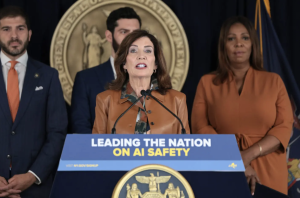
Governor Hochul Signed the Bill on October 28
According to a report from AFP carried by The Express Tribune, Hochul signed the legislation on Wednesday, 28 October 2026. In plain terms, the law tells companies that run AI chatbots to find out how old their users are and to treat anyone under 18 differently. For those users, the chatbot may not play the part of a companion, may not pose as a friend or a boyfriend or girlfriend, and may not claim to be a person. The report names OpenAI’s ChatGPT as an example of a product whose operator falls under the rule, which suggests the target is wider than small apps built around virtual partners.
Hochul put the purpose bluntly. In the words the report attributes to her: “No longer will minors have access to chatbots that pretend to be their friends, boyfriends and girlfriends.” The sentence is useful because it shows what the law is aimed at. The concern is less that a young person might ask a chatbot a factual question and more that a product designed to feel like a relationship can pull a teenager into one.
Who is affected? Three groups, mainly. Families in New York with children or teenagers who use chatbots are the obvious one. Companies that operate chatbots reachable from New York are the second, and they carry the compliance burden. The third is everyone who builds a product on top of a chatbot, such as a homework tool or a coding helper, who now has to ask whether the law reaches them. Because online services rarely stop at a state line, some companies may choose to apply new safeguards to all of their young users rather than build a separate version for one state, though nothing in the reporting says that any company has decided to do so.
A caution about sourcing belongs here. Everything this article says about the content of the law comes from that single news report, not from the bill text, so treat the descriptions as a summary and not as a legal reading. Where the report is silent, this article says so rather than guessing.
The report also places New York in a wider pattern. California and other states have passed similar measures, it says, and New York’s law uses some of the broadest language yet. In the United States, rules about children and online services have tended to arrive state by state while national legislation stalls, so a patchwork is a realistic expectation. Readers in other countries will find that approaches differ, since some governments regulate online services for children through national codes and regulators and not through state statutes.
It is also worth saying what kind of law this is. It is a product-design rule. It does not tell a teenager to stay off the internet, and it does not punish a child for using a chatbot. It places obligations on the companies that build and run the software, which is the same approach lawmakers have long taken with toys, car seats and food labels: the burden sits with the maker, since a ten-year-old cannot be expected to audit a product. Whether that approach works for software that changes every few weeks is the open question, and it is one reason the details of enforcement, discussed below, carry so much weight.
Requirements Placed on Chatbot Operators
The law is easiest to follow when broken into its parts. The report lists several duties, and they fall into a few families: finding out who is a minor, changing what a chatbot may do for that person, being honest about what the chatbot is, and limiting what the operator may keep. The table below condenses them, and the subsections that follow explain what each is likely to mean in practice.
| Provision as reported | What it means in plain language | Main audience |
| Verify users’ ages | Operators must find out whether a user is under 18 | Operators |
| Strip back features for under-18 users | The minor’s version of the product must offer less | Operators |
| No companion roleplay for minors | No pretending to be a friend, boyfriend or girlfriend | Operators, parents |
| No claims of being human, alive or able to feel | The bot must not present itself as a person or as emotional | Operators |
| No suggested personal or professional relationship, no authority role | The bot cannot imply it is a therapist, doctor or mentor-like figure | Operators |
| No responses framed as personal opinions with minors | Answers should not read as the bot’s own views | Operators |
| No keeping sensitive emotional or physical health information about a minor | Data retention is restricted | Operators, privacy staff |
Finding Out Who Is a Minor
The first duty is age verification. A rule that treats under-18 users differently cannot function unless the operator has some way of telling who they are. The report does not say what methods are acceptable, so it is not clear whether a self-declared birth date would count or whether stronger checks would be expected. That detail matters a great deal, and readers should watch for guidance once it appears.
Stripping Back the Product for Younger Users
The report says that when a user is under 18, operators must strip back features. It does not list which ones. The more specific prohibitions give the best hint: anything that makes the chatbot behave like a companion, a friend or a partner is out. A reasonable reading is that the version of a chatbot a teenager sees becomes more like a tool and less like a character, but the exact line will depend on the full text and on how it is applied.
Honesty About Being a Machine
The law bars chatbots from claiming to be human, alive or capable of feeling emotions. That is easy to picture. A companion app that tells a lonely user “I missed you today” or “I feel sad when you leave” is doing exactly what this provision describes. Under the law, a chatbot talking with a minor cannot say such things as though they were true. The related ban on suggesting a personal or professional relationship, or presenting itself as an authority figure, addresses a quieter problem: a confident, friendly voice can seem like a trusted adult even when it is a text generator.
No Personal Opinions and No Sensitive Records
Two further limits are narrower. With minors, chatbots cannot frame responses as personal opinions, which seems aimed at the habit of speaking as though the bot has views, tastes and loyalties of its own. And operators cannot keep sensitive information about a minor’s emotional and physical health. This is a privacy rule as much as a safety rule. A child who confides in a chatbot about anxiety, an eating problem or a physical condition is creating a record, and the law says that record should not be kept.
How “keep” is defined, and whether it covers temporary storage inside a single conversation, is not addressed in the reporting. For companies, the practical task is probably to decide what a chatbot needs to remember in order to be useful, and to delete or never collect the rest. For parents, the provision is a small comfort, since it means a difficult late-night conversation is less likely to sit in a database for years, though without the effective date and enforcement details nobody can say how well it will work.
Details the Reporting Leaves Out
Anyone planning around this law needs to know what has not been published, at least in the report available. It does not state when the law takes effect. It does not state what penalties apply to a company that breaks it. It does not describe who enforces it or how. Those three gaps are not trivial, because a rule with no start date and no clear consequence cannot be planned around, and families should not assume that every provision is already in force.
For that reason, this article makes no claim about how the law will be enforced. State laws of this kind sometimes give enforcement to an attorney general, sometimes allow private lawsuits, and sometimes do both, but which model New York chose is a question for the statute itself. Readers who want certainty should look at the text on the state legislature’s website or ask a lawyer who handles technology regulation, and companies should not treat a news summary as compliance advice.
Another open point concerns specific products. The report ran a photo caption showing Grok, but it does not say whether the law applies to it. Captions are not analysis, and nothing should be inferred from a picture. The same uncertainty probably applies to many products that sit in gray areas: a chatbot inside a game, a character feature in a social app, a voice assistant, or a customer service bot that happens to be friendly. Whether each counts as a covered chatbot, or as an AI companion, depends on definitions that the report does not quote.
A further gap is the lack of any published list of covered features. The report says operators must strip back features for minors but names none, so product teams, parents and schools are left to infer what a minor’s version looks like. Memory of past conversations, voice, a named persona, an avatar, and notifications that nudge a user to return are all features that can make a chatbot feel like a relationship, yet the report does not say that any of these is restricted. They are examples of what a reader might look for in the final text, not statements about what the law says.
A final gap is the phrase “vague language,” which industry critics used. If definitions are loose, the first months after the law takes effect could bring a lot of caution from companies, and perhaps a lot of disagreement about what is allowed. Courts, regulators and updated guidance usually settle such questions over time, which is another reason to avoid treating early summaries as the last word.
Reactions From Advocates and Industry
The responses in the report split along familiar lines. Children’s advocates called the law a milestone, an industry group warned about collateral damage, and the largest AI companies stayed quiet.
Supporters
Common Sense Media, a nonprofit that rates media for families, called the measure “the strongest kids’ AI safety bill in the country,” according to the report. Its chief executive, Jim Steyer, said: “Now, those harmful features will be outlawed in New York.” Note the phrase “harmful features.” Supporters frame the problem as a set of product design choices, not as AI in general, and they argue that law is the right tool because commercial incentives reward engagement. A companion that remembers a user, flatters them and is always available is, from a business standpoint, a product that keeps people coming back.
Industry Criticism
Tech:NYC, an industry group, criticized what it called “vague language” in the law, as the report tells it, and warned that the rule could restrict tutoring, homework help, coding assistants and career platforms. The worry is practical. If a rule is written to stop chatbots from acting like friends but the definition is wide, a homework helper that uses a warm tone, remembers a student’s earlier questions and encourages them might be swept in. Industry groups have an interest in lighter regulation, so their warnings deserve scrutiny, but vagueness is a fair criticism of any law until courts or regulators have applied it.
The Companies Themselves
According to the report, OpenAI and Anthropic declined to comment. Both companies are among the best-known makers of general-purpose chatbots, and the report uses ChatGPT as its example of a covered product. Silence is not a position, and it would be a mistake to read agreement or opposition into it. Companies often hold back until they have reviewed the final text and consulted lawyers. If they publish policy updates for teen users in the coming months, those statements will say more than a refusal to comment does today.
Age Checks, Privacy and the Tutoring Question
Two practical debates sit underneath the law. One is how a company can tell whether a user is a minor without collecting more personal data than it should. The other is whether a ban on companionship can leave room for the educational uses that many families value.
Age Verification in Practice
Age assurance can take several forms. The simplest is asking for a birth date, which is cheap and easy to bypass. More demanding options include checking a government identification document, using a facial estimate from a camera image, relying on a payment card, or drawing on signals from an app store or a device account that already holds a verified age. Each method has costs. Identification checks create a sensitive record that can be breached. Facial estimation avoids documents but raises worries about biometric data and error rates. Device-level signals shift the work to the phone maker, which then holds more information about children.
The law’s own data limit points to a tension. If operators must verify ages but cannot keep sensitive health information about minors, they will have to design systems carefully to separate the two. The report does not say which verification methods New York will accept, so these are general observations about the technology and not descriptions of the law.
Why Tutoring and Companionship Are Different
A homework helper and a virtual friend can run on the same underlying model, so the line has to be drawn by behavior. A tutor explains a concept, checks an answer, and offers a hint. A companion says it cares, remembers private details, and tries to keep the conversation going. The benefits of the first are plain for students who cannot afford private help or who are too embarrassed to ask a teacher the same question twice. The risks of the second are also plain: a young person may start to prefer a bot that never disagrees to the awkward work of real friendships, and may disclose private things to something that cannot truly care about them.
Neither benefit nor risk has been measured in this article, since no study figures are among the facts available here, and it would be wrong to invent any. What can be said is that the debate is real and that thoughtful people disagree about where the boundary lies. Teachers and librarians who have watched students use these tools often say that the best educational chatbots behave like patient reference desks: they answer, they explain, and they send the student back to the work. A bot that tries to become the center of a child’s emotional life is doing something else entirely. A sensible family reading of the law is that it targets pretending, not teaching. A chatbot that helps with fractions and says plainly that it is an AI model is the kind of tool most parents would accept. One that tells a young teenager that it is their best friend and loves them is the kind the law is meant to remove.
A Practical Plan for Families
Laws take time to arrive and to be enforced. Children are using these products now. The most reliable protection, in New York or elsewhere, is still an ongoing conversation at home, backed by settings that are within a parent’s control. This article offers general information; it is not legal advice, and no setting or statute can promise that a child is protected.
Starting the Conversation
Ask before you restrict. Children are more likely to talk if the first question is curious, not accusing: which chatbots do you use, what do you like about them, what do you ask them? Many teenagers use chatbots mainly for schoolwork, and hearing that is a relief. Some will describe a chatbot as a friend. If that happens, resist the urge to mock it. Explain that the bot is software producing sentences that sound caring, that it cannot feel anything, and that the warmth is a product feature. The point of the New York law, after all, is that companies should not blur that line for minors, and parents can reinforce the same message at home.
Signs of Emotional Reliance
Some patterns deserve attention. A child who hides their use, becomes upset when they cannot get online, withdraws from friends and family, or says the chatbot is the only one who gets them may be relying on it too heavily. None of these signs proves anything by itself, because teenagers are private and moody at the best of times. If several appear together, or if a child seems low, anxious or distressed, talk to them calmly and consider involving a trusted adult such as a school counselor, a pediatrician or another health professional. A chatbot is not a substitute for any of them, and a child in crisis needs a person.
Controls Families Can Use Anywhere
Families outside New York cannot count on this law. Practical options are available regardless of where you live. Phones and tablets have built-in family settings that can limit which apps are installed, set time limits and require approval for downloads. App stores publish age ratings, and checking the rating and the app’s own description before a child installs something is a good habit.
Many chatbot services have account settings, including options for teen accounts or content filters, though what they offer changes often, so check the current settings in each app. It also helps to set the same ground rules for every device in the house, including shared tablets, school-issued laptops and game consoles, since a chatbot can appear inside any of them. Children sometimes meet chatbot characters inside games and social apps without ever installing a dedicated chatbot, so ask about those as well. No control is perfect, and a determined teenager can work around many of them, which is why talking matters more than blocking.
A Short Sequence to Follow
If you want a short sequence of things to do, start with a conversation this week about which chatbots your child uses and why. Then look at the devices and accounts involved. Check the age ratings on each app, review the family settings on the phone or tablet, and look inside each chatbot app for teen or parental options. If a service lets you see or delete conversation history, find out how.
Next, agree on a few simple rules that fit your family. Examples include no sharing of full names, addresses, school details or private health information with any chatbot, and a standing promise that your child can tell you about anything unsettling that a bot says without being punished. Make clear that a chatbot is allowed as a study aid but is not a place to take serious personal troubles.
Then keep an eye on the law. Because the reporting does not give an effective date or penalties, check the New York legislature’s website or credible news coverage in the months ahead for updates. If you are a New Yorker and a chatbot appears to ignore the rules once they take effect, find out whether the state has set up a way to report concerns. Educators and schools may also issue their own guidance on AI tools, and it is worth reading.
Finally, keep perspective. The law addresses one slice of a large subject. Tutoring tools, creative writing helpers and coding assistants can be valuable for young people when used with judgment. The target here is a specific type of product design, the chatbot that pretends to be a friend or lover. Helping a child recognize that design, and name it, may be the most durable protection of all.
Frequently Asked Questions
When Does the New York Chatbot Law Take Effect?
The report from AFP, carried by The Express Tribune, does not give an effective date. Check the text of the law or recent news coverage for the date before assuming any rule is already in force.
Does the Law Ban All AI Chatbots for People Under 18?
No. According to the report, it bars companion-style behavior, such as posing as a friend or romantic partner, and requires operators to strip back features for minors. Tutoring, homework help and similar uses are not described as banned, though industry critics fear they could be caught by vague wording.
Who Enforces the Law and What Are the Penalties?
The report does not say. It gives no details about penalties or enforcement, so any claim about fines or lawsuits would be speculation. The statute itself is the place to look.
Can a Chatbot Still Tell a Child It Cares About Them?
Under the law as reported, chatbots cannot claim to be human, alive or capable of feeling emotions, and they cannot suggest a personal relationship with a minor. A statement that the bot cares for the child would run against those limits. A plain, polite tone is different from claiming feelings.
Should Parents Outside New York Do Anything Differently?
Yes, because families elsewhere cannot rely on this law. Use device-level family controls, check app age ratings, and talk with your children about which chatbots they use. The report notes that California and other states have passed similar measures, so rules in your own state may be worth checking.
Does the Law Apply to Grok or Other Specific Chatbots?
The report does not say. A photo caption showed Grok, but no statement in the article indicates whether the law covers it. The report names ChatGPT only as an example of a chatbot operator, and it does not rule on any product.