
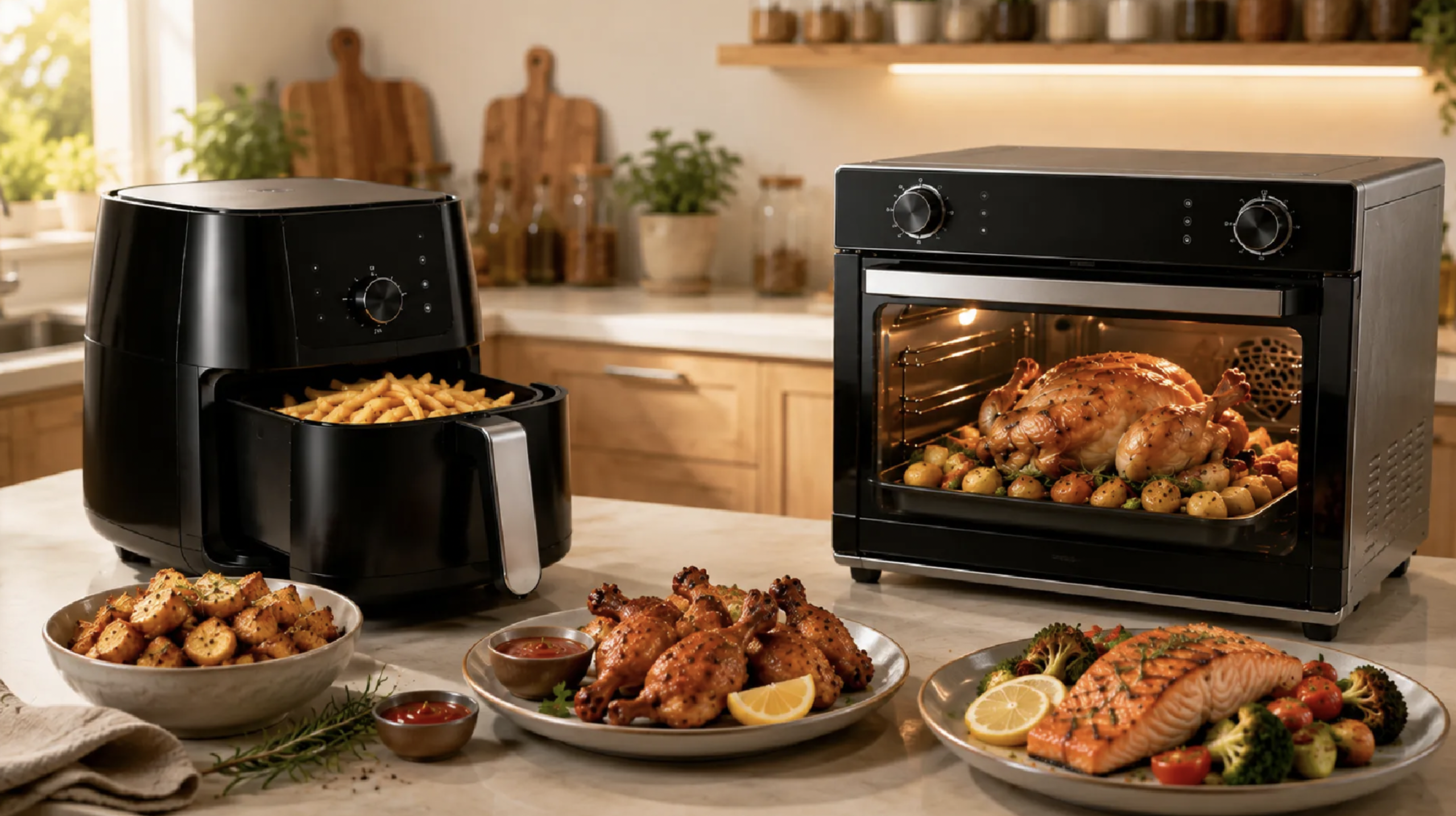
Kitchen counters across the country have filled up with air fryers over the past several years, often sitting right next to an oven that already has a convection setting capable of similar results. Both appliances rely on the same core shared principle, circulating hot air rapidly around food to produce a crisp exterior without deep frying, which raises a fair question about whether a dedicated air fryer offers anything beyond what an existing oven already provides.
This article compares the two options directly on cooking time, energy use, capacity, and everyday convenience to help households decide whether buying a separate appliance makes practical sense.
Evaluating How Each Appliance Really Cooks Food
An air fryer is, at its core, a compact convection oven built into a smaller chamber with a fan positioned closer to the food than a standard oven allows. This tighter chamber size means hot air reaches food faster and more directly, which is the main reason air fryers tend to produce slightly crispier results in less time compared with a full-sized convection oven running the same temperature setting.
A convection oven, whether a standalone appliance or a convection setting built into a standard oven, uses a similar fan-driven air circulation system but within a much larger cooking cavity. This larger volume means the hot air has further to travel before reaching the food, which generally translates into a somewhat longer cooking time and a slightly less intense crisping effect compared with an air fryer at the same temperature.
- Chamber size: Air fryers use a compact chamber while convection ovens offer a much larger cooking cavity.
- Air circulation distance: Shorter distance in an air fryer speeds up heat transfer to the food’s surface.
- Crisping intensity: Tighter air circulation in an air fryer typically produces a slightly crisper exterior.
- Capacity tradeoff: The same compact design limiting air fryer capacity also speeds up its cooking process.
In practice, this means an air fryer’s main functional advantage over a convection oven comes down to speed and crisping intensity for smaller batches, rather than any fundamentally different cooking method between the two appliances.
Heating element placement adds a further technical distinction worth noting between the two appliance types. Most air fryers position the heating element directly above the food, close enough that radiant heat adds noticeably to the browning effect alongside the circulating air itself.
A convection oven’s heating element sits further from the food, relying more heavily on the circulating fan to distribute heat evenly throughout the larger cavity rather than depending on close-range radiant heat from above. This difference in heat source proximity explains why air fryers sometimes produce a more pronounced browning pattern on the top surface of food compared with a convection oven cooking the same item at an identical temperature setting.
Preheating behavior also differs in ways that affect practical cooking time beyond the core cooking duration itself. An air fryer’s small chamber reaches target temperature within a minute or two in most cases, while a full-sized oven, even with convection engaged, typically takes several minutes longer to preheat fully due to the larger volume of air and the oven walls themselves needing to reach a stable temperature before cooking begins in earnest.
Exploring Cooking Time Differences Across Common Foods

Cooking time comparisons vary by food type, and testing across common items reveals a consistent pattern: air fryers generally cook faster for smaller portions, while the time advantage narrows or disappears entirely once a convection oven is loaded to a similar density per square inch of cooking surface.
Frozen foods like French fries or chicken nuggets show some of the biggest time differences, often finishing in an air fryer in roughly half the time a standard oven setting would require, with a convection oven setting typically falling somewhere in between.
Larger items, such as a whole chicken or a tray of roasted vegetables, tend to show a smaller time advantage for air fryers, partly because these larger or bulkier items often cannot fit into a standard air fryer basket at all without being cut into smaller pieces first. This capacity limitation effectively caps the practical time savings an air fryer can offer for larger meals, since multiple batches may be needed where a convection oven can handle the same food in one load.
- Frozen snack foods: Air fryers often finish in roughly half the time of a standard oven setting.
- Small protein portions: Chicken breasts or fish fillets cook notably faster in an air fryer’s tighter chamber.
- Whole or large items: Air fryer capacity limits often require multiple batches, narrowing the time advantage.
- Vegetable roasting: Both appliances perform similarly well, with air fryers offering a modest speed edge.
Batch size matters enormously in this comparison, since a convection oven’s larger capacity can sometimes offset its slightly longer per-batch cooking time by handling an entire meal in a single load rather than requiring sequential batches.
Texture results also vary by food category in ways that pure cooking time comparisons do not fully capture. Breaded foods, such as chicken tenders or mozzarella sticks, tend to achieve a more uniformly crisp coating in an air fryer because the shorter cooking distance and tighter airflow dry out the breading’s surface moisture faster than a convection oven managing the same item.
Baked goods, on the other hand, often perform better in a convection oven, since the larger, more stable cavity provides more even heat distribution across a full tray of cookies or a cake pan than a compact air fryer basket typically allows, where uneven air circulation around a dense batter can produce inconsistent results from one side of the basket to the other.
Assessing Energy Use Between the Two Appliances
Energy consumption comparisons depend heavily on cooking duration and appliance wattage, both of which favor the air fryer for smaller portions but shift in favor of the convection oven once batch sizes grow. A typical air fryer draws between 1,200 and 1,800 watts, while a full-sized oven, even on a convection setting, typically draws more power overall due to the larger heating element required to warm a bigger cavity.
Because air fryers finish cooking faster for small portions, the lower per-minute energy draw combined with shorter cooking time usually results in noticeably lower total energy use for single servings or small batches. Once a meal requires multiple air fryer batches to replicate what a convection oven can cook in a single load, the energy comparison shifts, since running an air fryer two or three times in sequence can use more total energy than one longer convection oven cycle handling the same total food volume.
- Air fryer wattage: Typically 1,200 to 1,800 watts, drawing less power per minute than a full oven.
- Oven wattage: Larger heating elements drawing more power to warm a bigger cooking cavity.
- Single-batch efficiency: Air fryers generally use less total energy for small, single-batch meals.
- Multi-batch crossover point: Convection ovens can become more efficient once multiple air fryer batches are required.
Households cooking primarily small portions, such as single servings or meals for one or two people, tend to see the clearest energy savings from an air fryer, while larger households regularly cooking for several people may find the energy advantage shrinks or reverses depending on typical batch sizes.
Standby power draw, while small compared with active cooking wattage, is worth a brief mention for households that keep either appliance plugged in continuously rather than unplugging between uses. Most modern air fryers and ovens with digital displays draw a small trickle of power even while idle, powering clocks, displays, and standby circuitry.
This standby draw is roughly similar between the two appliance types and rarely factors much into an overall energy comparison, though unplugging either appliance when not in regular use eliminates this minor, ongoing draw entirely for anyone focused closely on minimizing household electricity use.
Climate and season can shift the practical energy calculation in a less obvious way. In warmer months, a full-sized oven’s larger heat output can noticeably raise a kitchen’s ambient temperature, indirectly increasing air conditioning costs in homes that cool actively during summer. An air fryer’s smaller, more contained heat output produces far less of this secondary heating effect, which means the total household energy picture during hot weather can favor an air fryer by a wider margin than the appliance’s direct electricity use alone would suggest.
Balancing Counter Space Against Everyday Convenience

Beyond cooking time and energy use, the practical daily experience of using each appliance shapes satisfaction just as much as the technical performance differences. An air fryer demands dedicated counter space, which can become a real constraint in smaller kitchens already crowded with other small appliances like a coffee maker, blender, or toaster.
A convection oven setting, built into an appliance already present in nearly every kitchen, requires no additional counter space and no separate appliance to store, clean, or maintain. This convenience factor matters more for some households than the modest time and energy differences, especially for anyone with limited kitchen storage or counter space who would need to find a home for an additional appliance used only occasionally.
- Counter space requirements: Air fryers need dedicated space, while a convection oven setting uses existing equipment.
- Storage needs: Appliances used only occasionally still require a storage spot between uses.
- Preheat convenience: Air fryers often preheat faster due to their smaller chamber size, saving a few minutes per use.
- Cleanup differences: Air fryer baskets are generally easier to clean than a full oven’s larger interior surfaces.
Cleanup convenience often tips the balance for households that cook smaller items frequently, since wiping down or washing a compact air fryer basket takes noticeably less effort than cleaning a full oven interior after a single small meal.
Installing and Setting Up Either Option in a Kitchen
Setting up an air fryer requires nothing beyond finding counter space near an outlet, making it an accessible option even for renters or anyone unable to modify existing kitchen appliances. Most models plug into a standard outlet without needing a dedicated circuit, unlike some larger kitchen appliances that require specific electrical considerations.
Using a convection setting on an existing oven requires no setup at all beyond learning the specific temperature and time adjustments most manufacturers recommend when switching from a standard bake setting to convection, since convection cooking typically requires a lower temperature or shorter time than a standard setting to avoid overcooking food that circulates hot air more efficiently around it.
- Air fryer setup: Simple plug-in setup requiring only counter space and a nearby standard outlet.
- Convection learning curve: Adjusting temperature and timing from standard bake settings when using convection mode.
- Ventilation needs: Some air fryer models benefit from a few inches of clearance around vents for proper airflow.
- Recipe conversion: Existing recipes often need temperature adjustments of twenty to twenty-five degrees when switching to convection.
Many standard recipes, written for conventional oven settings, benefit from a temperature reduction of roughly twenty to twenty-five degrees when adapted for either an air fryer or a convection oven setting, since both rely on the same faster heat transfer that a standard oven lacks.
Maintaining Each Appliance for Long-Term Performance
Air fryers require regular cleaning of the basket and the heating element area to prevent grease buildup, which can affect performance and create smoke if left unaddressed over multiple uses. Most manufacturers recommend cleaning the basket after every use and performing a deeper clean of the heating element area every few weeks depending on cooking frequency and the types of food prepared.
A convection oven, being a larger and typically more durable appliance built for daily use across many years, generally requires less frequent dedicated maintenance beyond the periodic deep cleaning most ovens need regardless of whether convection settings are used. The fan mechanism in a convection oven is usually built to a more robust standard than a compact air fryer’s fan, given the oven’s role as a primary kitchen appliance expected to last far longer than a smaller, more specialized gadget.
- Basket cleaning frequency: Regular cleaning after each use to prevent grease buildup affecting performance.
- Heating element maintenance: Periodic deeper cleaning to remove residue that accumulates over repeated use.
- Oven fan durability: Convection oven fans are typically built to a sturdier standard for long-term daily use.
- Expected lifespan: Ovens generally outlast air fryers, which see heavier use relative to their smaller, less robust components.
Replacing an air fryer every few years is common even with careful maintenance, since the compact design and lower-cost components used in most models do not match the durability expected from a full-sized kitchen oven built for years of daily service.
Odor transfer is a smaller maintenance consideration worth noting for households that cook a wide variety of foods in the same air fryer basket. Strong-smelling foods, such as fish or heavily spiced dishes, can leave residual odors in the basket’s nonstick coating that linger into subsequent uses unless the basket is cleaned thoroughly with a degreasing dish soap after each strongly flavored meal.
Convection ovens experience a similar effect to a lesser degree, since their larger interior volume and typically more durable surfaces tend to disperse and release lingering odors more readily than a compact air fryer basket’s tighter, more enclosed space.
Final Thoughts
Air fryers and convection ovens rely on the same underlying principle, and the choice between them comes down to household cooking patterns rather than one option being fundamentally better than the other. Air fryers win on speed, energy use for small portions, and cleanup convenience, while convection ovens win on capacity, no added counter space, and long-term durability for larger or more frequent cooking needs.
Households preparing small portions regularly, especially for just one or two people, tend to get the most practical value from a dedicated air fryer, while those cooking larger family meals or already comfortable using a convection setting may find a separate appliance adds limited benefit beyond what their existing oven already provides.
Frequently Asked Questions
Does an air fryer produce noticeably crispier food than a convection oven?
Generally yes, due to the tighter air circulation in a smaller chamber. The difference is often modest, however, and a convection oven running slightly longer can produce comparable crispness for most common foods.
Is it worth buying an air fryer if an oven already has a convection setting?
It depends on cooking habits. Households regularly preparing small portions may appreciate the speed and lower energy use, while those cooking larger meals or family-sized portions may find the convection oven setting sufficient.
Which option uses less electricity overall?
For small single-serving meals, air fryers generally use less total energy. For larger meals requiring multiple air fryer batches, a convection oven handling the same food in one load can end up using comparable or less energy.
Can every recipe be adapted for an air fryer?
Most recipes can be adapted with temperature and time adjustments, though very large or liquid-heavy dishes do not translate well to an air fryer’s compact basket and are better suited to a conventional or convection oven.
How long does a typical air fryer last before needing replacement?
Most air fryers last a few years with regular use before components like the heating element or fan motor begin to wear down, a shorter lifespan compared with a full-sized oven built for many years of daily service.
Do air fryers require special cookware or accessories?
Most air fryers come with a basic basket sufficient for everyday use, though accessories like parchment liners, racks, or skewers can expand versatility for baking, roasting, or cooking multiple food types at once.