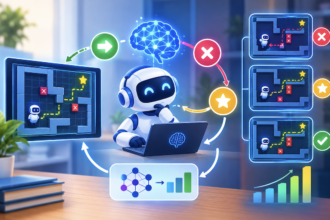

In today’s highly digital and data driven world, businesses of all sizes are turning to cloud computing to innovate faster, scale efficiently, and gain actionable insights. Among the leading cloud providers, Google Cloud Platform (GCP) has become a popular choice because of its strong infrastructure, artificial intelligence (AI) leadership, and advanced data analytics capabilities. Whether you are a small startup or a global enterprise, Google Cloud offers a wide array of tools that help transform ideas into powerful, real world solutions.
Below, we’ll explore the top use cases of Google Cloud Platform, spanning artificial intelligence, data analytics, application development, and beyond.
1. Artificial Intelligence and Machine Learning at Scale
Google Cloud’s AI and ML services are among the most sophisticated in the industry, thanks to Google’s decades of experience with search, image recognition, and language understanding. With Vertex AI, AutoML, and pre trained APIs for vision, speech, and translation, companies can deploy intelligent systems without requiring deep data science expertise.
For example, retail businesses use GCP’s machine learning models to forecast demand and optimize inventory. Healthcare organizations use AI powered tools to analyze medical imaging data, detect anomalies, and assist doctors with faster diagnostics. Meanwhile, financial institutions rely on ML algorithms to detect fraudulent transactions and manage real time risk.
The result is a smarter, data-aware environment where decision making is faster, more accurate, and constantly improving as data grows.
2. Data Storage, Processing, and Analytics
Handling massive amounts of data efficiently is one of the biggest challenges for modern organizations. GCP addresses this with services such as BigQuery, Cloud Storage, Dataflow, and Dataproc, which together create a powerful, scalable data ecosystem.
BigQuery stands out as a fully managed, serverless data warehouse that allows users to analyze terabytes or even petabytes of data in seconds using standard SQL queries. Combined with Looker and Data Studio, teams can turn raw data into interactive dashboards and visual insights.
From marketing analytics and customer segmentation to real time IoT data monitoring, GCP’s analytics stack helps organizations transform information into intelligence, empowering leaders to act with confidence.
3. Application Development and Modernization
Developers love Google Cloud because of its open, flexible environment that supports multiple programming languages, frameworks, and platforms. The Google Kubernetes Engine (GKE) has set the benchmark for container orchestration, enabling teams to deploy and manage containerized applications efficiently.
For companies aiming to modernize legacy systems, GCP offers Cloud Run and App Engine for serverless execution, where infrastructure automatically scales based on demand. This means less time spent on servers and more focus on building robust, innovative applications.
Organizations leveraging GCP’s development tools gain agility, faster product cycles, and cost efficiency while maintaining reliability through Google’s global network.
4. Hybrid and Multi Cloud Flexibility

In reality, not every workload belongs entirely in one cloud. GCP’s Anthos enables hybrid and multi cloud environments, giving enterprises the ability to manage workloads across on premises systems, Google Cloud, and even other cloud providers.
Anthos ensures consistent operations, unified security policies, and simplified application management. This approach offers choice and freedom; businesses can run applications where they perform best, all while maintaining centralized visibility and compliance.
5. Big Data Integration for Innovation
As the volume of global data explodes, organizations must unify structured, unstructured, and streaming data sources. GCP’s tools make this seamless. For instance, Pub/Sub and Dataflow enable real time data ingestion and pipeline creation, while Dataprep helps cleanse and prepare data for analysis.
Enterprises use these tools to build innovative solutions from predictive supply chain systems to personalized customer experience models bridging the gap between raw data and business intelligence.
6. Security, Compliance, and Privacy
Trust is fundamental in cloud computing. Google Cloud builds security into every layer, with default encryption, advanced threat detection, and compliance certifications across industries. Identity and Access Management (IAM), Cloud Security Command Center, and Chronicle ensure users know exactly who can access what, and when.
Because security is handled as a shared responsibility, organizations benefit from Google’s expertise while maintaining control over their data governance policies.
7. Collaboration and Productivity Boost
Through Google Workspace, many teams already integrate communication, file sharing, and real time collaboration. When combined with broader GCP services, organizations unify their workflows, linking business intelligence dashboards with documents or integrating Apps Script automations with cloud hosted data sets. This synergy enhances productivity and fosters a truly connected enterprise culture.
Conclusion
Google Cloud Platform continues to redefine what’s possible in the digital era. From AI and data analytics to modern application development and multi cloud management, GCP’s ecosystem empowers innovation at every level. Its combination of scalability, intelligence, and security not only accelerates business transformation but also inspires organizations to explore new frontiers of data driven decision making.
In short, Google Cloud isn’t just infrastructure, it’s a foundation for progress, helping businesses of every size harness the full power of technology to create smarter, faster, and more resilient futures.