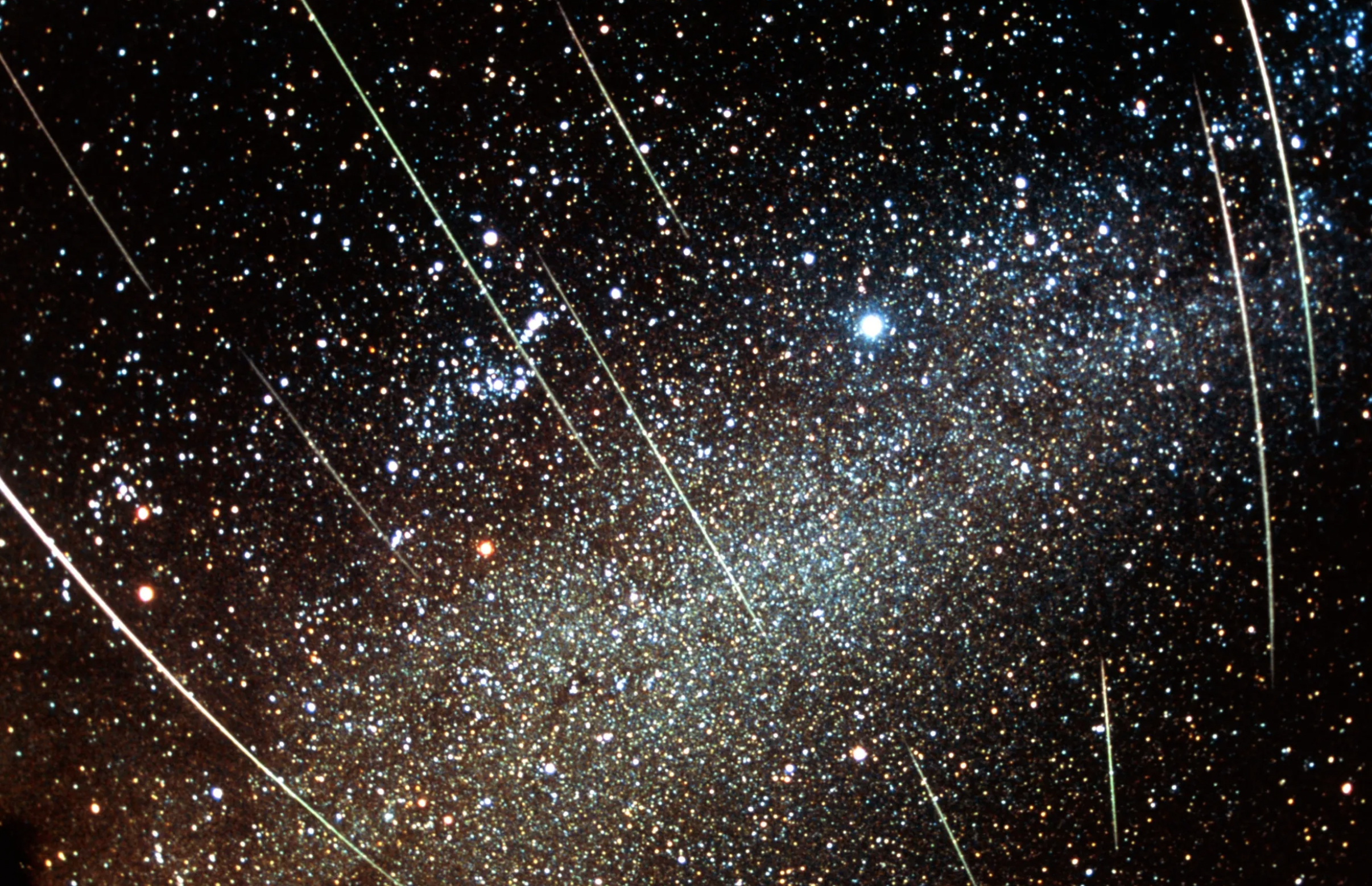
If you have a clear night, a warm coat and a bit of patience, the Leonid meteor shower is one of the easiest celestial events to enjoy this autumn. It needs no telescope, no ticket and no expertise, only a dark sky and time for your eyes to adjust. This year the Moon is a half disk that sets early, which changes the plan slightly.
In this article we will discuss when the Leonids peak, what causes them, how the Moon affects what you see, and how to prepare.
Peak Timing for the 2026 Leonids
The peak night is 17 to 18 November 2026. According to the Star Walk guide, the predicted maximum falls around 23:45 GMT on 17 November. The Farmers’ Almanac says the shower is active for a much longer stretch, from about 6 November to 30 November, so a few meteors can show up on many nights before and after the main event. Think of the peak as the top of a gentle hill rather than a single moment. The nights on either side are still worth a look if the weather on the peak night turns bad.
Turning the Peak Time Into Your Local Clock
The predicted maximum is given in GMT, which is the time standard used by astronomers and by the UK in winter. For readers in Britain and much of Europe, that moment falls late in the evening. For readers in North America, it lands in the early evening, before most people have even thought about stargazing. That sounds like bad luck, but it matters less than you might expect. Meteor shower predictions come with a margin of uncertainty, and the stretch of hours around the maximum is nearly as good as the maximum itself.
There is also a geometric reason to wait. The Leonids appear to spread out from a point in the constellation Leo, and Leo climbs higher in the sky as the night goes on. When the point of origin is low, fewer meteors are visible because part of the sky is hidden by the Earth. Once Leo is well up, you see more. For that reason the Farmers’ Almanac recommends roughly midnight to 5:30 a.m. local time as the best window, and that advice applies in every time zone.
Choosing Which Night to Go Out
If skies are clear on the night of 17 November and into the early hours of 18 November, that is the obvious choice. If the forecast looks cloudy, check the night before and the night after. A shower with a long activity window rewards flexibility. In the weeks before the peak the rates are lower, but dark skies and a calm evening can still produce a pleasant half hour of watching.
What Peak Means for a Meteor Shower
A peak is the time when the Earth passes through the densest part of the debris stream, and so when the most meteors are expected. It is a statistical idea, not a switch. Rates climb slowly toward the maximum, hover near it for a while and then fade. Because the stream is not perfectly smooth, the actual best hour can differ from the forecast, and different guides sometimes give slightly different times. That is a good reason to treat any single time as a rough guide and to watch over several hours instead of arriving for one minute and leaving.
Comet Dust Behind the Shooting Stars
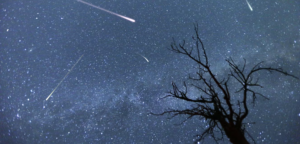
The Leonids are not stars, and they are not coming from Leo. They are dust. The shower is produced by debris left behind by Comet 55P/Tempel-Tuttle, which sheds a trail of tiny particles each time it passes close to the Sun. Every November, the Earth crosses the stream of that old debris, and the particles slam into the upper atmosphere.
The shower returns every year at about the same time for a simple reason: the Earth follows the same orbit around the Sun each year, so it meets the same band of comet dust on roughly the same dates. The comet itself is far away for most of that time. Its legacy, a thin river of grains spread along its path, is what we run into each November.
How Small the Grains Are
According to the guides, the particles are typically under 1 millimeter across, which makes them smaller than a grain of rice and often closer to a speck of sand. They are traveling at tremendous speed relative to the Earth, and that speed is what makes them glow. The air in front of a grain is compressed and heated so quickly that the grain vaporizes. What you see is a streak of glowing gas and vaporized material rather than a rock burning like a lump of coal.
Why Nothing Reaches the Ground
The same guides say these grains burn up roughly 60 miles above the surface. That is far higher than airplanes fly and well above the weather. In practical terms, a meteor of this kind is not dangerous. There is nothing to dodge and nothing to fear, and a Leonid will not hit you, your car or your house. The sight is harmless even though it can look dramatic.
Why the Radiant Matters
The word radiant refers to the point in the sky from which the meteors seem to spread. For the Leonids it is in the constellation Leo, near the star Regulus. This is an effect of perspective, much like the way parallel railroad tracks appear to meet in the distance. The meteors are traveling in parallel paths, but you see them fanning out from one spot. Knowing the radiant is helpful because it gives the shower its name, but it is not a target. You do not need to stare at Leo to see Leonids.
Moon, Rates and Clouds
Three factors decide how good the night will be: how many meteors there are, how bright the sky is and whether you can see the sky at all. The figures below combine what the guides report.
| Detail |
Reported value |
Source |
| Peak night | 17 to 18 November 2026 | Star Walk |
| Predicted maximum | Around 23:45 GMT on 17 November | Star Walk |
| Activity period | About 6 to 30 November | Farmers’ Almanac |
| Rate under dark skies | Up to about 15 meteors an hour | Star Walk |
| Normal non-storm year | 10 to 15 meteors an hour | Farmers’ Almanac |
| Moon | First quarter, about 53 percent lit, sets around 11 p.m. local time | Star Walk |
| Best viewing window | Roughly midnight to 5:30 a.m. local time | Farmers’ Almanac |
| Radiant | Constellation Leo, near Regulus | Both guides |
The Half Moon and When It Leaves
Moonlight is the main enemy of faint meteors, because a bright sky washes out the dimmer streaks. The Star Walk guide describes a first-quarter Moon, about 53 percent lit, that sets around 11 p.m. local time. That leaves the later part of the night dark, and it happens to line up with the hours when Leo is climbing. The new Moon falls on 9 November, so the Moon is waxing through the days that lead up to the peak, and it is a half disk on the peak night itself.
The practical advice is to plan your session to start after the Moon goes down. If you go out in the early evening, the half Moon will still be shining and you will see fewer meteors than a dark sky would offer. If you go out after midnight, you get the darker sky. The Farmers’ Almanac describes the Moon differently, in a way that does not match the lunar calendar, so this article follows the Star Walk description, which is consistent with the new Moon on 9 November.
Why the Rate Says up To
Star Walk reports a rate of up to about 15 meteors an hour under dark skies, while the Farmers’ Almanac gives 10 to 15 an hour in a normal non-storm year. Those two statements agree more than they differ. The important words are “up to.” A published rate is an estimate for ideal conditions: a very dark site, a clear sky and the radiant high overhead. Real viewers rarely get all three, so the number you count will usually be lower. If you see a handful an hour from a suburban yard, the shower is performing as expected rather than failing.
A rate of 10 to 15 an hour averages to a meteor every few minutes, but they do not arrive on a schedule. You may see nothing for a long while and then several in quick succession. That uneven pattern is normal for random dust, and it is a good reason to stay out long enough to give the sky a fair chance.
A Simple Way to Count Honestly
If you want to turn the night into a small project, keep a tally. Note the time you start, jot down how many meteors you see in each half hour and mention the conditions: clouds, haze, Moon and how dark the site felt. Over a few years, a notebook like this teaches you how much your own location matters. It also shows why published rates are ceilings, since your counts will usually be lower than the quoted number. You do not need an app, and a paper notebook with a dim red light works well.
Clouds and Light Pollution
Clouds are the biggest risk, and they are also the easiest to check. Look at a local forecast for cloud cover rather than just the chance of rain, because a thin overcast sky can hide the whole show. Many weather apps show an hourly cloud percentage, and astronomy-focused forecasts exist too. If the forecast is poor, move to another night within the activity window.
Light pollution is the quieter problem. City and suburban lighting create a glow that hides faint meteors, so a site away from town lights can multiply what you see. A park on the edge of town, a field, a rural road with a safe pull-off or a beach can all work. Even moving a short distance to put a hill or a row of trees between you and the nearest streetlights helps.
Building a Good Viewing Setup
Meteor watching is more comfortable than most outdoor hobbies if you prepare for the cold. You will be lying or sitting still, and in November that makes a bigger difference than any equipment.
Picking a Spot
Choose somewhere with a wide, open view of the sky. Trees, buildings and hills block meteors that would otherwise be visible. The guides disagree about which direction to face, so this article does not give a compass heading. The more useful advice is to scan a wide area of sky rather than concentrating on one spot. Meteors can appear in any part of the sky, and their trails can extend long distances. Some observers like to face away from the horizon glow of the nearest town, and that is a reasonable habit.
Before you go, tell someone where you are headed and when you expect to be back. Pick a place you can reach safely in the dark, and avoid unlit roadsides, steep ground and private land without permission. If you are in a rural area, remember that wildlife may be active at night, and keep your distance from animals.
Comfort and Clothing
The guides advise dressing warmly, and it is difficult to overstate that. Layers work better than one thick coat, and a hat, gloves and warm socks matter because you will be still for a long time. A reclining chair, a camping mat or a sleeping bag lets you look up without straining your neck. Bring a blanket even if you think you will not need it. A flask of something hot is a pleasure and a practical way to keep warm.
Letting Your Eyes Adjust
Human eyes need about 20 to 30 minutes to adapt to darkness, according to the guides. During that time the pupils widen and the light-sensitive cells in the retina become much more responsive. The adjustment is easily undone by a bright light, which can reset much of the progress in seconds. For that reason it is wise to avoid white light entirely. If you need a flashlight, use a dim red one or cover the lens with red cellophane.
Your phone is the most common culprit. Switch it to dark mode, turn the brightness all the way down and keep it in your pocket unless you need it. Some phones have a night mode that shifts the screen toward red, and that is better than nothing. Many experienced observers simply leave the phone alone for the first half hour.
Dew, Frost and Gear
Cold November nights often bring dew or frost, and both can make a blanket damp and fog up a camera lens. A plastic sheet or tarp under your chair keeps moisture off your bedding. If you are bringing a camera, keep a dry cloth handy and let the lens warm up slowly when you come indoors afterward, so condensation does not form inside the equipment. These details are minor, but they can mean the difference between a comfortable hour and a miserable one.
No Telescope Required
The guides are clear that no telescope or binoculars are needed. If anything, they would get in the way. A telescope shows a tiny patch of sky, while meteors streak across wide areas, and you would miss almost all of them. Your naked eyes see the whole dome of the sky at once, which is exactly what you want.
Photographing Meteors
A phone camera will not capture much, but a camera with manual controls can. In general terms, photographers use a wide lens, a sturdy tripod, a long exposure and a high ISO setting, then take many frames in a row and hope that a meteor crosses one of them. Pointing the camera at a wide patch of sky near the radiant increases the odds. Settings vary by camera and by the darkness of your site, so it helps to run a few test shots earlier in the evening. Be ready to take a great many pictures for a handful of keepers, and do not let the camera replace your own viewing.
Taking Children
The Leonids can be a good introduction to astronomy for children, as long as expectations are realistic. A meteor every few minutes is not a fireworks display, and a young child may lose interest quickly. Bring blankets, a hot drink and a snack, and treat it as an outdoor picnic with a chance of a streak of light. Starting after the Moon sets means a late night, so a younger child may do better with a shorter session. Let them count the meteors, and remember that seeing even one is a good result.
Staying Safe in the Cold
Cold is the most realistic hazard. Lying still on the ground loses body heat faster than most people expect, so insulate from below with a mat or thick blanket. Signs that you are getting too cold include shivering that will not stop, numb fingers and clumsy movements, and if you notice them, go indoors or to a car and warm up. Do not drive when you are tired after a late night. Stay with a friend if you can, because watching the sky is more fun with company and safer in the dark.
Storms of the Past and the Taurids on the Side
The Leonids have a reputation that few other showers can match, because in some years they have turned into meteor storms. The Farmers’ Almanac notes notable storms in 1833 and 1966, when the sky was reportedly filled with meteors. A storm is a very different event from an ordinary year: instead of a few meteors an hour, the rate can leap to a huge number. The next storm-level outburst is guessed to be around 2033 to 2034, though the estimate is uncertain.
Why Storms Are Rare and Hard to Predict
The storms occur when the Earth passes through an especially dense clump of dust, and those clumps are shed by the comet when it comes close to the Sun. The comet returns only every few decades, and the dust trails drift and spread over time. Predicting exactly where a dense trail will be relative to the Earth is difficult, and forecasters have been wrong in the past about both timing and strength. This year is not expected to be a storm year. The guides describe an ordinary shower, which is why the rates sit at 10 to 15 an hour with a top figure of about 15.
For ordinary viewers, the lesson from the storm years is not to expect a repeat but to appreciate how much the shower can vary. A shower that is quiet one year can be spectacular decades later, which is why astronomers keep watching even the modest years. Your observations in a plain year are part of the long record of how the stream behaves, and amateur counts have historically been useful to researchers who study meteor activity.
Fireballs From Other Sources
November has a second attraction. The Northern and Southern Taurids are also active this month, at about 5 meteors an hour. The Taurids are known for slow, bright fireballs, which stand out because they move more leisurely across the sky than the quick Leonid streaks. If you see a meteor that seems unusually slow and bright, you may have caught a Taurid rather than a Leonid. The rate is low, so you will not see many, but the chance of one bright event adds to the reward of staying out.
Conclusion
Here is a straightforward way to put all of this together. A few days beforehand, check the forecast and pick two possible nights, with the peak night first. Choose a site away from town lights with an open view of the sky, and tell someone about your plan. Pack warm layers, a blanket, a reclining chair and a hot drink, plus a red light if you have one.
On the night, aim to arrive while the half Moon is still up, so your eyes can begin to adapt. Put your phone in dark mode and keep it away. When the Moon sets around 11 p.m. local time, the sky should deepen, and you can lie back and scan the whole sky. Plan to stay at least an hour. If you can manage it, stay until after midnight, since the best window runs from roughly midnight to 5:30 a.m.
Finally, keep your expectations proportionate. You are looking at dust grains under a millimeter across, burning up about 60 miles overhead, from a comet that last shed them long ago. A handful of bright trails in a quiet, dark field is a perfectly good result. If clouds win, there is always another night in the long activity window, and another November next year.
There is one last practical point. Because meteor watching rewards time more than skill, it is a good activity to share. Invite a friend or a neighbor, or turn it into a family outing, and agree on a simple routine of calling out each meteor. Shared sightings make the hour pass quickly, and it is surprising how many streaks one person misses that another person catches.
Frequently Asked Questions
How Many Leonids Can I Expect to See per Hour?
Star Walk reports up to about 15 meteors an hour under dark skies, and the Farmers’ Almanac gives 10 to 15 an hour in a normal non-storm year. Your own count will likely be lower if you are near town lights or the sky is hazy. Treat the published figure as a ceiling for good conditions.
When Is the Best Time to Watch the Leonids?
The Farmers’ Almanac suggests roughly midnight to 5:30 a.m. local time. The predicted maximum is around 23:45 GMT on 17 November, but Leo is higher later in the night, so the hours after midnight are usually better in any time zone.
Can I Still See the Leonids With the Moon in the Sky?
Yes. Star Walk describes a first-quarter Moon, about 53 percent lit, that sets around 11 p.m. local time. After it sets, the later part of the night is dark, so plan to watch after moonset for the best view.
Do I Need a Telescope or Binoculars?
No. The guides say neither is needed, and both can make it harder to see meteors because they narrow your view. Your naked eyes cover the whole sky, which is what you want.
Is a Leonid Meteor Storm Coming This Year?
No storm is expected. The guides describe an ordinary year with up to about 15 meteors an hour. The Farmers’ Almanac says the next storm-level outburst is guessed at around 2033 to 2034, though that estimate is uncertain.
Should I Look Toward Leo to See the Meteors?
Not necessarily. The meteors seem to spread from Leo, near the star Regulus, but they can appear anywhere in the sky. It is better to scan a wide area, because staring at one patch means you miss streaks elsewhere.