
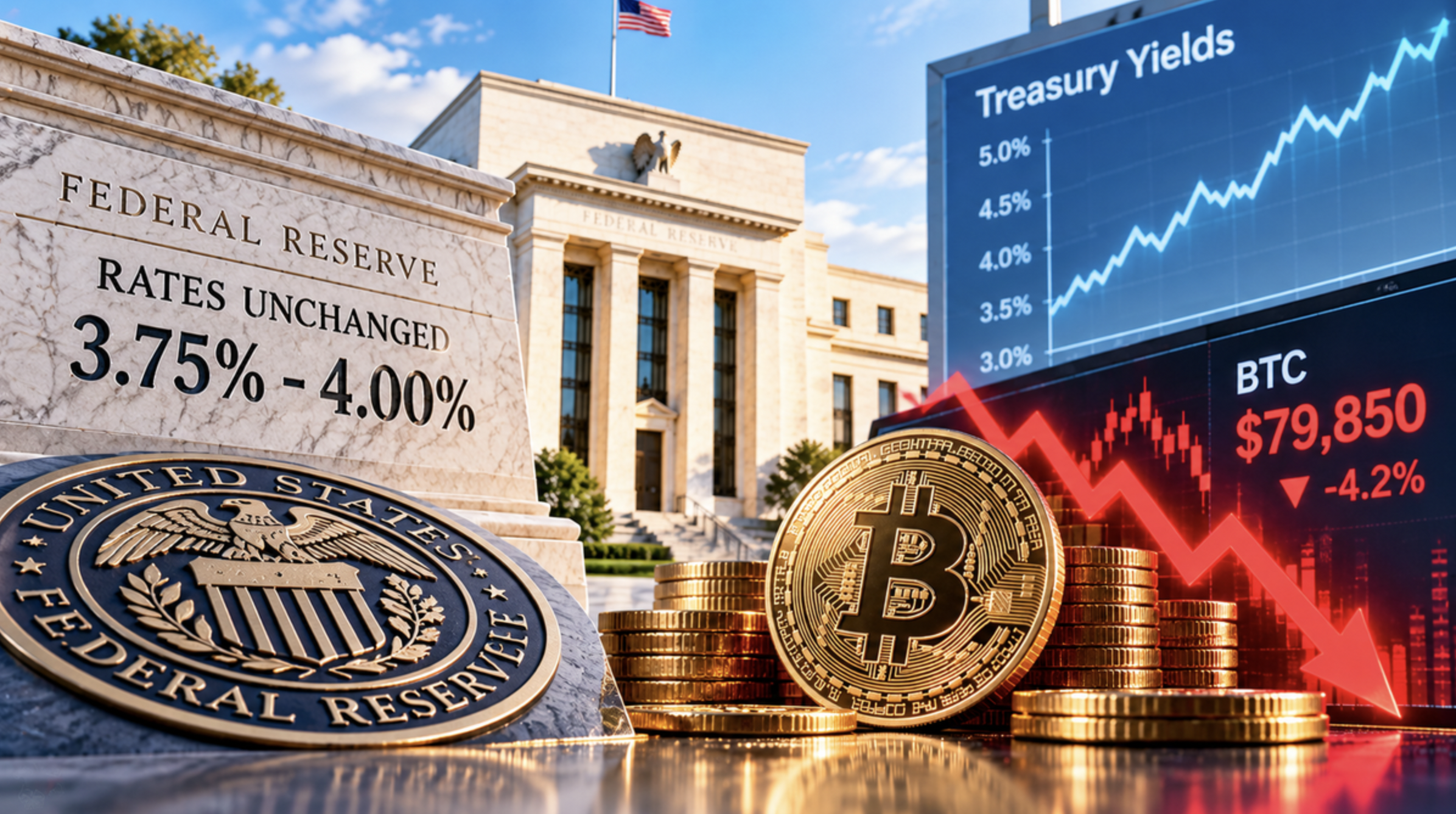
The Federal Reserve left its benchmark interest rate where it was at the end of October, but the vote behind that decision was less settled than the headline suggests. Two officials wanted a quarter-point increase, and that disagreement matters to anyone with a mortgage, a credit card, a car loan or a savings account in the United States.
In this article we will explore what the policy committee decided on 28 October 2026, how to read its wording and its vote, and how rate moves reach household budgets.
A Hold, a Split and the September Backdrop
On 28 October 2026 the Federal Open Market Committee, the group inside the Fed that sets short-term interest rate policy, kept the federal funds target range unchanged at 3.75 to 4 percent. The vote was 10 to 2. The two members who voted no, Lisa D. Cook and Beth M. Hammack, preferred to raise the range by a quarter of a percentage point. Everyone else backed leaving it alone.
The October result looks different next to September. According to the statement redline, which compares the new statement with the previous one line by line, the committee voted 12 to 0 in September to raise the range by a quarter point to 3.75 to 4 percent. So the committee moved up in September with no dissent, paused in October, and picked up two voices for going further. That sequence is worth noticing, because a hold that follows a unanimous increase and arrives with hawkish dissents is a different kind of pause from a hold in a quiet stretch.
A quick refresher on the rate itself helps. The federal funds rate is what banks charge one another for overnight loans of reserves. The committee does not set one exact number. It announces a target range, and the Fed uses its tools to keep the market rate inside that band. Because overnight lending sits underneath almost every other rate in the financial system, a change in the range gradually moves what households and businesses pay and earn, although not in lockstep.
For most households a hold means continuity. Payments on fixed loans stay as they are, variable rates do not get a fresh push from the Fed, and savings yields are not under new pressure to change. What a hold does not do is settle the question of direction, which is why the vote count and the wording drew so much attention.
A word on geography is also useful. This is a United States story, and the Fed’s decisions apply directly to dollar borrowing and saving. Readers in other countries live under their own central banks, which set their own rates on their own schedules. A US move can still reach abroad through exchange rates and through the cost of dollar-denominated debt, but a local mortgage in another country follows its home central bank much more closely than it follows Washington.
Statement Wording That Shifted and Wording That Held

Central bank statements are short and heavily edited, so small word swaps are read closely. The October text offers one clear change from September, a few phrases that stayed put, and one notable absence.
Activity Described as Strong
The committee now says economic activity is expanding at a strong pace. In September the statement used the word solid. The step from solid to strong is a modest edit on the page, but it signals that officials see the economy running a little hotter than they did a month earlier. Stronger activity can add to pressure on prices, since businesses with full order books have more room to raise what they charge and to bid for workers.
It is worth being careful here. A single adjective is not a forecast, and the statement does not say that stronger growth will lead to any particular action. It does fit with the fact that two members wanted a higher rate, which is a reminder that the choice in October was between holding and tightening, not between holding and cutting.
Jobs, Prices and a Firm Promise
On work, the statement says job gains have kept pace with the workforce and that the unemployment rate has changed little. In plain terms, hiring is neither racing ahead nor slipping. For households this reads as a labor market that is steady enough that the committee does not feel pushed to protect jobs at the expense of its price goal.
On prices, the wording is blunt: inflation remains elevated. The statement then adds that the Committee will deliver price stability. That second sentence is a commitment rather than a description, and it frames everything else. When a central bank says it will deliver price stability while also saying inflation is elevated, it is telling listeners that it regards the gap between the two as its job to close.
No Stated Path
What the statement does not contain is just as telling. There is no explicit rate path, meaning no sentence that says rates will rise, hold or fall over any stretch of meetings. The committee says instead that more information will help it determine the appropriate stance. That is the standard phrasing of a data-dependent approach: the next move depends on incoming numbers, not on a script.
The statement also says the Committee is continuing its policy of maintaining ample reserves in the banking system. Reserves are the deposits that banks hold at the Fed. Keeping them ample means the Fed runs its system with plenty of cash sloshing around the banks rather than a scarce supply. The phrase is mostly about the plumbing of how the Fed steers short-term rates, and for most readers it is background rather than a signal about the next decision.
Two Dissents and Why a Split Vote Carries Information
A dissent is a formal no vote on the committee’s decision. It does not change the outcome, since the majority decides, but it is recorded in public and each dissenting member is named. In October the two names were Lisa D. Cook and Beth M. Hammack, and both preferred a quarter-point increase.
The direction of the dissent matters as much as its existence. A dissent in favor of a higher rate tells observers that part of the committee sees the current setting as too loose given where prices are. If the same hold had drawn two dissents in favor of a cut, the message would have pointed the other way. Reading dissents this way gives a rough picture of which direction the internal debate leans, without telling anyone what the majority will do next.
The arithmetic of the vote is simple. Ten voted to hold and two voted to raise, which makes twelve voters in all, the same twelve who voted in September when the tally was 12 to 0. That comparison is the cleanest way to see what changed. Put simply, the committee that was unanimous for a quarter-point rise in September left a pocket of members who wanted to repeat the move.
The fact sheet for this article does not include the reasoning either member gave. The Fed has a habit of publishing explanations from dissenting members after meetings, and a reader who wants the reasoning should look for those statements on the Fed’s official site instead of relying on commentary that guesses at motives. Treat any confident account of why they voted as they did with some caution unless it quotes the members themselves.
Finally, the tally is published together with the statement, so the public learns of any dissent within minutes. That immediacy lets savers, borrowers and traders see right away that the committee was not of one mind, and it is one reason the October decision drew more attention than a plain hold usually would.
There is also a longer view. Over many years, committees that move in a series of small steps tend to show disagreement first as a few dissents, then as a shift in the majority, and sometimes not at all. History offers no fixed rule, so the October split should be read as a data point about the debate and not as a signal that a second increase is on its way.
From the Policy Rate to Your Own Borrowing and Saving
The federal funds rate is the starting point of a long chain, and the links in that chain vary in strength. Some consumer products move quickly with the Fed. Others barely react, because they follow longer-term market rates that depend on expectations as much as on the current policy setting. Specific consumer rates are not part of the sources behind this article, so the discussion below is about the mechanics, not about today’s advertised numbers. Check your lender’s own figures for those.
Credit Cards and Other Variable-Rate Debt
Most credit cards charge a variable rate that is built from a benchmark, usually the prime rate, plus a margin set by the issuer. The prime rate tends to track the Fed’s target range closely, so when the committee raises the range, card rates normally follow within a billing cycle or two. When it holds, as it did in October, nothing mechanical happens. The same applies to home equity lines of credit and many private student loans, which are often tied to a similar benchmark.
An illustration with invented round numbers shows the scale. Imagine a variable-rate balance of $10,000. If a quarter-point increase were passed through in full, the annual interest on that balance would rise by about $25, which is roughly $2 a month. A single move is small. The pressure builds when increases stack up across several meetings, or when the balance is large and the base rate is already high.
Mortgages and Why They Behave Differently
A common mistake is to assume that mortgage rates rise one-for-one with the Fed. A fixed-rate mortgage is priced off longer-term borrowing costs in the bond market, which reflect what investors expect about inflation and about the Fed’s path over many years. That means mortgage rates can move before a Fed decision, in anticipation of it, and can even move in the opposite direction on the day if the committee’s tone surprises markets.
Adjustable-rate mortgages are more directly exposed, since their rates reset periodically against a benchmark. Whether you are affected depends on the terms in your loan documents: the index it follows, how often it resets, and any caps on how much it can change in a given period. Readers with an adjustable loan should find the reset date and the cap in their paperwork now, not when a notice arrives.
Savings Accounts and Certificates of Deposit
Savers sit on the other side of the same chain. When the Fed raises its range, banks can afford to pay more on deposits, but they are not obliged to, and many take their time. The yield on a traditional account at a large bank can lag the policy rate, while online banks and credit unions often adjust faster because they compete harder for deposits. A hold means no new push in either direction, though yields that were set earlier remain in place.
Certificates of deposit lock in a rate for a fixed term. That can be attractive when rates are high and uncertain, but it carries an opportunity cost if rates climb further and your money is tied up. A common compromise is to split savings into a flexible account and a ladder of certificates with staggered maturities, so that some money becomes available at regular intervals.
Car Loans, Personal Loans and Business Credit
Auto loans and most personal loans are fixed once signed, so a change in the Fed’s range does not alter an existing payment. The effect lands on new borrowers, because lenders price fresh loans using current funding costs and their view of risk. Small businesses with floating-rate lines of credit feel changes more quickly, since those lines are commonly tied to prime in the same way as cards.
The table below summarizes the typical connection for each product. The sensitivities are general patterns, and individual contracts vary.
| Product | Link to the Fed’s range | Typical speed of response | What to check |
| Credit card | Variable, tied to the prime rate plus a margin | Fast, within a billing cycle or two | Your current annual percentage rate and margin |
| Home equity line of credit | Variable, usually tied to prime | Fast | Index, margin and any rate cap |
| Fixed-rate mortgage | Indirect, through longer-term bond yields | Moves with expectations, often before the decision | Whether refinancing makes sense after fees |
| Adjustable-rate mortgage | Reset against a benchmark | Depends on the reset schedule | Reset date and caps |
| Auto or personal loan | Affects new loans only | Gradual for new offers | Quotes from several lenders |
| Savings account | Banks may raise yields, but need not | Slow at many large banks, faster online | The posted yield versus competitors |
Market Odds, the Data Calendar and Unanswered Questions
After the meeting, attention shifted to what comes next. Much of the detail below comes from a single market report published by HackerNoon, so it is attributed to that outlet and should be read as one account of the days around the decision, not as an official record.
How Traders Priced December
According to HackerNoon, Chair Kevin Warsh did not commit to raising rates in December and said that coming data would help the committee decide. The same report says that after the decision, the CME FedWatch tool priced an 85.0 percent chance of a December increase, up from 78.3 percent the day before. FedWatch derives its figures from prices in interest-rate futures, so the number reflects what traders are betting on, not what the committee has decided or promised.
A probability of that kind is not a forecast of the outcome, and it should not be treated as one. Market pricing shifts with every data release and every speech, and it has been wrong before in both directions. The committee itself has said it has no preset path, and nobody outside the room can say how the December decision will go. What the pricing shows is the market’s current lean, which is useful context and nothing more.
The same report gives the latest inflation reading: September consumer prices were up 3.7 percent from a year earlier, with the core measure at 2.6 percent. Core inflation leaves out food and energy, which swing widely, so the gap between the two figures, simple arithmetic puts it at 1.1 points, suggests that volatile categories were adding to the headline. Policymakers watch both, and this is why the statement can describe inflation as elevated while a core number looks calmer.
The Dates That Matter Before the Next Meeting
Two data releases land before the committee meets again, according to the report, and the meeting itself is on the calendar. The table lists them in order.
| Date | Event | Why it matters |
| 6 November | October payrolls report | Shows whether hiring has kept pace with the workforce |
| 10 November | October consumer price index | Updates the inflation picture after the 3.7 percent September reading |
| 8 to 9 December | Next Federal Open Market Committee meeting | The next scheduled decision on the target range |
For an ordinary budget, rates on new loans and new deposits start to shift well before the committee meets, as traders and lenders react to each release. Because the committee describes itself as data dependent, these two reports carry more weight than usual. Data dependent does not mean the committee reacts to every number. It means officials say their decisions follow the trend in jobs, prices and growth, not a calendar promise. A strong jobs report and a hot inflation print point one way; a soft jobs report and cooler prices point the other. Anyone who claims to know beforehand how the numbers will land is guessing.
A Change to the Calendar From 2027
HackerNoon also reports that from 2027 some committee meetings become long-term strategy sessions without rate votes, and that 2027 will have seven rate-setting meetings. If that description holds, borrowers and savers will have fewer scheduled moments each year when the target range can change, and more of the committee’s discussion will be devoted to its framework instead of a decision. Because this rests on one report, readers who want the details should check the Fed’s published calendar for the year.
One more point on timing: central banks tend to prefer to explain a decision after the fact and to avoid surprising markets. Statements are therefore written to preview, with care, how officials think about their next step, and the October text is consistent with that habit. It signals attention to inflation and to activity, and it holds back from a commitment. Readers who want more detail can read the full statement and the vote record on the Fed’s site, which are short and free to read.
Final Thoughts: Choices in a Sensible Order
None of this is a reason to make a dramatic change to a household budget. The committee held rates, the next decision is more than a month away, and there is no official promise about direction. Still, a hold with hawkish dissents is a fair prompt to tidy up money matters that would be more expensive if rates rose later. What follows is general information, not financial advice, and a licensed adviser can look at an individual situation.
Start With Debt That Floats
List every balance with a variable rate: credit cards, home equity lines, adjustable mortgages and any private loans tied to a benchmark. These are the first to get more expensive if the committee raises its range. Paying down the highest-rate card first is a sound habit in almost any rate environment, and it matters more when upward pressure is a live possibility. If a balance transfer offer makes sense, read the fee and the length of the promotional period before acting.
Then Look at Where Cash Sits
Compare the yield on your savings with a few alternatives, including online banks, credit unions and money market accounts. A difference of a fraction of a percentage point is worth little on a small balance, but on a larger cushion it adds up over a year. Make sure any account is covered by federal deposit insurance up to its limits, and check the limits that apply to your situation.
Keep the Emergency Fund Intact
An emergency fund is the piece of a financial plan that makes rate swings easier to ride out. Many advisers suggest holding several months of essential expenses in an easily accessible account. If rising rates squeeze a variable payment, that cushion buys time to adjust instead of forcing a sale of investments at a poor moment.
Revisit Fixed and Floating Choices
When a household has the option to fix a rate, the decision usually comes down to certainty against cost. A fixed rate gives a payment that never changes, which many families value highly, while a floating rate can start lower and then rise. Neither is right for everyone. A borrower with tight monthly margins often benefits from the predictability of fixing, while one with plenty of slack and a plan to repay soon may accept the risk of floating. If you are weighing a refinance, count the fees and the number of months it would take to earn them back before deciding.
Resist Guessing the Meeting
Because market odds are not a forecast, building a plan around a December guess is risky. A better approach is to ask whether your finances can handle a payment that is a bit higher, and a rate that is a bit lower. If the answer to both is yes, the exact outcome of the next meeting matters much less to you, and that is the position to aim for.
Frequently Asked Questions
Did the Fed Raise or Cut Rates on 28 October 2026?
Neither. The committee kept the federal funds target range unchanged at 3.75 to 4 percent. The vote was 10 to 2.
Who Voted Against the Decision to Hold Rates?
Lisa D. Cook and Beth M. Hammack dissented. Both preferred a quarter-point increase.
When Is the Next Fed Meeting?
According to HackerNoon’s market report, the next meeting is scheduled for 8 to 9 December. Check the Fed’s official calendar to confirm the dates.
Does a Fed Hold Change My Mortgage Payment?
A hold does not change a fixed-rate mortgage payment, and it adds no new push to an adjustable one. Adjustable loans still reset on their own schedule, so read your loan terms for the date and caps.
Is an 85 Percent Market Probability a Promise of a December Hike?
No. HackerNoon reports that CME FedWatch priced an 85.0 percent chance after the decision, but that figure comes from futures trading and is not a forecast or a commitment by the committee.
When Is the Next Inflation Report Due?
HackerNoon’s report lists October payrolls on 6 November and the October consumer price index on 10 November. Official release calendars are published by the Bureau of Labor Statistics.