Two announcements on consecutive days in early October put some of the strangest particles in the universe and some delicate laboratory tricks in front of a global audience. The physics prize turned on high-energy neutrinos from beyond Earth, and the chemistry prize on how molecules can be made in just one of two mirror-image forms.
In this article we will discuss what each prize recognizes, explain the underlying science in plain language, look at how the Nobel process works, and suggest ways to follow the coverage with confidence.
Francis Halzen and the Physics Prize
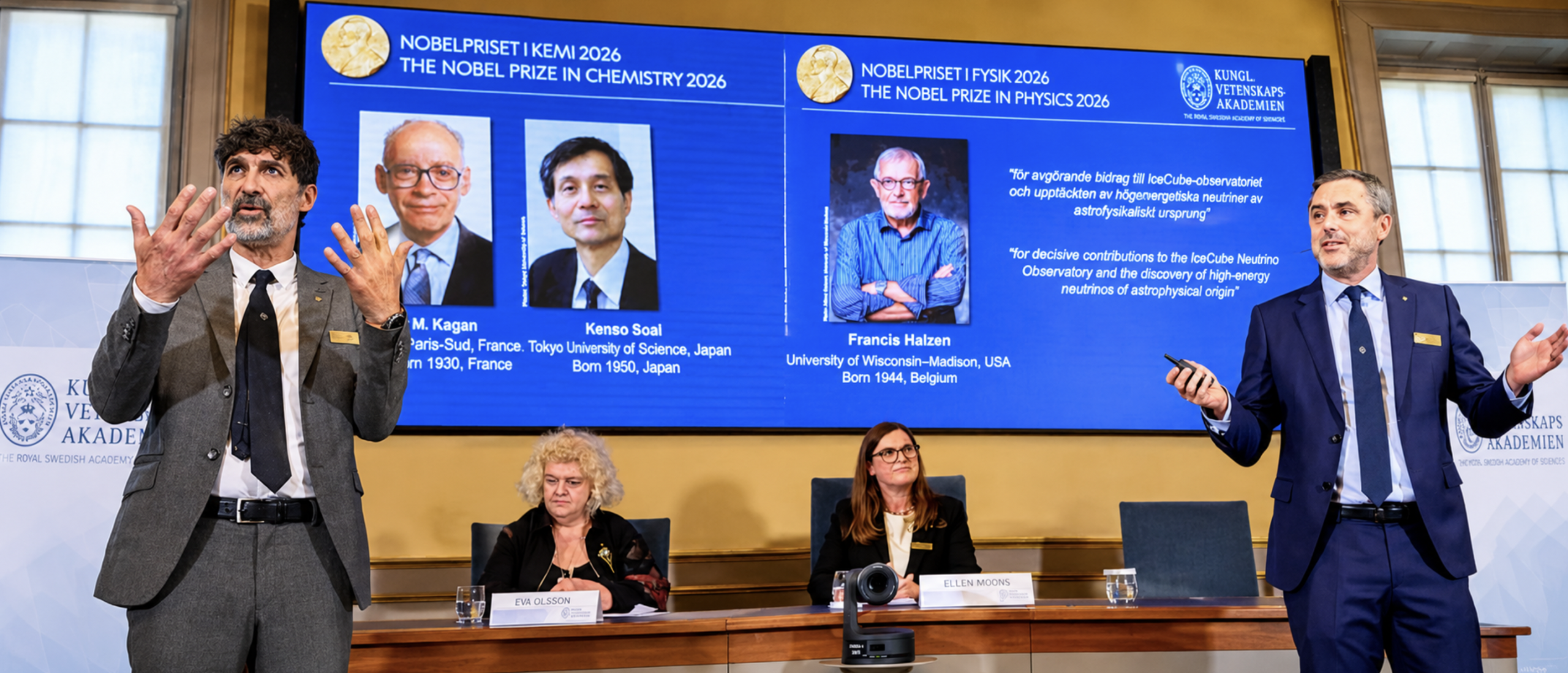
The Nobel Prize in Physics was announced on Tuesday 6 October 2026. According to Daily Maverick, the prize went to Francis Halzen, a Belgian-American particle physicist, for “decisive contributions to the IceCube Neutrino Observatory and the discovery of high-energy neutrinos of astrophysical origin.” That report names no co-winners and gives no institution, so this article does not either. Readers who want the complete laureate list, the official citation wording and biographical details should check the Nobel Prize organization directly, since a single news report can omit names.
The physics prize carries 12 million Swedish crowns, which Daily Maverick put at about $1.2 million, shared when there are several winners. That is the headline number the press repeats each autumn, though what a laureate takes home depends on how many people share the prize and on exchange rates.
Neutrinos in Plain Terms
Neutrinos are among the most abundant particles in the universe and also among the hardest to catch. They are extraordinarily light and they interact so rarely with ordinary matter that countless numbers pass through your body every second without leaving a trace. Physicists can say they exist because the particles are produced in well-known processes, such as nuclear reactions in stars and the decay of certain radioactive atoms, and because very large and very patient instruments can occasionally register a single collision.
The reason neutrinos are worth the trouble is that they travel straight. Light from distant cosmic objects can be absorbed or scattered by dust and gas, and charged particles are bent by magnetic fields along the way, so their paths do not point back to where they began. A neutrino carries no electric charge and passes through almost anything, so in principle it can reveal where it came from and bring news from regions that are otherwise hidden.
What “Astrophysical Origin” Means
The prize citation refers to high-energy neutrinos “of astrophysical origin.” In practice that means neutrinos produced by sources far outside the Earth’s atmosphere, such as violent environments in distant galaxies, as opposed to those created when cosmic rays strike the upper atmosphere nearby. Separating the two is hard, since both produce neutrinos, and part of the achievement credited to the IceCube collaboration is showing that a stream of high-energy neutrinos reaches Earth from outside the atmosphere. This article does not go into how the experiment extracted that signal, because the news report supplies only the citation, and the technical details are best read in the Nobel Committee’s own scientific background.
Why Detectors Are Built in Ice or Water
A neutrino detector is usually a very large volume of transparent material watched by light sensors. When a neutrino does collide with an atom in the material, the products of the collision can emit a faint flash of light that the sensors record. The bigger the volume, the more targets are available for the rare collision, which is why such instruments are huge compared with the particles they chase. Natural ice and deep water are attractive because they are clear, plentiful and cheap compared with building a tank of equal size, and they can shield sensors from other kinds of radiation. The IceCube observatory is generally described as a detector built into deep natural ice, which fits that logic, though readers should consult the project itself for specifics.
Why the Discovery Matters to Astronomy
For most of history, astronomy meant collecting light. Later generations added radio waves, X-rays and other forms of radiation, and more recently gravitational waves, each of which opened a new window on the cosmos. Neutrinos are another such window, and a rare one, because they can emerge from the dense interiors of violent objects where light cannot escape.
The hope behind projects like IceCube, in general terms, is that combining neutrino signals with observations in light and other messengers will help identify which cosmic objects accelerate particles to extreme energies, a question that has puzzled physicists for a long time. The prize citation points to the discovery of the neutrinos themselves, and the harder task of tying each neutrino stream to a specific kind of source belongs to ongoing research. Readers should treat any claim that the mystery of cosmic rays is solved with caution.
There is also a lesson here about scale and patience. Building a detector large enough to catch rare events takes years of planning, funding and engineering, and the results emerge slowly as data accumulate. The physics prize is a reminder that some discoveries come not from a single dramatic experiment but from a long campaign by a large collaboration, with a scientific leader whose contribution the committee singles out.
Kagan, Soai and the Chemistry Prize
The Nobel Prize in Chemistry followed on Wednesday 7 October 2026. Khaleej Times reported that Henri Kagan and Kenso Soai were honored “for the discovery of non-linear effects and autocatalysis in asymmetric organic synthesis,” with the award coming from the Royal Swedish Academy of Sciences. The prize of 12 million Swedish crowns was reported as shared between the two. As with the physics announcement, this is the account of a single outlet, and readers should check the Nobel Prize website for the official wording.
Handedness in Molecules
Many molecules come in two forms that are mirror images of each other, much like a left hand and a right hand. Chemists call this property chirality, and they call the two forms enantiomers. The two hands contain the same atoms connected in the same order, yet they cannot be laid on top of one another, just as you cannot wear a left glove on your right hand. Ordinary chemical reactions that begin with symmetrical ingredients usually produce an equal mix of the two forms, known as a racemic mixture.
That would be a curiosity if it did not matter in living things. Biology is built from molecules with a definite handedness, so a protein in your body will interact with one form of a molecule differently from its mirror image. Two enantiomers can smell different, taste different and, in medicines, behave differently in the body. One form may do the intended job while the other does nothing, causes side effects, or even works against it. The mirror-image forms of a thalidomide-type drug are often cited to illustrate the danger, although the real story is more complicated than the simple version suggests.
What Asymmetric Synthesis Aims to Do
Asymmetric synthesis is the branch of chemistry that tries to make one hand rather than a mixture. A chemist might use a chiral helper, such as a catalyst or an auxiliary that is itself handed, to steer a reaction toward the desired form. The goal is to deliver a product that is as pure as possible in the form you want, with as little wasted material as possible. This matters for drug manufacturing, for fragrances and flavors, for agricultural chemicals and for materials, and a great deal of modern synthetic chemistry is organized around it.
Why the Field Matters Beyond the Lab
The appeal of asymmetric synthesis is practical as well as intellectual. A process that makes only the wanted form wastes less material than one that makes both and then separates them, and separation of mirror-image molecules is notoriously difficult because they share almost all their physical properties.
Cleaner reactions can mean fewer steps, less waste and lower cost, which is why industrial chemists follow advances in the field closely. For patients, the payoff is medicines that contain the right form and not a mixture, and for farmers and consumers it is products that do their job with less unnecessary chemical material. These are general benefits of the approach, not claims about any specific product linked to this year’s laureates.
It is also worth noting that catalysts, the helpers that speed reactions without being used up, are central to this story. A good chiral catalyst can create a very large amount of product from a small amount of material, so a clever design multiplies its value. That is why discoveries about how catalysts behave, including the quirks of mixtures described in the next section, can have an outsized influence on how reactions are planned.
Autocatalysis and Non-Linear Effects in Plain Terms
The chemistry citation uses two phrases that sound intimidating, so it helps to take them in turn. This is a general explanation of the ideas, not a description of the laureates’ specific experiments, which the news report does not detail. The Nobel Committee’s own materials will give the precise story.
Non-Linear Effects
In a straightforward world, the purity of a product would track the purity of the catalyst that made it. If a catalyst were mostly one hand, the product would be mostly one hand, in proportion. A non-linear effect means that this proportionality fails, and the result can be more or less pure than the simple arithmetic predicts. The idea is that the two hands in a mixed catalyst can interact with each other, sometimes tying each other up so that the leftover material behaves better than expected.
Why does this matter? Because it changes how chemists design reactions. If a modest amount of imperfect catalyst can still deliver a highly pure product, then the catalyst is cheaper to prepare and easier to use. And if the relationship is not what the textbooks predicted, knowing how it works lets chemists avoid unwelcome surprises in industrial settings. The citation describes the discovery of these effects, and the relevant point for general readers is that the behavior of mixtures can be richer than a simple average.
Autocatalysis
Autocatalysis describes a reaction in which a product helps to make more of itself. Think of a snowball that gathers more snow the more it grows. In an ordinary reaction, the catalyst is supplied from outside, but in an autocatalytic reaction the output also serves as the catalyst, so the process can accelerate once some product has appeared. Now combine that with handedness. If the product is a chiral molecule and it catalyzes its own formation, then a tiny excess of one hand at the start can be amplified, because the favored hand guides the reaction to make still more of itself.
The general name for the concept is asymmetric amplification, and it is of great interest to scientists thinking about how life on Earth might have ended up with a single handedness for its building blocks. That origin question remains open, and the prize does not claim to answer it. The point here is simply that autocatalysis in asymmetric synthesis shows how small imbalances can grow into large ones under the right conditions.
An illustration with invented round numbers may help. Imagine a flask that starts with a slight tilt, say 51 left-handed molecules for every 49 right-handed ones. If each new left-handed molecule makes the next left-handed one slightly more likely than a right-handed one, the tilt can grow batch after batch until the flask holds mostly one hand. The numbers are made up purely for illustration and do not come from any experiment.
Why do these ideas belong together in one citation? Both describe surprising behavior in systems where mirror-image molecules interact. Non-linear effects show that the makeup of a catalyst can have effects that are larger or smaller than expected, while autocatalysis shows that a product can steer its own production. Together, they widened the toolbox of asymmetric synthesis and gave chemists new ways to think about how handedness is created, copied and amplified. The details of who found what, and when, are best taken from the Nobel Committee’s scientific background rather than from a summary like this one.
How Nobel Committees Choose Their Winners
The Nobel announcements follow a published calendar. The announcement window in 2026 ran from 5 to 12 October, with medicine on Monday 5 October, physics on Tuesday 6 October, chemistry on Wednesday 7 October, literature on Thursday 8 October and peace on Friday 9 October. Daily Maverick reports that the medals are presented in Stockholm on 10 December. This article covers only the physics and chemistry prizes, so readers looking for the other categories should consult the Nobel Prize site.
| Prize | Announced | Cited for | Amount | Reported by |
| Physics | Tuesday 6 October 2026 | Decisive contributions to the IceCube Neutrino Observatory and the discovery of high-energy neutrinos of astrophysical origin | 12 million Swedish crowns (about $1.2 million), shared if there are several winners | Daily Maverick |
| Chemistry | Wednesday 7 October 2026 | Discovery of non-linear effects and autocatalysis in asymmetric organic synthesis | 12 million Swedish crowns, shared between the two laureates | Khaleej Times |
Who Decides
In general terms, each Nobel prize is judged by a committee of experts that works for the awarding institution, and for physics and chemistry that body is the Royal Swedish Academy of Sciences. Committees invite nominations from qualified people around the world, review the candidates in depth, consult outside specialists and then present a recommendation that the wider body of the Academy votes on. The process runs for many months before the announcement in October.
Secrecy and Its Effects
Nominations and the discussions around them are kept secret for 50 years. That rule means nobody outside the process can know for certain who was considered, and the speculation that fills the weeks before each announcement is guesswork by journalists and commentators. Treat any confident list of favorites with skepticism, including lists that happen to be right in hindsight. It also means that historians eventually get to read the nomination files, which sometimes reveal that a celebrated discovery was nominated many times before it won, or that a prize was decided after long deliberation.
Why Recognition Can Lag the Discovery
Nobel prizes often honor work done long before. A discovery needs time to be confirmed by other groups, to prove its usefulness and to settle into the textbooks. That lag is one reason the winners tend to be established figures, and it is also why the prizes celebrate achievements that were hard to appreciate when they were first reported. The rule that a prize may be shared among several people, as the chemistry prize shows, reflects the reality that modern discoveries are rarely the work of a single mind.
Tips for Following Science News With a Critical Eye
Prize weeks produce a flood of articles, and quality varies. A few habits make it easier to separate the solid from the shaky. Start with the primary source. The Nobel Prize website publishes the official announcement, a popular-level summary and a more detailed scientific background for each prize. These documents are written by the committees themselves and are usually clearer than second-hand coverage. If a news story gives a quotation or a citation, compare it with the official text, especially when the story leaves out names, as with the single-source reports on which this article relies.
Next, notice who is speaking. A news outlet may repeat a claim without checking it, and the first reports on an announcement are often written in minutes. Later explanations by working scientists in the field, usually found on university and research-institute websites, tend to add context and correct early slips.
Be wary of hype. Phrases such as “rewrites physics” or “solves the mystery of life” are rarely supported by the science. Recognizing a discovery does not mean the question it touches is settled. The prize for astrophysical neutrinos does not tell us everything about the sources of cosmic particles, and the chemistry prize does not explain the origin of life’s handedness.
Finally, keep the human side in view. Many discoveries rest on the work of large teams, and the prize rules limit the number of laureates per category. When you read that one person won a prize for work involving a big collaboration, remember that the citation recognizes a contribution within a larger effort, and look at how the committee explains it.
It is also sensible to read the numbers and names in a story twice. In the days after any big announcement, small errors spread quickly: a misspelled name, a prize attributed to the wrong institution, a date shifted by a day because of time zones. When two outlets disagree, go to the official source and, if it is not yet clear, wait. This is especially wise when a story is based on a single report, as the details of the 2026 physics and chemistry announcements in this article are, because a lone source cannot be cross-checked against another.
Last, separate the prize from the person. A Nobel is a recognition of specific work, not a certificate of wisdom about unrelated subjects. Laureates are experts in their own corners of science, and when they speak about politics, medicine or economics, they are speaking as citizens. That does not diminish the achievement, but it does mean the prize should not settle every argument.
Final Thoughts: A Reading Plan for the Curious
If these two prizes sparked your interest, there are easy next steps that do not require a physics degree. Start with the official popular summaries on the Nobel Prize website, which are written for non-specialists. Then try a free public lecture, because many universities record and post talks on particle physics and organic chemistry, and a good talk can make an abstract idea click in an hour.
Science museums and planetariums are another good resource. Many have exhibits or online guides about particles, the structure of molecules and the history of the prizes, and some host evening events around the December ceremonies. Local libraries often carry introductory books and can order more specialized ones for you. If you teach or have school-age children, simple activities help: holding up your hands to a mirror makes handedness tangible in seconds, and a snowball rolled down a hill demonstrates the idea of a process that feeds on itself.
For the physics, a useful way in is to start with the question of why we want to look at the universe with something other than light. For the chemistry, think about the last time you read a medicine label, and wonder how the manufacturer ensures that each tablet contains the right form of the active ingredient. Both questions lead to the same place, which is the unglamorous but rewarding work of controlling nature at tiny scales.
Last, give yourself permission to go slowly. These are research fields with decades of accumulated work, and nobody absorbs them in a weekend. Reading the official background, watching a lecture and returning to the subject when the next news item appears is a perfectly good way to learn. The medals will be presented in Stockholm on 10 December, and the lectures and ceremonies around them are often livestreamed, giving a second chance to hear the laureates explain their work in their own words.
Teachers and parents can turn the news into a conversation without any special equipment. Ask a child what they think is the smallest thing in the world, and whether something could be so small that it passes through a wall. Ask a teenager why two things that look identical might still behave differently, and let the mirror and the glove supply the answer. Questions of this kind do not require the right answer on the spot, and they often lead children to the library or to a good video with a curiosity that a lecture cannot produce. For adults, the same approach works: pick one phrase from the citations, such as astrophysical origin or asymmetric synthesis, and see how far you can explain it to a friend in your own words.
Frequently Asked Questions
Who Won the 2026 Nobel Prize in Physics?
According to Daily Maverick, the prize went to Francis Halzen, a Belgian-American particle physicist, for contributions to the IceCube Neutrino Observatory and the discovery of high-energy neutrinos of astrophysical origin. That report names no co-winners, so check the Nobel Prize website for the full list.
Who Won the 2026 Nobel Prize in Chemistry?
Khaleej Times reported that Henri Kagan and Kenso Soai were honored for the discovery of non-linear effects and autocatalysis in asymmetric organic synthesis. The Royal Swedish Academy of Sciences made the award, with the 12 million Swedish crowns shared between the two.
How Much Money Comes With a Nobel Prize?
The reports for both prizes gave the amount as 12 million Swedish crowns, which Daily Maverick said is about $1.2 million. The sum is shared when there are several winners.
Does Astrophysical Origin Mean a Neutrino Came From Outside the Atmosphere?
Yes. It means the neutrino was produced by a cosmic source beyond Earth, rather than by cosmic rays hitting the atmosphere nearby. Detecting such neutrinos can provide information about distant, energetic environments.
How Does Handedness Matter in Medicines?
The two mirror-image forms of a molecule can behave differently in the body, because biological molecules are themselves handed. One form can be useful while the other has little effect or causes problems, which is why chemists try to make just one.
When Are the Nobel Medals Presented?
Daily Maverick reports that the medals are presented in Stockholm on 10 December. The announcements themselves took place between 5 and 12 October.