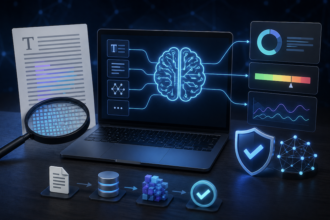

Training AI models traditionally requires gathering enormous amounts of data onto a centralized server, but this approach creates genuine privacy concerns, particularly when that data comes from personal devices containing sensitive information. Federated learning offers a genuinely different approach, and understanding how it actually works reveals a clever solution to training capable AI models while keeping your personal data on your own device.
What Federated Learning Actually Means
Federated learning is a machine learning technique that trains AI models across many individual devices without requiring the underlying raw data to ever leave those devices. Instead of collecting your personal data onto a central server for training, the AI model itself travels to your device, learns from your local data there, and only sends back the resulting learned improvements, not your actual raw personal information.
This represents a genuinely fundamental shift from traditional machine learning approaches, where training data typically needs to be centrally collected and stored, since federated learning specifically keeps sensitive data distributed across individual devices while still allowing the overall AI model to benefit and improve from that widely distributed information.
How Federated Learning Actually Works Step by Step
Understanding the genuine technical process behind federated learning helps clarify exactly how this privacy-preserving training approach actually functions in practice.
- A central server sends the current version of an AI model out to participating individual devices
- Each device trains this model further using only its own local, private data
- Devices then send back only the resulting model updates, not the actual underlying raw data
- The central server combines these updates from many devices to improve the overall shared model
This selective information sharing represents the genuine core innovation behind federated learning, since the model updates sent back to the central server represent learned patterns and adjustments rather than your actual personal photos, messages, or other sensitive data, meaning your specific private information genuinely never needs to leave your own device throughout this entire training process.
Why This Approach Genuinely Protects Your Privacy
Understanding specifically why federated learning provides meaningfully stronger privacy protection compared to traditional centralized training approaches helps clarify its genuine practical value for privacy-conscious applications.
- Your actual raw personal data never gets transmitted to or stored on external servers
- Only abstract, aggregated model improvements travel between your device and the central system
- This significantly reduces the risk of a data breach exposing your specific personal information
- Even if the central server were compromised, no centralized collection of raw user data would be exposed
This breach risk reduction deserves particular emphasis, since traditional centralized data collection creates a genuinely attractive target for attackers, given that successfully breaching one central server could expose enormous amounts of aggregated personal data, while federated learning’s distributed approach means no single point of compromise could expose this same volume of sensitive raw information.
Common Real-World Applications of Federated Learning
Understanding where this technology has already found genuine practical application helps illustrate its real-world value beyond just theoretical privacy benefits.
- Smartphone keyboards that improve text prediction based on your typing patterns without uploading your actual messages
- Voice assistants that improve speech recognition accuracy using on-device audio processing
- Healthcare research that allows training models across multiple hospitals without centralizing sensitive patient data
- Smart device features that adapt to individual usage patterns without transmitting detailed personal usage data
Smartphone keyboard prediction represents a particularly relatable example of this technology in action, since your phone can genuinely learn your specific typing habits, commonly used words, and personal writing style to improve prediction accuracy, all without your actual private messages ever needing to leave your device or become visible to the company providing that keyboard technology.
Why Federated Learning Still Involves Some Genuine Trade-Offs
Despite its genuine privacy advantages, federated learning is not without real limitations and trade-offs worth understanding for a balanced, accurate picture of this technology.
- Training across many distributed devices with varying computational power can be less efficient than centralized training
- Ensuring model updates genuinely do not leak sensitive information requires careful, additional technical safeguards
- Coordinating training across numerous devices with inconsistent connectivity presents genuine technical challenges
- The overall training process can take considerably longer compared to training on centrally collected data
This efficiency trade-off deserves genuine acknowledgment, since coordinating training across potentially millions of individual devices, each with varying processing power, battery constraints, and network connectivity, introduces genuine logistical complexity that centralized training on powerful, dedicated servers simply does not need to navigate.
Why Model Updates Themselves Require Additional Privacy Safeguards
Understanding that even the aggregated model updates sent back to a central server can theoretically reveal some information about the underlying data helps clarify why federated learning often incorporates additional privacy techniques beyond the basic distributed training approach alone.
- Sophisticated analysis of model updates could theoretically reveal some information about underlying training data
- Additional techniques, like adding statistical noise to updates, help further protect against this genuine risk
- These supplementary privacy measures work alongside the core federated learning approach for stronger protection
- Understanding this additional layer helps clarify why genuinely robust privacy protection requires more than distributed training alone
Practical Implications for Everyday Technology Users
- Federated learning allows you to benefit from improving AI features without sacrificing as much personal privacy
- This technology increasingly powers features you may already use daily without realizing the underlying privacy-preserving approach
- Understanding this technology helps you make more informed choices about which AI-powered features you are comfortable using
- Companies increasingly highlight federated learning use as a genuine privacy feature worth understanding when evaluating products
How Federated Learning Handles Devices Going Offline Mid-Training
Understanding how this distributed training approach genuinely accounts for the reality that individual devices may lose connectivity, run low on battery, or simply be turned off partway through a training round helps clarify the practical engineering considerations involved beyond the basic concept alone.
Since federated learning coordinates training across potentially millions of individual, independently operated devices, the overall system needs to remain functional even when a meaningful percentage of participating devices become temporarily unavailable at any given moment. Well-designed federated learning systems typically account for this by not requiring every single device to successfully complete and report its training update, instead aggregating results from whichever devices did successfully participate within a given training round, allowing the overall process to continue progressing even amid this genuinely expected, ongoing device availability fluctuation.
- Federated learning systems must remain functional despite devices frequently going offline mid-process
- Well-designed systems do not require every single device to successfully complete each training round
- Results get aggregated from whichever devices successfully participated at any given time
- This design accounts for the genuine, expected reality of fluctuating device availability across a distributed network
Final Thoughts
Federated learning represents a genuinely clever technical approach to training capable AI models while keeping sensitive personal data distributed across individual devices rather than centralized on external servers. Understanding how this technology actually works, and why it provides meaningfully stronger privacy protection despite some genuine efficiency trade-offs, helps explain why it has become an increasingly important approach for building AI features that genuinely respect user privacy while still delivering the personalized, improving functionality people have come to expect.
Frequently Asked Questions
1. Does federated learning mean my data never gets used to improve AI models at all?
No, your data does genuinely contribute to improving the AI model, but through local, on-device training rather than being uploaded and directly analyzed by a central server, meaning you still contribute to model improvement while your actual raw data remains on your own device.
2. Is federated learning used by major technology companies today?
Yes, several major technology companies have implemented federated learning for various features, particularly those involving text prediction and voice recognition, where preserving user privacy while still improving these AI-powered features provides genuine practical and reputational value.
3. Can federated learning completely eliminate all privacy risks associated with AI training?
Not entirely, since some theoretical risks remain around what sophisticated analysis of aggregated model updates might reveal, though federated learning genuinely represents a significant privacy improvement compared to traditional centralized data collection approaches.
4. Does federated learning make AI models less accurate compared to traditional centralized training?
Not necessarily, though the training process can be somewhat less efficient logistically, and with proper implementation, federated learning can achieve genuinely comparable accuracy to centralized approaches while providing better privacy protection meaningfully.
5. How can I tell if a specific app or device feature uses federated learning?
This information is not always prominently disclosed, though companies increasingly mention this approach in their privacy documentation or marketing materials when they do implement it, making checking a specific product’s privacy policy or technical documentation the most reliable way to find this information.