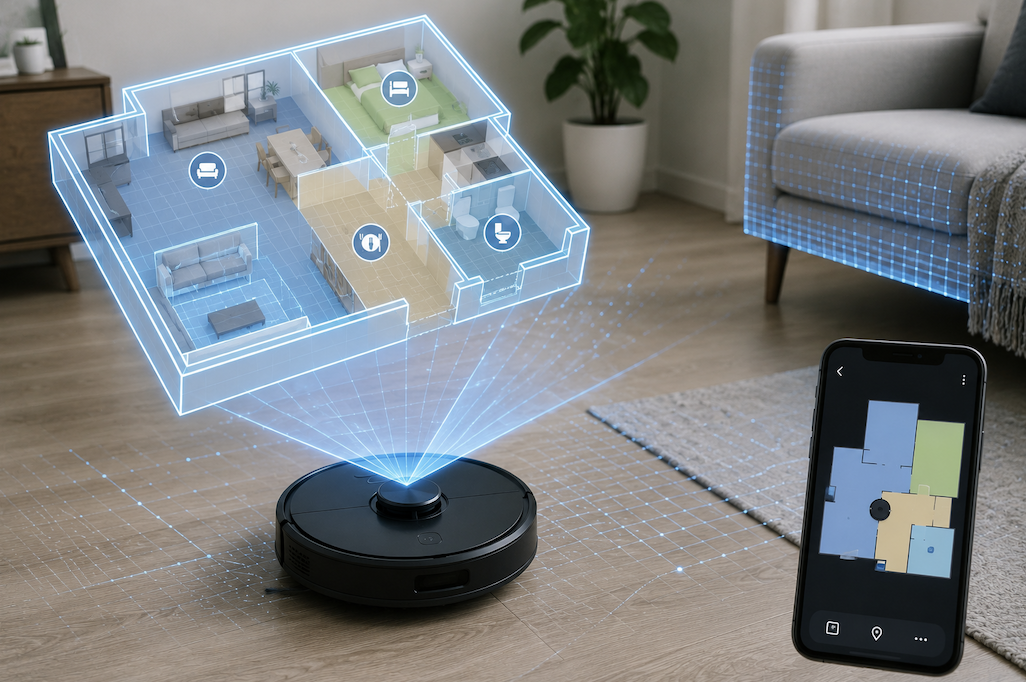
Watching a robot vacuum methodically clean a room in neat, efficient rows, rather than bumping around randomly, reveals genuinely sophisticated technology working behind that unassuming little disc. Modern robot vacuums build detailed maps of your home, allowing them to clean efficiently and avoid obstacles intelligently. This article explains exactly how these devices manage to map and navigate your space.
How Early Robot Vacuums Navigated Without Mapping
Early generations of robot vacuums lacked genuine mapping capability, instead relying on a random, bump-and-turn navigation approach, colliding gently with obstacles and changing direction repeatedly until they had, in theory, covered most of a room through sheer repetition. This approach worked reasonably well for basic cleaning but was genuinely inefficient, often missing spots or repeatedly covering the same areas unnecessarily.
Modern robot vacuums have moved considerably beyond this random approach, using genuine spatial mapping technology to navigate methodically and efficiently, similar in concept to how a person might clean a room in organized, systematic rows.
The Core Sensor Technology Used for Modern Mapping
Modern robot vacuums typically rely on one or more specific sensor technologies to build an accurate map of your home’s layout, each with distinct advantages.
- Lidar sensors spin continuously, sending out laser pulses to measure distances and map room boundaries precisely
- Camera-based systems use visual recognition to identify landmarks and build a spatial map
- Some models combine multiple sensor types for more robust, reliable mapping accuracy
- Infrared and other proximity sensors help detect nearby obstacles the primary mapping sensor might miss
Lidar-based systems, which use the same fundamental laser distance measuring principle found in some self-driving car sensors, tend to offer particularly accurate and reliable mapping, since they work consistently regardless of lighting conditions, unlike camera-based systems that can struggle in low light.
How the Robot Actually Builds a Map During Its First Cleaning Run
During an initial cleaning session in a new space, the robot vacuum continuously takes distance and position measurements as it moves, gradually piecing together an increasingly accurate map of walls, furniture, and obstacles. This process, often called simultaneous localization and mapping, allows the device to understand both where it is located and what its surrounding environment looks like at the same time.
- The robot continuously measures distances to walls, furniture, and obstacles as it moves
- These measurements gradually combine into an increasingly accurate map of the space
- The device simultaneously tracks its own position within this developing map
- Subsequent cleaning sessions can reference and refine this previously built map
This is exactly why robot vacuums often navigate somewhat less efficiently during their very first cleaning session in a new space, since they are simultaneously exploring and mapping the environment for the first time, before settling into more efficient, methodical patterns during future cleaning sessions.
How Robot Vacuums Handle Multiple Rooms and Floors
More advanced robot vacuum models can recognize and remember distinct rooms within your home, allowing you to direct cleaning toward specific areas rather than requiring a full-home cleaning cycle every time. Many models also support saving multiple separate maps, allowing the same device to maintain accurate navigation across different floors of a multi-level home.
- Room recognition allows targeted cleaning of specific areas rather than the entire home
- Multiple saved maps allow accurate navigation across different floors or living spaces
- Virtual boundaries can often be set within the app to keep the robot away from specific areas
- Maps can typically be manually edited or renamed for easier reference within the companion app
Practical Tips for Getting the Most Accurate Mapping
- Allow the robot to complete a full, uninterrupted initial cleaning cycle to build an accurate map
- Avoid moving furniture significantly between cleanings, since this can confuse existing map data
- Clear the floor of loose cables or small objects during the initial mapping run for best accuracy
- Use the companion app to review and manually correct any obvious mapping errors after the first run
How Robot Vacuums Decide Which Cleaning Path to Actually Take
Beyond simply building a map, a robot vacuum’s onboard software has to make genuinely intelligent decisions about the most efficient order and pattern for actually cleaning the mapped space. Rather than cleaning rooms in a random or arbitrary order, modern systems typically calculate an efficient path that minimizes unnecessary
backtracking and ensures thorough coverage of the entire mapped area.
This path planning has to account for numerous practical factors simultaneously, including furniture placement, doorways connecting different rooms, and areas that may require special attention, like heavily trafficked zones that tend to accumulate more dust and debris. The result is the methodical, row-by-row cleaning pattern many people notice once their robot vacuum has completed its initial mapping run, a considerable improvement over the inefficient, random coverage of earlier generations.
- Modern systems calculate efficient cleaning paths rather than following random movement patterns
- Path planning accounts for furniture placement, doorways, and connections between different rooms
- Some systems identify heavily trafficked areas that may benefit from more thorough, repeated cleaning
- This intelligent path planning significantly improves cleaning efficiency compared to earlier generations
Final Thoughts
Robot vacuums have moved well beyond the random bump-and-turn navigation of earlier generations, now relying on genuinely sophisticated sensor technology to build detailed, accurate maps of your home. Understanding how this mapping process actually works helps explain both why that first cleaning run sometimes feels less efficient and why subsequent cleanings tend to become noticeably more methodical and thorough over time.
Frequently Asked Questions
1. Does a robot vacuum need internet access to build a map?
The actual mapping and navigation typically happens using onboard sensors and processing, though many models use an internet connection to sync maps with a companion app for viewing and adjusting settings remotely.
2. Why does my robot vacuum sometimes get stuck or seem confused?
This can happen if furniture has moved significantly since the map was built, if lighting conditions affect a camera-based system, or if an obstacle was not accurately captured during the initial mapping process.
3. Can a robot vacuum map more than one floor of my house?
Many modern models support saving multiple separate maps, allowing the device to maintain accurate, distinct navigation data for different floors or areas of a multi-level home.
4. Do all robot vacuums use the same mapping technology?
No, different models use different combinations of lidar, camera-based vision, and other sensors, which meaningfully affects mapping accuracy, cost, and how well each specific device performs in varying lighting conditions.