Security advice consistently recommends long, complex, unique passwords for every account, yet this advice often feels genuinely impractical for anyone trying to actually remember dozens of these passwords without writing them down somewhere insecure. Fortunately, there are legitimate approaches to creating passwords that are both genuinely strong and realistically memorable. This article walks through practical, effective strategies for doing exactly that.
Why Traditional Password Advice Often Fails in Practice
Common password advice, mixing random uppercase letters, numbers, and symbols into a short string, technically creates strong passwords in theory, but in practice, this approach often backfires. Passwords like this are genuinely difficult to remember, leading many people to either write them down insecurely, reuse them across multiple accounts, or choose predictable patterns that undermine the intended security benefit entirely.
Understanding why length actually matters more than complexity for password strength helps explain a more practical, sustainable approach to creating passwords you can genuinely remember without compromising security.
Why Length Matters More Than Complexity
From a pure mathematical security perspective, a longer password is generally significantly harder to crack than a shorter, more complex one, even if that longer password uses only simple, memorable words. This is because the total number of possible character combinations grows exponentially with each additional character, meaning length provides an outsized security benefit compared to complexity alone.
- A longer password with simple words can be mathematically stronger than a short, complex one
- Each additional character exponentially increases the total number of possible combinations
- This means a memorable passphrase can offer genuinely strong security without complex, hard-to-recall characters
- Complexity still matters, but length provides the larger overall security benefit
The Passphrase Approach to Creating Memorable Strong Passwords
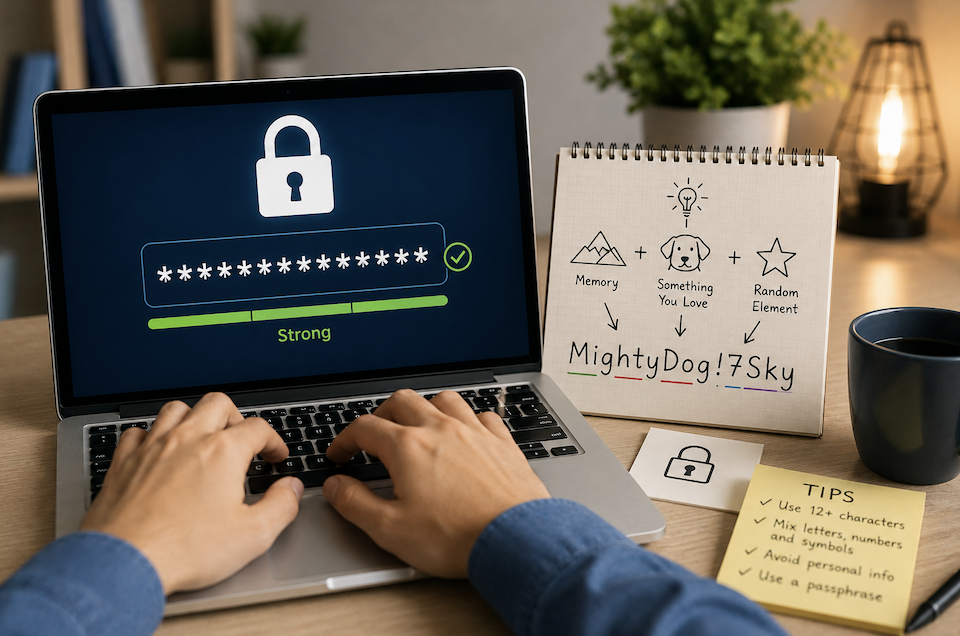
A passphrase approach involves stringing together several unrelated, memorable words rather than relying on a single, shorter word with substituted symbols and numbers. This creates a password that is both genuinely long and therefore mathematically strong, while remaining considerably easier for you to actually recall compared to a short, complex string of random characters.
- Choose four or more unrelated words rather than a single word with symbol substitutions
- Avoid common phrases, song lyrics, or predictable word combinations that attackers might anticipate
- Consider adding a number or symbol somewhere within the phrase for additional strength
- Create a personal, meaningful association with the specific word combination to aid memory
For example, a passphrase combining several unrelated, randomly chosen words creates something genuinely difficult for an attacker to guess through common cracking techniques, while remaining considerably easier for you to remember than a short jumble of random characters and symbols.
Why You Still Need a Password Manager Regardless
Even with a strong passphrase approach, remembering a genuinely unique passphrase for every single account you use remains impractical for most people. This is exactly why security experts still recommend using a password manager for the vast majority of your accounts, reserving your memorized passphrase specifically for your password manager’s own master password and perhaps a small handful of other critical accounts.
- Use your strong, memorable passphrase specifically for your password manager’s master password
- Let the password manager generate and store genuinely random, unique passwords for other accounts
- This combines the best of both approaches: memorability where it matters and maximum randomness elsewhere
- You only need to actually remember one strong passphrase using this combined approach
Common Password Mistakes Worth Avoiding
- Reusing the same password, or minor variations of it, across multiple different accounts
- Using easily guessable personal information, like birthdays or pet names, within your passwords
- Choosing predictable patterns, like sequential numbers or keyboard patterns, that attackers commonly test
- Writing passwords down in easily accessible, insecure locations like sticky notes on your monitor
How Attackers Actually Try to Crack Passwords in Practice
Understanding how password cracking actually works in practice helps explain why the length-focused passphrase approach genuinely holds up against real-world attacks. Attackers typically use automated tools that systematically try enormous numbers of possible password combinations, often starting with commonly used passwords, known leaked passwords from previous breaches, and predictable patterns before moving to more exhaustive, brute-force attempts.
A longer passphrase, even one built from ordinary words, dramatically increases the total number of combinations an attacker’s tool would need to work through, since the total possibility space grows exponentially with each additional character. Combined with the fact that an unusual, personally chosen combination of unrelated words is unlikely to appear in any precompiled list of common passwords, this approach genuinely holds up well against the actual techniques attackers use in real password cracking attempts.
- Automated cracking tools typically start with common passwords and known leaked password lists
- A longer passphrase dramatically increases the total combinations an attacker’s tool must work through
- Unusual, personally chosen word combinations are unlikely to appear in precompiled common password lists
- This combination of length and uniqueness genuinely holds up against real-world cracking techniques
Final Thoughts
Creating a strong password does not require an unmemorable jumble of random characters and symbols. A thoughtful passphrase approach, combined with a password manager for your remaining accounts, offers genuinely strong security without the impractical memory burden that traditional password advice often creates, making good password hygiene something you can actually maintain consistently over time.
Frequently Asked Questions
1. Is a passphrase really more secure than a short, complex password?
Generally yes, since the added length of a multi-word passphrase provides a greater mathematical security benefit than the added complexity of a shorter password packed with symbols and substitutions.
2. How many words should a strong passphrase actually contain?
Most security experts recommend at least four unrelated words for a genuinely strong passphrase, though adding additional words further increases the overall security strength.
3. Do I still need to change my passwords regularly if I use strong passphrases?
Regularly scheduled password changes matter less than they once did, as long as your passwords are genuinely strong and unique per account, though you should always change a password immediately if that specific account was involved in a data breach.
4. Is it safe to use a passphrase made of common, everyday words?
Yes, as long as the specific combination is unique and not a commonly used phrase or predictable pattern, since attackers typically rely on cracking tools that test length and complexity rather than judging word familiarity alone.