
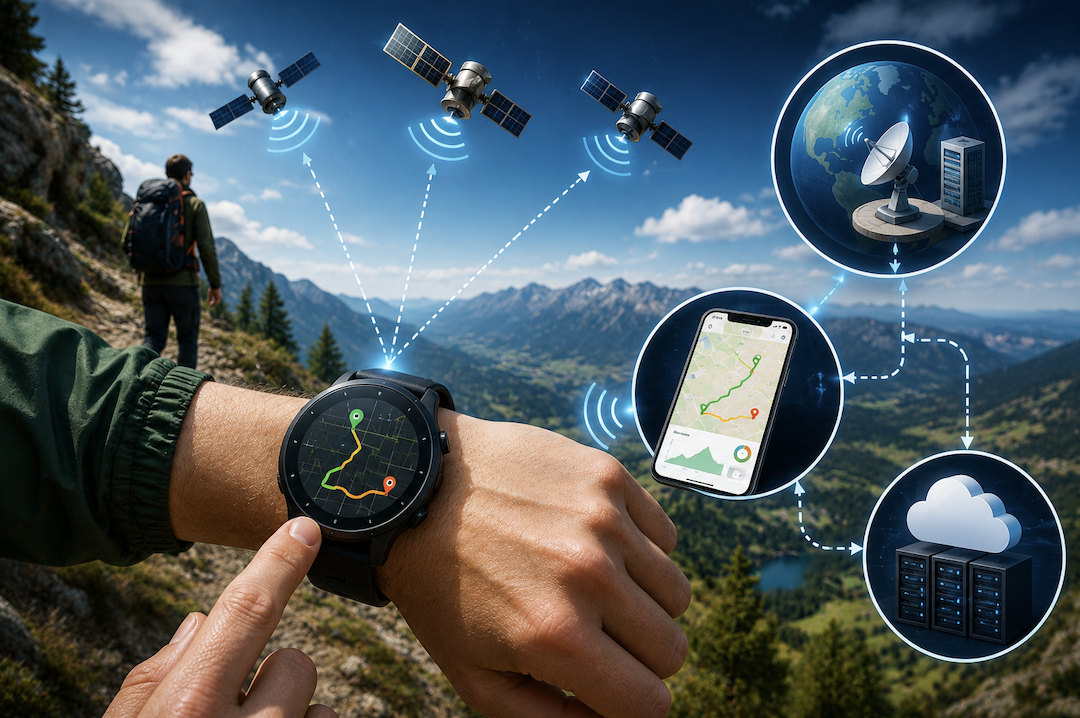
Glancing at your wrist mid-run and seeing an accurate map of the route you just covered, along with your exact pace and distance, relies on a remarkably sophisticated satellite-based positioning system packed into a device small enough to wear comfortably on your wrist. Understanding how GPS tracking actually works on a smartwatch reveals genuinely impressive engineering happening in a device most people take entirely for granted during their daily workouts.
What GPS Actually Is and How It Fundamentally Works
GPS, short for Global Positioning System, relies on a network of satellites orbiting Earth, each continuously broadcasting signals containing precise timing and positioning information. A GPS receiver, like the one built into your smartwatch, captures signals from multiple satellites simultaneously and calculates its own exact position based on how long each signal took to arrive.
This calculation relies on a principle called trilateration, using the precise timing differences between signals received from at least three or four different satellites to mathematically determine your exact location on Earth’s surface. The more satellites your device can successfully receive signals from, the more accurate this positioning calculation typically becomes.
- GPS satellites continuously broadcast precise timing and positioning signals
- Your smartwatch’s GPS receiver captures signals from multiple satellites simultaneously
- Trilateration calculations use timing differences between these signals to determine exact location
- Receiving signals from more satellites generally improves overall positioning accuracy
How a Smartwatch Actually Fits This Technology Into Such a Small Device
Packing genuine GPS receiving capability into a device as small as a smartwatch represents a significant engineering achievement, since early GPS receivers were considerably larger and more power-hungry than
what modern smartwatches now accomplish in a device worn comfortably on your wrist.
Modern smartwatch GPS chips have become dramatically more power-efficient and physically compact, allowing manufacturers to include this capability without requiring an impractically large battery or device size. This miniaturization has been a genuinely important factor enabling smartwatches to offer standalone GPS tracking without needing to remain tethered to a paired smartphone for location data.
- Modern GPS chips have become significantly smaller and more power-efficient over time
- This miniaturization allows standalone GPS tracking without requiring a constantly paired smartphone
- Battery efficiency remains a genuine ongoing engineering challenge, since GPS tracking consumes meaningful power
- Continuous GPS use during a workout typically has a noticeably larger impact on battery life than everyday standby use
Why GPS Accuracy Can Vary in Different Environments
GPS accuracy is not consistent across every environment, and understanding why helps explain occasionally inconsistent tracking results you might notice during certain activities or locations.
- Open outdoor areas with a clear view of the sky generally provide the most accurate GPS positioning
- Dense urban environments with tall buildings can cause signal reflection and interference, reducing accuracy
- Heavy tree cover or indoor locations can block or weaken GPS signals considerably
- Weather conditions can occasionally affect signal quality, though modern receivers handle this reasonably well
This is exactly why GPS tracking during a run through a dense city with tall buildings might show a less precisely accurate route compared to the same run through an open park or rural area with a clear, unobstructed view of the sky.
How Smartwatches Combine GPS With Other Sensors for Better Accuracy
Many modern smartwatches do not rely purely on GPS positioning alone, instead combining it with additional sensor data to improve overall tracking accuracy, particularly in challenging environments where GPS signals alone might be less reliable.
- Accelerometer data helps track movement patterns even during brief GPS signal interruptions
- Gyroscope data provides additional information about direction and orientation changes
- Some watches combine multiple satellite positioning systems beyond just the original GPS network for improved accuracy
- This sensor fusion approach helps smooth out temporary GPS accuracy issues during a tracked activity
This combination of multiple data sources represents a similar underlying principle to how other complex tracking systems work, using several complementary data sources together to produce a more accurate, reliable result than any single sensor could achieve entirely on its own.
Why GPS Tracking Meaningfully Affects Battery Life
Continuous GPS tracking during a workout represents one of the more power-intensive features a smartwatch regularly performs, since maintaining an active connection to multiple satellites and continuously calculating position requires more power than the device’s typical standby operations.
- GPS tracking during an activity typically consumes noticeably more battery than standby smartwatch use
- Longer activities, like extended hikes or long-distance runs, place greater cumulative demand on battery life
- Some watches offer reduced-accuracy GPS modes specifically designed to extend battery life during longer activities
- Understanding this trade-off helps you choose appropriate settings for particularly long planned activities
Practical Tips for Getting the Most Accurate GPS Tracking
- Allow your smartwatch a brief moment to establish a GPS signal lock before beginning your activity
- Choose open outdoor areas with clear sky visibility when accuracy is particularly important
- Keep your smartwatch’s software updated, since GPS performance improvements are sometimes included in updates
- Consider a reduced-accuracy GPS mode for very long activities where extending battery life matters more than maximum precision
- Be aware that tracking accuracy may be somewhat reduced in dense urban areas or under heavy tree cover
How Multiple Satellite Systems Have Improved GPS Accuracy
While the term GPS technically refers specifically to the original American satellite positioning system, many modern smartwatches actually receive signals from multiple independent satellite networks operated by different countries, combining this additional data to achieve meaningfully improved accuracy and faster initial positioning compared to relying on a single satellite system alone.
This multi-system approach means a modern smartwatch can potentially receive signals from a considerably larger total number of satellites at any given moment, since it is not limited exclusively to the original GPS constellation. More available satellite signals generally translate into faster initial position acquisition when you begin an activity, along with improved accuracy in more challenging environments where a clear view of enough satellites from any single system might otherwise be limited.
- Modern smartwatches often support multiple independent satellite positioning systems simultaneously
- This multi-system approach provides access to a larger total number of available satellites
- Faster initial position acquisition and improved accuracy in challenging environments both benefit from this approach
- Not every smartwatch model supports every available satellite system, so checking specific device capabilities is worthwhile
Final Thoughts
GPS tracking on a smartwatch combines genuinely sophisticated satellite positioning technology with additional sensor data, all packed into a remarkably small, power-efficient device worn comfortably on your wrist. Understanding how this technology actually works, including why accuracy varies by environment and why it affects battery life, helps you get more reliable tracking results and set realistic expectations for this genuinely impressive everyday feature.
As satellite positioning chips continue becoming smaller, more accurate, and more power-efficient, it is reasonable to expect smartwatch GPS tracking to keep improving in both precision and battery impact over the coming years, further narrowing the gap between what a wrist-worn device can achieve and what previously required considerably larger, dedicated GPS hardware to accomplish reliably.
Frequently Asked Questions
1. Does my smartwatch need to be paired with my phone for GPS tracking to work?
Many modern smartwatches include standalone GPS capability that works independently without requiring a paired smartphone nearby, though some older or more basic models may rely on the phone’s GPS instead of including their own dedicated chip.
2. Why does my GPS tracked route sometimes look inaccurate on a map?
This typically results from temporarily weakened or interrupted GPS signals, often caused by dense urban environments, heavy tree cover, or tall buildings interfering with a clear line of sight to enough satellites for accurate positioning.
3. How much does GPS tracking actually affect my smartwatch’s battery life?
Continuous GPS use during an activity typically has a considerably more noticeable impact on battery life compared to normal standby use, which is why many watches offer specific battery life estimates for GPS tracking mode separately from typical daily use.
4. Can GPS tracking work indoors?
Generally no, since GPS relies on receiving satellite signals that require a reasonably clear line of sight to the sky, meaning indoor GPS accuracy is typically poor or nonexistent, which is why indoor workouts usually rely on other sensors instead.
5. Is smartwatch GPS as accurate as dedicated GPS devices?
Modern smartwatch GPS has become quite accurate for most everyday fitness tracking purposes, though dedicated, specialized GPS devices designed for professional or highly precise applications may still offer marginally better accuracy in certain demanding situations.