Watching a car navigate traffic without a driver actively steering can feel like something out of science fiction, yet self driving technology is already being tested and deployed on real roads today. Behind that seemingly effortless movement sits an incredibly sophisticated array of sensors working together every fraction of a second. This article breaks down exactly how those sensors allow a self driving car to actually perceive and navigate the world around it.
The Core Sensor Types Self-Driving Cars Rely On
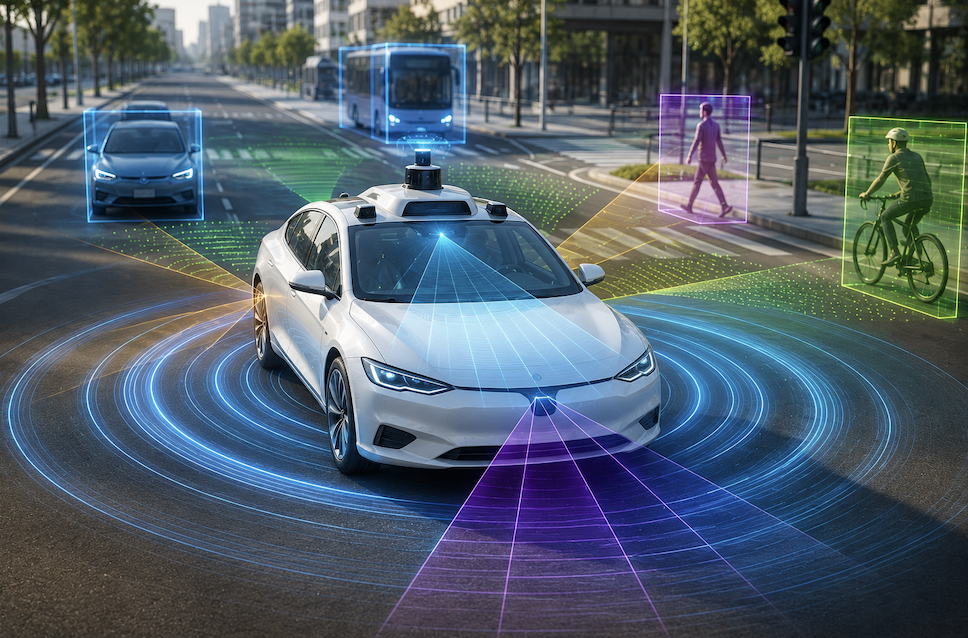
Self driving cars do not rely on a single sensor to understand their surroundings. Instead, they combine several different sensor types, each with its own strengths and weaknesses, to build a more complete and reliable picture of the environment.
- Cameras capture detailed visual information, similar to human eyes, helping identify traffic signs, lane markings, and pedestrians
- Radar uses radio waves to detect the distance and speed of nearby objects, working reliably even in poor weather conditions
- Lidar sends out rapid pulses of laser light to create a highly precise, three dimensional map of the surrounding environment
- Ultrasonic sensors detect close range objects, commonly used for parking assistance and low speed maneuvering
Each sensor type compensates for the limitations of the others, which is why self driving systems rely on multiple sensors working together rather than trusting any single source of information alone.
How Lidar Creates a 3D Picture of the Road
Lidar, short for light detection and ranging, works by emitting rapid pulses of laser light and measuring exactly how long each pulse takes to bounce back after hitting an object. By calculating this timing across millions of pulses per second, the system builds an extremely detailed three dimensional map of everything around the vehicle, including the exact distance to nearby cars, pedestrians, curbs, and obstacles.
This spinning or scanning process happens continuously, creating what is often called a point cloud, essentially a dense collection of data points that represents the physical shape of the surrounding environment in real time.
How Cameras and Radar Add Essential Context
While lidar excels at measuring precise distance and shape, it does not naturally understand color, text, or context the way a camera does. Cameras fill this gap by identifying traffic light colors, reading road signs, and recognizing lane markings, information that lidar alone cannot easily interpret.
Radar, meanwhile, plays a crucial role in tracking the speed and movement of surrounding vehicles, and it continues working reliably in fog, heavy rain, or low light conditions where cameras and even lidar can struggle to perform accurately.
- Cameras: best for recognizing colors, signs, lane lines, and pedestrians
- Radar: best for tracking object speed and functioning reliably in bad weather
- Lidar: best for precise distance measurement and detailed 3D mapping
How the Car’s Computer Combines All This Sensor Data
All of this raw sensor information gets fed into the vehicle’s onboard computer, which uses a process called sensor fusion to combine the different data streams into a single, unified understanding of the surrounding environment. This fused data is then processed by software trained to recognize objects, predict their movement, and make driving decisions accordingly.
This entire process, from sensing to decision making, happens continuously many times per second, allowing the vehicle to react to sudden changes, like a pedestrian stepping into the road, almost instantly.
The Real Challenges These Sensors Still Face
- Heavy rain, snow, or fog can still reduce the accuracy of cameras and, to a lesser extent, lidar
- Unusual or unpredictable objects on the road can sometimes confuse object recognition systems
- Sensor calibration must remain precise, since even small misalignments can affect accuracy significantly
- Processing enormous volumes of sensor data in real time requires substantial onboard computing power
How Manufacturers Test and Validate These Sensor Systems
Before a self driving sensor system is trusted on public roads, it goes through an extensive, multi stage testing process designed to catch weaknesses well before they become real world safety concerns. This typically begins with simulated environments, where engineers can test how the system responds to millions of virtual scenarios, including rare, unusual situations that would be difficult or dangerous to recreate physically.
After simulation, systems move to closed test tracks, where engineers can safely recreate real world conditions like sudden pedestrian crossings or unexpected obstacles in a controlled environment. Only after extensive closed course testing do these systems progress to supervised real world testing, typically with a trained safety driver ready to intervene if the sensors or software behave unexpectedly.
- Simulation testing exposes the system to millions of scenarios, including rare edge cases
- Closed track testing recreates real world conditions safely before public road exposure
- Supervised real world testing includes a trained safety driver ready to intervene if needed
- Continuous data collection from deployed vehicles helps refine and improve sensor performance over time
This layered testing approach reflects just how seriously manufacturers treat sensor reliability, since even a rare edge case failure could have serious consequences once these vehicles operate among other drivers and pedestrians on public roads.
Final Thoughts
Self driving car sensors represent an impressive blend of physics, engineering, and computing working together in real time. By combining cameras, radar, lidar, and ultrasonic sensors, these vehicles build a remarkably detailed and reliable picture of their surroundings, laying the groundwork for a technology that continues to advance year after year.
Frequently Asked Questions
1. Do self-driving cars rely on just one type of sensor?
No, they combine multiple sensor types, typically cameras, radar, lidar, and ultrasonic sensors, since each one compensates for the limitations of the others to create a more reliable overall picture.
2. Can self-driving car sensors work well in bad weather?
Radar performs reliably in poor weather, while cameras and lidar can be somewhat affected by heavy rain, snow, or fog, which is exactly why combining multiple sensor types matters so much for safety.
3. What is sensor fusion in self-driving cars?
Sensor fusion is the process of combining data from multiple different sensors into a single, unified understanding of the environment, allowing the vehicle’s computer to make more accurate and reliable driving decisions.
4. How fast do these sensors actually process information?
Extremely fast, often processing and updating their understanding of the environment many times per second, allowing the vehicle to react to sudden changes almost instantly.