
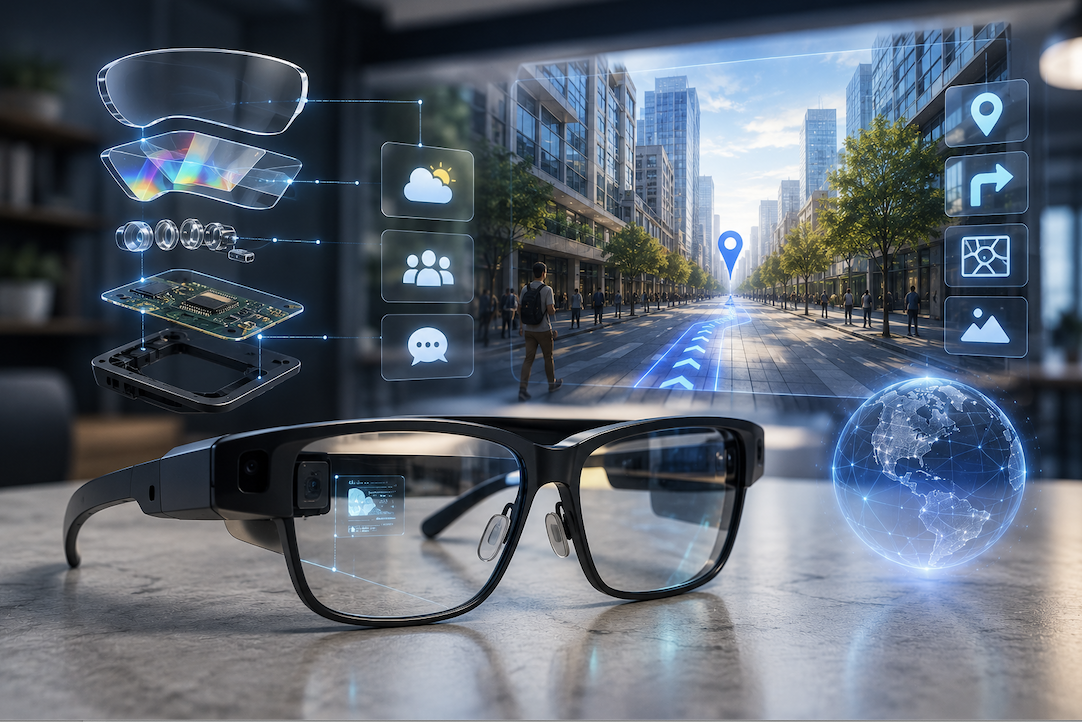
Smart glasses that overlay digital information directly onto your view of the real world have moved from science fiction concept to genuine, if still evolving, consumer product category. Augmented reality glasses represent a fundamentally different approach to displaying digital content compared to a phone or computer screen. This article explains what AR glasses actually are and how the underlying technology works.
What AR Glasses Actually Do Differently
Augmented reality glasses overlay digital content, such as text, images, or interactive elements, directly onto your natural view of the physical world, rather than replacing that view entirely the way virtual reality headsets do. This means you can see digital directions overlaid on the actual street in front of you, or a notification appearing to float in your field of vision, all while still seeing and interacting with your real surroundings normally.
This distinction from virtual reality matters significantly, since AR glasses are designed to enhance and supplement your perception of the real world, while VR is designed to fully replace it with an entirely simulated environment.
How AR Glasses Actually Display Digital Content
Creating the illusion of digital content appearing within the real world requires genuinely sophisticated optical engineering. Most AR glasses use small projectors combined with specialized lenses or waveguides that direct light into your eyes in a way that overlays convincingly onto your natural vision.
- A small built-in projector generates the digital image content to be displayed
- Specialized waveguide lenses direct this projected light precisely into your field of view
- The system must calculate correct positioning so digital content appears anchored realistically
- Sensors track your head movement to keep digital content properly positioned as you move
This waveguide technology, which channels light through the lens material itself before directing it toward your eye, is one of the most technically challenging aspects of AR glasses, since it needs to remain lightweight and reasonably transparent while still accurately projecting digital content.
How AR Glasses Understand the World Around You
For digital content to appear convincingly anchored to real-world objects and surfaces, AR glasses need to understand the physical space around you in real time. This typically involves cameras and depth sensors that continuously map your surroundings, identifying surfaces, distances, and objects.
- Built-in cameras continuously capture and analyze your physical surroundings
- Depth sensors help the system understand distances and the three-dimensional layout of a space
- This spatial understanding allows digital content to appear convincingly anchored to real surfaces
- Continuous tracking keeps this alignment accurate even as you move around
This spatial mapping capability is what allows a virtual object to appear to sit convincingly on your actual desk, or a navigation arrow to appear to point down the actual street in front of you, rather than simply floating disconnected from your real environment.
Real-World Applications Beyond Simple Notifications
- Navigation systems that overlay turn-by-turn directions directly onto your view of the street
- Industrial and repair applications that overlay instructional diagrams onto actual equipment
- Language translation that overlays translated text directly over foreign language signs
- Remote assistance, allowing an expert to see what you see and annotate it in real time
- Retail applications that let you visualize how furniture or products would look in your actual space
The Genuine Challenges AR Glasses Still Face
- Battery life remains limited given the power demands of continuous sensing and display
- Achieving a genuinely lightweight, comfortable form factor while including all necessary hardware is difficult
- Field of view, meaning how much of your vision the digital overlay actually covers, remains limited on many devices
- Cost remains relatively high compared to established, mature technology categories
How AR Glasses Compare to Using a Phone for Augmented Reality
Many phones already support basic augmented reality experiences through their cameras and screens, raising a reasonable question about what dedicated AR glasses genuinely add beyond what a phone can already do. The core advantage comes down to hands-free, continuous use, since holding a phone up to view augmented content is inherently limiting compared to glasses that provide this overlay naturally as you go about normal activities.
Phone based AR also requires actively pointing your camera at whatever you want to view augmented, breaking the experience into deliberate, separate moments rather than the continuous, ambient overlay that dedicated glasses aim to provide. This distinction matters considerably for applications like navigation or hands-on repair work, where continuously holding up a phone would be genuinely impractical compared to glasses that keep relevant information in view automatically.
- Phone based AR requires actively holding up and pointing a device at your surroundings
- Dedicated AR glasses aim to provide continuous, hands-free augmented overlay throughout normal activity
- This distinction matters significantly for practical, hands-on applications like repair work or navigation
- Both approaches will likely continue coexisting, serving somewhat different practical use cases
Final Thoughts
AR glasses combine sophisticated optical engineering, spatial sensing, and real-time tracking to overlay digital content convincingly onto your view of the physical world. While genuine technical challenges around comfort, battery life, and cost remain, understanding how the underlying technology actually works helps explain both its impressive current capabilities and the meaningful hurdles still standing between today’s devices and truly mainstream, everyday adoption.
- You May Want to Know Inmo Air 3 vs. RayNeo X3 Pro: Which Smart Glasses Actually Make Life Smarter?
Frequently Asked Questions
1. Is AR the same thing as VR?
No, augmented reality overlays digital content onto your view of the real world while keeping you aware of your actual surroundings, while virtual reality replaces your entire field of vision with a fully simulated environment.
2. Do AR glasses need to be connected to a phone to work?
Some AR glasses require a paired smartphone to handle processing, while increasingly, standalone models include their own onboard processing power, though this generally comes with trade-offs in battery life and weight.
3. Can AR glasses actually see and understand what I am looking at?
Yes, through built-in cameras and depth sensors, AR glasses continuously analyze your physical surroundings to accurately position digital content and, in some cases, provide contextual information about what is in view.
4. Why haven’t AR glasses become as mainstream as smartphones yet?
Current limitations around battery life, comfortable form factor, field of view, and cost have all slowed mainstream adoption, though the underlying technology continues improving with each new generation of hardware.