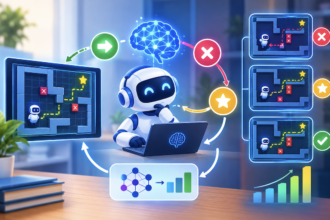

Generative AI has quickly moved from an advanced research topic to something millions of people use every day. You might use it to write an email, create an image, summarise a document, generate computer code, analyse data, or brainstorm business ideas.
But how does it actually work?
When you type a question into an AI chatbot and receive a detailed answer within seconds, it can feel almost magical. In reality, generative AI is built on complex mathematical models, enormous amounts of training data, and powerful computing systems. It does not think exactly like a human, and it does not simply search the internet and copy an answer. Instead, it learns patterns from data and uses those patterns to generate new content.
Understanding what generative AI is and how it works is useful for more than satisfying curiosity. It helps you use AI tools more effectively, recognise their limitations, protect your privacy, and understand why AI sometimes produces impressive results and sometimes makes confident mistakes.
Let’s break it down step by step in simple language.
What Is Generative AI?
Generative AI is a type of artificial intelligence that can create new content based on instructions, examples, or other input provided by a user.
The content can include:
- Text
- Images
- Audio
- Music
- Video
- Computer code
- 3D models
- Synthetic data
Traditional software usually follows a fixed set of instructions. For example, a calculator receives numbers and performs a mathematical operation according to a programmed rule. Generative AI works differently. It learns patterns from large collections of data and uses those learned patterns to produce new outputs.
Imagine showing a system millions of examples of written language. Over time, it can learn relationships between words, sentences, topics, grammar, and styles. When you later ask it to write an explanation, it generates a response based on the patterns it has learned.
The same general idea applies to image generation. An AI model can be trained on large numbers of images and learn patterns related to shapes, objects, colours, textures, and visual styles. When a user provides a prompt, the model generates an image that matches the relationships it learned.
This does not mean the AI has human understanding or imagination in the same way people do. It is better to think of generative AI as a highly advanced pattern-learning system that can produce remarkably sophisticated results.
How Does Generative AI Work?
To understand how generative AI works, it helps to look at the process in stages.
Most modern generative AI systems involve:
- Collecting and preparing data
- Training a machine learning model
- Learning patterns and relationships
- Receiving an input or prompt
- Processing the input
- Generating a response
- Improving the output through additional techniques
The exact process differs depending on the type of AI model. A chatbot, image generator, and music-generation system do not work in precisely the same way. However, the basic principle is similar: the model learns patterns from data and uses those patterns to generate something new.
For example, suppose you ask an AI system:
“Explain climate change to a 10-year-old.”
The system analyses the words in your request, identifies the topic and desired level of complexity, and generates a response that matches the instructions. It does not have a little database entry labelled “answer to this exact question”. Instead, it creates a new response using the patterns and information represented in its model.
This is why the same prompt can produce different answers at different times, especially when the system is designed to introduce variation.
Step 1: Generative AI Learns From Large Amounts of Data
Before a generative AI model can create useful content, it must first be trained.
Training involves exposing the model to large datasets. Depending on the purpose of the system, this data may include text, images, audio, video, code, or combinations of these.
For a language model, the training data might contain examples of:
- Books
- Articles
- Websites
- Documentation
- Public discussions
- Educational material
- Code
The model does not simply read this information like a person reading a book. Instead, the data is converted into a format that a computer can process mathematically.
The model then looks for patterns. It may learn that certain words often appear together, that particular sentence structures are common, or that a question is usually followed by a certain type of response.
For example, consider the sentence:
“The sun rises in the ___.”
A model may learn that “east” is a highly likely answer because it has encountered many examples of this relationship in its training data.
With more complex examples, the model can learn relationships between language, ideas, context, style, and meaning. The process requires enormous amounts of computing power, which is one reason advanced AI models can be expensive to develop.
However, training data is not the same as perfect knowledge. Data can be incomplete, outdated, biased, inaccurate, or contradictory. This is one of the reasons generative AI systems can produce incorrect information.
Step 2: The Data Is Converted Into Tokens
A key part of understanding how generative AI works is understanding tokens.
AI models do not process language exactly as humans do. Text is broken into smaller pieces called tokens. A token may be a complete word, part of a word, punctuation, or another text fragment.
For example, a sentence such as:
“Generative AI creates new content.”
might be broken into several tokens.
The exact tokenisation depends on the model and language. A short common word may be represented as one token, while a longer or less common word may be divided into several pieces.
Why does this matter?
Because the AI model processes these tokens mathematically. It analyses the relationships between them and uses those relationships to predict what should come next.
When you ask a chatbot a question, your prompt is converted into tokens. The model processes those tokens and generates additional tokens one by one until it produces a complete answer.
This is a simplified explanation, but it captures an important idea: a language model generates text by making a sequence of predictions based on context.
Step 3: Neural Networks Learn Patterns
Generative AI systems usually rely on neural networks, a type of machine learning technology inspired loosely by the way biological brains process information.
Artificial neural networks contain layers of mathematical operations. During training, the model adjusts enormous numbers of internal values, often called parameters or weights.
These values help the model represent relationships within the data.
For example, a language model may gradually learn relationships between:
- Words and their meanings
- Grammar and sentence structure
- Questions and possible answers
- Concepts and related concepts
- Programming commands and their functions
- Different writing styles
The model does not store every piece of knowledge in the same way a traditional database stores a record. Instead, information is represented across a vast network of numerical relationships.
This is one reason AI models can generalise. After learning from many examples of writing, the model can produce a sentence it has never seen before.
That ability to generate new combinations is central to generative AI.
What Is a Large Language Model?
A large language model, often called an LLM, is a type of AI model designed to understand and generate human language.
Chatbots that write text, answer questions, summarise information, and generate code often use large language models.
The word “large” generally refers to the scale of the model and the amount of data and computing used during training. Modern language models can contain billions of parameters, although size alone does not automatically guarantee better performance.
A large language model typically works by predicting the next token based on the tokens that came before it.
For example:
“I poured a cup of hot…”
The model may assign a high probability to words such as “tea” or “coffee”, depending on the surrounding context.
But modern models are much more sophisticated than simple autocomplete. They can analyse long instructions, follow formatting requirements, connect related concepts, write code, and adjust their responses to the context of a conversation.
Still, the underlying process remains related to prediction. The model repeatedly selects likely next tokens until it completes the response.
This explains both the strength and weakness of generative AI. The system can produce remarkably natural language, but producing a fluent sentence does not guarantee that the information is factually correct.
The Transformer Architecture Explained Simply
Many modern generative AI systems use an architecture called the Transformer.
The Transformer became important because it allows AI models to process relationships between different parts of a sequence more effectively.
Consider this sentence:
“The dog chased the ball because it was excited.”
To understand the sentence, a model needs to connect “it” with the correct earlier word. Transformers use a mechanism called attention to help the model examine relationships between words and determine which parts of the input are important.
The term “attention” does not mean the AI is consciously paying attention. It is a mathematical technique that helps the model assign different levels of importance to different tokens.
For example, if you ask:
“What are the main benefits of solar energy for homeowners?”
the model needs to understand the relationship between “benefits”, “solar energy”, and “homeowners”. The attention mechanism helps it process these connections.
This ability to consider context is one of the reasons Transformer-based models became so powerful for language and other forms of generative AI.
How Does Generative AI Create Text?
When you type a prompt into an AI chatbot, the text-generation process generally follows a sequence like this:
1. You enter a prompt
For example:
“Write a simple explanation of how electric cars work.”
2. The prompt is converted into tokens
The system breaks your words into units the model can process.
3. The model analyses the context
It considers the words in your prompt and the relationships between them.
4. The model predicts the next token
It calculates possible next tokens and assigns probabilities to them.
5. It selects a token
The model chooses one based on its settings and the probabilities it calculates.
6. The process repeats
The model predicts the next token again and again until the answer is complete.
The final response may appear to have been written all at once, but the generation process happens sequentially.
This also explains why changing a few words in a prompt can significantly change the output. A small change in context can influence the probability of many later tokens.
How Does AI Image Generation Work?
Generative AI is not limited to text. AI image generators use different techniques to create visual content.
Many modern image-generation systems use diffusion models.
The basic idea is relatively simple:
- The model learns visual patterns from training images.
- During training, images may be gradually changed by adding noise.
- The model learns how to reverse this process.
- When generating a new image, it starts with random noise.
- It gradually removes noise while following the user’s instructions.
- A final image emerges.
Suppose you enter:
“A small wooden cabin beside a lake at sunrise, realistic photography.”
The system analyses the text and translates the concepts into numerical representations. It then generates an image that gradually takes shape according to the relationships between the prompt and its learned visual patterns.
The result is not usually a direct copy of one particular training image. It is a newly generated combination of visual patterns.
This is why image generators can create unusual combinations, such as a medieval castle on Mars or a robot cooking in a traditional kitchen.
How Does Generative AI Create Audio and Video?
Audio and video generation follow similar principles but involve additional complexity.
An AI music model may learn relationships between:
- Rhythm
- Melody
- Instruments
- Tempo
- Musical structure
A voice-generation model may learn patterns in speech, including pronunciation, rhythm, tone, and timing.
Video generation is particularly challenging because the system must create individual frames while maintaining consistency over time. If a person appears in a video, their face, clothing, body position, and surroundings should remain reasonably consistent from one frame to the next.
Generative AI is improving rapidly in these areas, but limitations still exist. AI-generated video can sometimes contain strange movements, inconsistent objects, or unrealistic physical behaviour.
The more complex the content, the more difficult it becomes for a model to maintain consistency.
What Is a Prompt, and Why Does It Matter?
A prompt is the instruction or input you give to a generative AI system.
For example:
“Explain email marketing.”
is a basic prompt.
A more detailed prompt might be:
“Explain email marketing to a small business owner in simple English. Use three practical examples and keep the explanation under 500 words.”
The second prompt gives the AI more useful context.
Good prompting is not about using complicated words. It is about clearly explaining what you want.
A useful prompt may include:
- The task
- The audience
- The desired format
- Important context
- Limitations
- Examples
- The expected tone
For instance, a business owner asking AI to create a product description will probably get a better result by explaining the target customer, product features, brand style, and desired length.
The more clearly you communicate the goal, the easier it is for the system to generate a useful result.
Does Generative AI Actually Understand What It Creates?
This is a difficult question, and the answer depends on what we mean by “understand”.
Generative AI can process relationships between words, images, concepts, and other forms of data with remarkable sophistication. It can explain complex subjects, identify patterns, translate languages, and respond to questions.
However, it does not necessarily understand the world in the same way a human does.
A person who understands that fire is dangerous may have physical experiences, emotions, memories, and real-world knowledge connected to that concept. An AI model represents relationships through mathematical patterns.
This difference matters.
An AI can write a convincing explanation about a medical topic without having a body or personal experience of illness. It can describe a historical event without having lived through it. It can write about emotions without experiencing emotions in the human sense.
This is why fluency should not be confused with consciousness or human understanding.
Generative AI can be extremely useful while still having fundamentally different abilities from human intelligence.
What Are the Main Uses of Generative AI?
Generative AI is already used across many industries.
Content Creation
Writers, marketers, and businesses use AI to brainstorm ideas, create outlines, draft content, and adapt writing for different audiences.
A marketing team might use AI to create ten headline ideas before a human editor chooses and improves the strongest option.
Software Development
Developers use generative AI to explain code, suggest solutions, generate boilerplate code, and identify possible errors.
However, generated code still needs to be reviewed. A program can look correct while containing security vulnerabilities or logic errors.
Education
Students and teachers can use AI for explanations, practice questions, study plans, and personalised learning support.
For example, a student struggling with fractions could ask for the same concept to be explained using a simple real-world example.
Customer Service
Businesses use AI systems to answer common questions, summarise customer conversations, and assist support teams.
The best systems usually combine AI with human oversight, especially for complicated or sensitive problems.
Design and Marketing
AI can help generate visual concepts, advertising ideas, product mockups, social media content, and campaign variations.
A small business that cannot afford a large design team may use AI to create early concepts before refining them professionally.
Healthcare Research
Researchers can use AI to analyse scientific information, assist with drug discovery, and identify patterns in large datasets.
This is a high-stakes area, so AI outputs require careful testing and expert review.
A Real-World Example: How a Small Business Might Use Generative AI
Imagine a small online clothing store with one owner and two employees.
The owner needs to launch a new product collection. Traditionally, the team might spend days creating:
- Product descriptions
- Email campaigns
- Social media captions
- Customer FAQs
- Advertising ideas
Generative AI can help create initial drafts in a much shorter time.
The owner might provide product information and ask the AI to create several versions of a product description for different customer groups.
The AI can then help turn the same information into social media posts and an email newsletter.
But the human team still needs to check the work. They must confirm that product claims are accurate, the tone matches the brand, and no important information has been invented.
This is a practical example of the most effective way to use generative AI: not necessarily replacing every person involved, but helping people complete certain tasks faster.
What Are the Benefits of Generative AI?
Generative AI offers several important advantages.
It Can Save Time
Tasks that once took hours can sometimes be completed in minutes.
Creating a first draft, summarising a long document, or generating ideas can become much faster.
It Can Improve Accessibility
People who struggle with writing, language, or technical subjects can use AI to simplify information and communicate more effectively.
Someone can ask for a complicated explanation to be rewritten in simpler language or translated into another language.
It Supports Creativity
AI can help people explore ideas quickly.
A designer can generate several concepts. A writer can brainstorm different story directions. A business owner can explore possible marketing strategies.
The human still decides which ideas are useful.
It Can Personalise Experiences
AI systems can adapt explanations, recommendations, and content to individual needs.
An educational tool, for example, could provide different explanations depending on a student’s level of understanding.
What Are the Limitations and Risks of Generative AI?
Generative AI is powerful, but it is not perfect.
AI Can Produce False Information
One of the most important problems is that AI can generate information that sounds convincing but is incorrect.
This is sometimes called a hallucination.
For example, an AI might invent a source, provide an incorrect statistic, or confidently describe an event that never happened.
The solution is simple but important: verify important information.
AI Can Reflect Bias
If training data contains social, cultural, or historical biases, the model may reproduce some of those patterns.
Developers use different methods to reduce bias, but eliminating it completely is difficult.
Privacy Can Be a Concern
Users should be careful about entering sensitive personal, financial, business, or confidential information into AI tools.
Before using an AI service for confidential work, understand how the provider handles data and whether conversations may be stored or used for improvement.
Copyright Questions Are Complex
Generative AI has created ongoing debates about training data, ownership, originality, and copyright.
The legal rules differ by country and continue to develop. Businesses and creators should pay attention to the laws and policies relevant to their location and industry.
AI Can Encourage Overreliance
If people accept every AI-generated answer without checking it, mistakes can spread quickly.
The strongest approach is to treat AI as a powerful assistant rather than an unquestionable authority.
For foundational information about artificial intelligence, machine learning, and related technologies, the National Institute of Standards and Technology (NIST) AI Risk Management Framework is a useful authoritative resource.
Why Does Generative AI Sometimes Make Mistakes?
A common misconception is that AI makes mistakes only because it lacks enough information.
The reality is more complicated.
A generative AI model is designed to produce likely outputs based on patterns. It is not automatically checking every statement against a perfect, constantly updated database.
If the model has incomplete information, unclear context, conflicting sources, or a question outside its reliable knowledge, it may generate an answer that sounds reasonable but is wrong.
Imagine asking someone to complete a sentence while encouraging them to sound confident, even when they are unsure. The result might be fluent but inaccurate.
This is why AI-generated content should be checked more carefully when accuracy matters.
For everyday brainstorming, a small mistake may be easy to correct. For legal, medical, financial, scientific, or safety-related information, verification is much more important.
Generative AI vs Traditional AI
Traditional AI and generative AI are related, but they often perform different types of tasks.
A traditional AI system might be designed to:
- Detect spam
- Recommend products
- Identify fraud
- Predict demand
- Classify images
Generative AI, on the other hand, creates new content.
For example:
- Traditional AI may identify whether an image contains a cat.
- Generative AI may create a new image of a cat wearing a space helmet.
A recommendation system may predict which product you are likely to buy. A generative AI system may write a personalised product description.
The difference is not always absolute because modern AI systems can combine several capabilities. Still, the key distinction is useful: traditional AI often analyses or predicts, while generative AI creates.
How Businesses Can Use Generative AI Responsibly
Businesses should begin with practical problems rather than adopting AI simply because it is popular.
A good starting point is to identify repetitive tasks that consume time but still benefit from human review.
Examples include:
- Drafting internal documents
- Summarising meetings
- Creating first drafts of marketing content
- Organising information
- Generating customer support suggestions
- Analysing large amounts of text
A sensible implementation process might look like this:
- Identify a specific business problem.
- Test whether AI can genuinely improve the process.
- Create clear rules for privacy and data handling.
- Keep human review where accuracy matters.
- Measure the results.
- Improve the workflow based on real experience.
The goal should not be to use AI everywhere. The goal should be to use it where it provides genuine value.
Common Mistakes People Make When Using Generative AI
Many disappointing AI results are caused by poor instructions rather than a complete failure of the technology.
One common mistake is giving an extremely vague prompt and expecting a highly specific answer.
Another is assuming that the first output is automatically the best one.
A better approach is to treat AI interaction as a process. Start with a clear request, review the result, identify what is missing, and provide additional context.
People also often fail to verify important information. This can be especially dangerous when AI-generated content is used for health, law, finance, education, or business decisions.
Finally, users sometimes try to make AI replace judgement entirely. That is usually a mistake.
The best results come from combining the speed and pattern-processing abilities of AI with human experience, context, responsibility, and critical thinking.
The Future of Generative AI
Generative AI is likely to become more integrated into everyday software.
Instead of always opening a separate chatbot, people may interact with AI inside:
- Word processors
- Email applications
- Design tools
- Search engines
- Business software
- Education platforms
- Customer service systems
AI systems are also becoming more multimodal. This means they can work with several types of information, such as text, images, audio, video, and code.
For example, a future AI assistant might receive a written instruction, analyse a spreadsheet, understand a voice message, inspect an image, and produce a report.
However, the future of AI will not be defined only by better technology. Questions about privacy, reliability, copyright, employment, education, security, and regulation will also become increasingly important.
The most useful question is not simply, “Can AI do this?”
A better question is:
“How can AI do this safely, accurately, and in a way that genuinely helps people?”
How to Start Learning About Generative AI
If you are a beginner, you do not need to understand advanced mathematics before using generative AI.
Start with the fundamentals.
Learn:
- What machine learning means
- How neural networks work at a basic level
- What large language models are
- How prompts influence outputs
- Why AI can make mistakes
- How to verify AI-generated information
- How to protect private data
Then practise with real tasks.
You could ask an AI tool to:
- Explain a difficult topic in simple language
- Create a study plan
- Summarise a document
- Generate ideas for a project
- Review a piece of writing
- Explain a programming error
The key is to experiment while staying critical. Ask yourself whether the answer is accurate, useful, and appropriate for the situation.
Final Thoughts
So, what is generative AI and how does it work?
Generative AI is a form of artificial intelligence that learns patterns from large amounts of data and uses those patterns to create new content. Language models generate text by predicting sequences of tokens. Image models can generate visuals by learning how to transform noise into meaningful images. Other systems can create audio, video, code, and more.
The technology is impressive, but it is not magic, and it is not infallible.
Generative AI can save time, support creativity, improve accessibility, and help people work with information more effectively. At the same time, it can produce inaccurate information, reflect bias, raise privacy concerns, and create new legal and ethical challenges.
The smartest way to use it is neither to blindly trust AI nor to dismiss it. Understand how it works, recognise where it can fail, verify important information, and use human judgement where it matters.
The future will probably belong not simply to people who use AI, but to people who understand how to work with it thoughtfully.
Frequently Asked Questions
1. What is generative AI in simple words?
Generative AI is technology that can create new content such as text, images, music, video, and computer code. It learns patterns from large amounts of existing data and uses those patterns to generate new outputs based on a user’s instructions.
For example, when you ask an AI chatbot to write an email, it analyses your request and generates a new response. It is not simply copying one answer from a database.
2. How does generative AI work?
Generative AI works by training a machine learning model on large amounts of data. The model learns patterns and relationships within that data. When a user provides a prompt, the model processes the input and generates new content based on the patterns it has learned.
Different types of generative AI use different methods, but the general process involves training, pattern recognition, and content generation.
3. What is the difference between AI and generative AI?
Artificial intelligence is a broad field that includes systems capable of performing tasks that normally require human intelligence.
Generative AI is a specific category of AI designed to create new content.
For example, an AI system may detect fraud or recommend a product, while a generative AI system may write an article, create an image, or generate computer code.
4. Is ChatGPT generative AI?
Yes. ChatGPT is an example of a generative AI application. It uses language models to generate text based on user prompts and conversation context.
It can perform tasks such as answering questions, summarising information, drafting content, explaining concepts, and generating code.
5. Can generative AI think like a human?
Generative AI can produce responses that appear intelligent, but it does not necessarily think or experience the world like a human.
It processes patterns and relationships using mathematical models. It does not have human experiences, emotions, personal memories, or consciousness in the same way people do.
6. Why does generative AI sometimes give wrong answers?
Generative AI can produce incorrect answers because it generates outputs based on learned patterns rather than automatically verifying every statement against a perfect source of truth.
It may have incomplete information, misunderstand a question, or generate a plausible but incorrect response. Important information should always be checked against reliable sources.
7. Is generative AI free to use?
Some generative AI tools offer free access, while others charge for advanced features, higher usage limits, business tools, or specialised capabilities.
The cost depends on the specific service. Some tools use subscription plans, while others charge businesses based on usage.
8. Will generative AI replace human jobs?
Generative AI is likely to change many jobs and automate certain tasks, but the effect will vary by industry and occupation.
Some repetitive tasks may become automated, while new roles and responsibilities may emerge. In many cases, people who know how to use AI effectively may work alongside these systems rather than being completely replaced.
9. Is generative AI safe?
Generative AI can be useful, but safety depends on how it is designed and used.
Important concerns include inaccurate information, privacy, bias, security, copyright, and misuse. Users should avoid sharing sensitive information unnecessarily and should verify AI-generated content when accuracy matters.
10. What is the best way to learn generative AI?
The best way to learn is to combine basic theory with practical experimentation.
Start by understanding concepts such as machine learning, neural networks, language models, prompts, and AI limitations. Then use AI tools for real tasks and learn how to check, improve, and refine their outputs.