
Artificial intelligence has changed the way we use technology. From recommendation systems on streaming platforms to self-driving cars, AI is becoming part of everyday life. But have you ever wondered how an AI system learns to make better decisions without someone telling it exactly what to do every time?
That is where reinforcement learning comes in.
If you’re searching for what is reinforcement learning explained simply, you’re probably looking for an easy-to-understand explanation without complicated maths or technical jargon. The good news is that reinforcement learning is actually based on a very familiar idea: learning through experience.
Think about teaching a child to ride a bicycle. They try, fall, adjust their balance, and eventually learn what works. Nobody gives them instructions for every tiny movement. Instead, they improve by trying different actions and learning from the results.
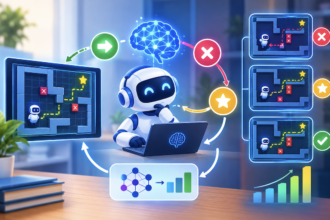
Reinforcement learning works in much the same way. Instead of following a fixed set of rules, an AI system experiments with different actions, receives rewards or penalties, and gradually discovers the best strategy over time.
In this guide, you’ll learn how reinforcement learning works, why it matters, where it is used, its strengths and weaknesses, and why it has become one of the most exciting areas of artificial intelligence.
What is Reinforcement Learning?
Reinforcement learning (RL) is a type of machine learning where an AI learns by interacting with an environment. Instead of being given the correct answer for every situation, the system figures things out through trial and error.
Every action produces a result.
If the action is helpful, the AI receives a positive reward.
If the action is harmful, it receives a negative reward or no reward at all.
Over thousands or even millions of attempts, the AI slowly learns which decisions lead to the highest rewards.
Imagine training a dog.
When the dog follows a command correctly, you give it a treat. When it ignores the command, it receives no reward. Eventually, the dog learns which behaviour earns rewards.
Reinforcement learning follows exactly this principle.
Unlike traditional computer programs that follow fixed instructions, reinforcement learning systems continuously improve as they gain more experience.
This makes them useful for solving problems where the best solution isn’t obvious from the beginning.
How Does Reinforcement Learning Work?
At first glance, reinforcement learning may sound complicated, but it follows a surprisingly simple cycle. Every reinforcement learning system is built around four basic parts.
1. The Agent
The agent is the learner.
This could be:
- A robot
- A game-playing AI
- A recommendation system
- A self-driving car
- An automated trading system
The agent makes decisions.
2. The Environment
The environment is everything around the agent.
For example:
- A chess board
- A road
- A warehouse
- A video game
- A factory floor
The environment reacts whenever the agent performs an action.
3. Actions
An action is simply the decision made by the agent.
Examples include:
- Turn left
- Accelerate
- Pick up an object
- Move a chess piece
- Recommend a movie
Each action changes what happens next.
4. Rewards
After every action, the environment provides feedback.
Positive reward:
- Winning a game
- Reaching a destination
- Saving energy
- Completing a task faster
Negative reward:
- Crashing
- Losing points
- Wasting fuel
- Making a poor recommendation
The agent always tries to maximise future rewards.
This process repeats over and over.
Observe → Decide → Act → Receive Reward → Learn → Repeat.
Although the cycle is simple, millions of repetitions allow the AI to develop surprisingly intelligent behaviour.
A Simple Real-Life Example of Reinforcement Learning
Imagine teaching a robot to deliver packages inside a large warehouse.
On its first day, it has no idea where to go.
It tries different routes.
Some routes are blocked.
Some take too long.
Some lead directly to the correct shelf.
Whenever the robot reaches the correct location quickly, it earns a reward.
If it gets stuck or takes unnecessary detours, it receives little or no reward.
After thousands of deliveries, the robot begins recognising the fastest paths.
Eventually, it can navigate efficiently without anyone programming every possible route.
This is reinforcement learning in action.
The robot learns from experience rather than memorising instructions.
Why is Reinforcement Learning Different from Other Types of Machine Learning?
Many beginners confuse reinforcement learning with supervised learning or unsupervised learning.
The biggest difference lies in how the AI learns.
Supervised Learning
The computer learns from labelled examples.
Example:
Thousands of images labelled “cat” and “dog.”
The AI learns to recognise each animal.
Unsupervised Learning
The computer finds patterns without labels.
Example:
Grouping customers with similar shopping habits.
Reinforcement Learning
The AI learns through rewards and mistakes.
Example:
Learning to drive without someone explaining every situation.
Instead, it gradually discovers better driving behaviour through continuous practice.
Each learning method solves different kinds of problems.
Why is Reinforcement Learning So Powerful?
One reason reinforcement learning receives so much attention is that it allows machines to solve problems humans may not fully understand themselves.
Instead of programming every possible situation, developers define a goal.
The AI discovers its own strategy.
This makes reinforcement learning especially valuable when:
- There are countless possible decisions.
- The environment changes over time.
- Long-term planning matters.
- The correct solution is unknown.
Many modern AI breakthroughs became possible because reinforcement learning allowed computers to learn strategies that humans never explicitly programmed.
Real-World Applications of Reinforcement Learning
Reinforcement learning is no longer limited to research laboratories. Today, businesses across multiple industries use it to solve practical problems that involve decision-making, optimisation, and continuous improvement. The common thread across these applications is that the AI learns by interacting with an environment and gradually improves its performance through feedback.
Self-Driving Cars
Autonomous vehicles must constantly make decisions while driving. They need to stay within lanes, recognise traffic signals, avoid obstacles, adjust speed, and respond to unpredictable situations such as pedestrians crossing the road or sudden braking by other vehicles.
Reinforcement learning allows these systems to improve their driving strategies through extensive simulation before they are tested in real-world conditions. During training, the AI receives rewards for safe driving behaviours and penalties for actions that could lead to accidents or inefficient routes.
For example, an AI driving simulator may run millions of virtual journeys in different weather conditions, road layouts, and traffic situations. Over time, the system learns which decisions consistently lead to safe and efficient driving.
Although reinforcement learning is only one part of autonomous vehicle technology, it plays an important role in helping these systems make better sequential decisions.
Robotics
Modern robots are becoming far more capable than simple machines that repeat pre-programmed movements. In factories, warehouses, hospitals, and research laboratories, robots often face changing environments where rigid instructions are not enough.
Imagine a warehouse robot responsible for picking products from shelves. Every item may have a different shape, size, or position. Rather than programming every possible movement, reinforcement learning enables the robot to experiment with different gripping techniques and receive rewards when it successfully picks up an object without dropping or damaging it.
Researchers also use reinforcement learning to teach robots how to walk, climb stairs, balance on uneven surfaces, and manipulate delicate objects. These skills improve gradually through repeated practice rather than manual programming.
As robotics continues to advance, reinforcement learning is expected to help robots become more adaptable and capable of handling increasingly complex tasks.
Video Games
One of the most famous uses of reinforcement learning is teaching AI to play games.
Games provide an ideal training environment because every action has a measurable outcome. Winning earns rewards, while losing results in penalties. The AI continuously experiments with different strategies until it identifies those that maximise long-term success.
Some reinforcement learning systems have achieved remarkable results by mastering games that require planning, memory, and strategic thinking. These systems often discover creative tactics that even experienced human players had never considered.
Although games may seem like entertainment, they provide valuable testing grounds for reinforcement learning techniques that can later be applied to real-world challenges such as logistics, healthcare, and industrial automation.
Recommendation Systems
Many online platforms aim to recommend content that users are most likely to enjoy. While recommendation systems often rely on several machine learning techniques, reinforcement learning can help improve recommendations over time.
For example, when a streaming service suggests a film, it observes whether the user watches it, skips it, or searches for something else. Positive interactions act as rewards, while ignored recommendations provide useful feedback.
Gradually, the system learns which recommendations are more likely to satisfy each individual user. This allows platforms to personalise experiences without manually creating rules for every customer.
Finance
Financial markets change constantly, making them challenging environments for traditional programming.
Reinforcement learning can help analyse market conditions and test different investment or trading strategies. Rather than predicting a single event, the AI learns which sequence of decisions tends to produce better long-term results while managing risk.
Financial institutions also use reinforcement learning for portfolio optimisation, fraud detection, and resource allocation. However, because financial markets are unpredictable, these systems require careful testing and human oversight before being used in real-world decision-making.
Healthcare
Healthcare is another area where reinforcement learning is showing promise.
Researchers are exploring ways to use reinforcement learning to personalise treatment plans, optimise medication schedules, and improve hospital resource management.
For example, an AI could learn how different treatment choices affect patient recovery over time. By analysing outcomes across many cases, it may suggest treatment strategies that improve long-term health while reducing unnecessary interventions.
Despite its potential, reinforcement learning in healthcare must meet extremely high standards for safety, transparency, and clinical validation before being widely adopted.
Advantages of Reinforcement Learning
Reinforcement learning offers several benefits that make it valuable for solving complex problems. These advantages explain why it continues to attract attention from researchers and businesses alike.
Learns from Experience
Instead of relying entirely on human-written rules, reinforcement learning improves through practice. As the system gathers more experience, it often becomes better at making decisions in situations it has never encountered before.
Handles Complex Decision-Making
Many real-world problems involve thousands or even millions of possible choices. Reinforcement learning can explore these possibilities and identify strategies that would be difficult for humans to design manually.
Optimises Long-Term Outcomes
Unlike systems that focus only on immediate results, reinforcement learning considers future rewards. This allows it to develop strategies that may involve short-term sacrifices for greater long-term success.
Adapts to Changing Environments
When the environment changes, reinforcement learning systems can continue learning and adjusting their behaviour rather than relying on outdated instructions.
Finds Creative Solutions
Because the AI explores different possibilities, it may discover innovative strategies that humans would not normally consider. Some reinforcement learning systems have developed highly efficient solutions that surprised even experienced researchers.
Challenges and Limitations
Despite its impressive capabilities, reinforcement learning is not a perfect solution. Understanding its limitations helps explain why it is used selectively rather than for every AI problem.
Requires Large Amounts of Training
Many reinforcement learning systems need millions of practice attempts before they perform well. This training can take considerable time and computing resources.
Trial and Error Can Be Expensive
In virtual environments such as games, making mistakes is inexpensive. In the real world, however, mistakes can damage equipment, waste resources, or create safety risks. This is why many systems are first trained in realistic simulations.
Designing Reward Systems is Difficult
The reward function determines what the AI learns. If rewards are poorly designed, the AI may find unexpected shortcuts that maximise rewards without actually solving the intended problem.
For example, a warehouse robot rewarded only for speed might move too quickly and damage products. Developers must carefully balance rewards to encourage safe and effective behaviour.
Exploration Versus Exploitation
A reinforcement learning system constantly faces a trade-off. Should it continue exploring new possibilities or stick with strategies that already work well?
Finding the right balance between exploration and exploitation is one of the central challenges in reinforcement learning.
High Computational Costs
Training sophisticated reinforcement learning models often requires powerful hardware and significant energy consumption. For many organisations, this represents a major investment.
Common Mistakes Beginners Make When Learning Reinforcement Learning
Many newcomers misunderstand reinforcement learning because it is often presented alongside other machine learning techniques. Here are a few common misconceptions.
- Believing reinforcement learning replaces all other machine learning methods.
- Assuming the AI learns instantly after only a few attempts.
- Thinking rewards alone are enough without careful system design.
- Ignoring the importance of the training environment.
- Expecting every reinforcement learning model to work well in the real world without extensive testing.
Understanding these points early helps build realistic expectations about what reinforcement learning can and cannot achieve.
Practical Takeaways for Beginners
If you want to start learning reinforcement learning, begin with the fundamentals before exploring advanced algorithms.
A good learning path includes:
- Understand basic machine learning concepts.
- Learn Python programming.
- Study probability and basic mathematics.
- Experiment with simple reinforcement learning environments.
- Explore popular libraries such as Gymnasium and Stable-Baselines3.
- Build small projects before tackling complex research topics.
For an authoritative introduction to reinforcement learning research, visit the Sutton and Barto textbook: https://incompleteideas.net/book/the-book.html
You may also want to read related beginner guides such as “What is Machine Learning?”, “What is Deep Learning?”, “How Artificial Intelligence Works”, and “Supervised vs Unsupervised Learning” to build a stronger understanding of the broader AI landscape.
The Future of Reinforcement Learning
Reinforcement learning is expected to play an increasingly important role as AI systems become more autonomous. Researchers are working to make these systems more sample-efficient, safer, and easier to train so they can be applied to real-world problems with fewer risks and lower costs.
Future developments may expand its use in areas such as personalised education, smart energy grids, advanced robotics, healthcare planning, autonomous transportation, industrial automation, and scientific research. As computing power improves and better algorithms emerge, reinforcement learning could help solve problems that are currently too complex for traditional software.
At the same time, responsible development will remain essential. Engineers must ensure that reinforcement learning systems are transparent, reliable, and aligned with human goals, particularly when they are used in safety-critical applications.
Conclusion
Reinforcement learning is one of the most fascinating branches of artificial intelligence because it teaches machines to learn through experience rather than through detailed instructions. By receiving rewards for successful actions and penalties for poor ones, an AI gradually develops strategies that improve its performance over time.
While the underlying technology can become highly sophisticated, the basic idea is surprisingly simple. Much like people and animals learn from practice, reinforcement learning systems improve by interacting with their environment, making decisions, observing the outcomes, and adjusting their behaviour.
Although it requires significant training, careful reward design, and substantial computing resources, reinforcement learning has already transformed fields such as robotics, gaming, recommendation systems, finance, and autonomous vehicles. As research continues, it is likely to become an even more important part of the future of artificial intelligence.
If you wanted to understand what reinforcement learning is explained simply, the key takeaway is this: reinforcement learning is about learning by doing. The AI is not told every answer. Instead, it discovers the best actions through repeated experience, making it one of the most powerful approaches to building intelligent systems.
Frequently Asked Questions
1. Is reinforcement learning easy to learn?
The basic concept is easy to understand because it is based on learning through rewards and mistakes. However, advanced reinforcement learning involves mathematics, probability, and programming, so it becomes more challenging as you progress.
2. What is reinforcement learning explained simply?
Reinforcement learning is a type of machine learning where an AI learns by trying different actions, receiving rewards for good decisions, and improving over time through experience.
3. Where is reinforcement learning used?
It is used in robotics, self-driving cars, video games, recommendation systems, finance, warehouse automation, industrial control, and scientific research.
4. Is reinforcement learning the same as deep learning?
No. Deep learning is a method for building neural networks, while reinforcement learning is a way of training AI through rewards. They can be combined in a technique called deep reinforcement learning.
5. Why is reinforcement learning important?
It enables AI systems to solve complex decision-making problems where there is no simple set of rules. This makes it useful for dynamic environments that require continuous learning and adaptation.
6. Does reinforcement learning always require rewards?
Yes. Rewards are a fundamental part of reinforcement learning because they guide the AI toward better decisions. Without rewards or penalties, the system has no way to evaluate whether its actions are improving.
7. Can beginners learn reinforcement learning without advanced maths?
Yes. You can begin by understanding the basic concepts and experimenting with beginner-friendly tutorials. As you progress, learning algebra, probability, and linear algebra will help you understand more advanced techniques.
8. What programming language is most commonly used for reinforcement learning?
Python is the most popular language because it has a large ecosystem of machine learning libraries, tutorials, and frameworks that support reinforcement learning development.