
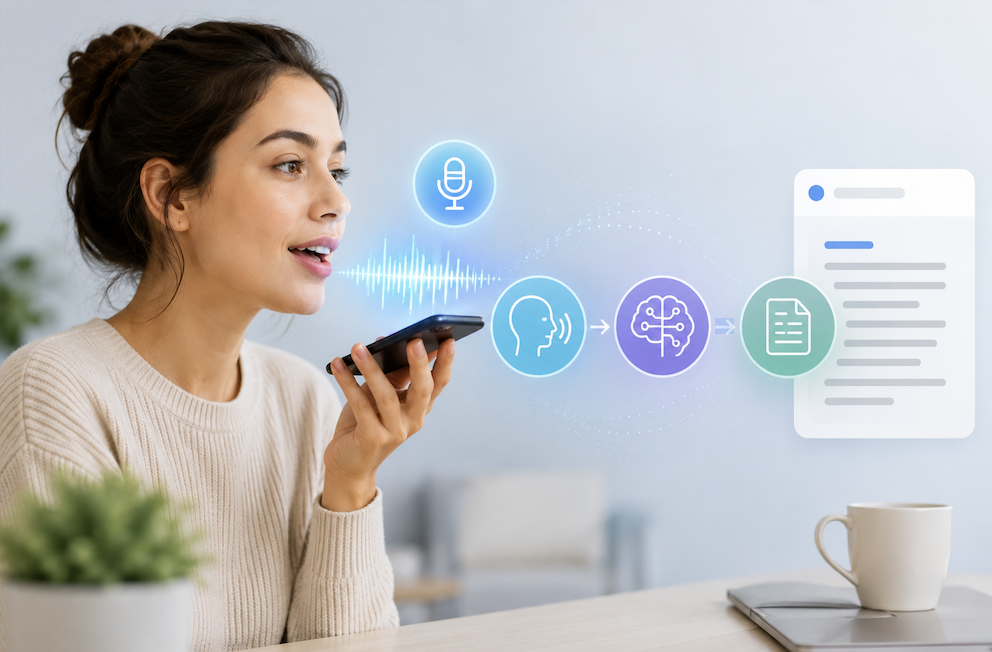
Speaking a command to a voice assistant, dictating a text message instead of typing it, or watching real-time captions appear beneath a video call all rely on the same underlying capability: a computer’s ability to convert spoken words into text it can actually process and understand. Speech recognition has quietly become remarkably accurate over the past decade, and understanding how it actually works reveals some genuinely clever engineering behind what now feels like an unremarkable, everyday feature.
What Speech Recognition Technology Actually Does
Speech recognition, sometimes called automatic speech recognition or voice recognition, refers to technology that converts spoken audio into written text that a computer system can process, store, or act upon. This differs from voice recognition in the narrower sense of identifying who is speaking, since speech recognition focuses specifically on understanding what is being said, regardless of the particular speaker’s identity.
The genuine technical challenge here is substantial. Human speech varies enormously between individuals in terms of accent, pace, pitch, and pronunciation, and even the same person speaking the same sentence rarely produces identical audio twice. Converting this genuinely messy, variable audio signal into accurate, structured text requires considerably more sophistication than simply matching sounds to a fixed dictionary.
How Audio Actually Gets Converted Into Text
The process begins with a microphone capturing sound waves and converting them into a digital audio signal, a continuous stream of numerical values representing air pressure changes over time. From there, the speech recognition system breaks this continuous audio into small segments and analyzes the acoustic characteristics within each one, looking for patterns that correspond to specific speech sounds, called phonemes.
- Raw audio gets captured and converted into a digital signal for processing
- The system breaks this signal into small time segments for detailed acoustic analysis
- Each segment gets analyzed for acoustic patterns corresponding to specific speech sounds
- These identified sounds get assembled into likely words based on trained language patterns
Modern systems rely heavily on machine learning models trained on enormous datasets of audio paired with accurate transcriptions, allowing the system to learn statistical patterns connecting specific sounds to specific words, rather than following rigid, hand-programmed rules that struggled significantly with the natural variation present in real human speech.
Why Context and Language Modeling Matter So Much
Purely analyzing acoustic sound patterns alone is not enough to achieve genuinely high accuracy, since many words sound identical or nearly identical despite having completely different meanings and spellings. Modern speech recognition systems address this by incorporating language modeling, using the broader context of surrounding words to determine which specific word was actually most likely intended.
- Homophones, words that sound alike but have different meanings, require contextual analysis to resolve correctly
- Language models predict which word makes grammatical and contextual sense within the surrounding sentence
- This combination of acoustic and language modeling significantly improves overall recognition accuracy
- The system essentially asks not just what sound was heard, but what word makes sense given everything said before it
This is genuinely similar in principle to how modern text prediction and language processing systems use surrounding context to interpret meaning, applied specifically to the challenge of converting ambiguous audio into the most probable, contextually sensible text.
Why Accuracy Has Improved So Dramatically in Recent Years
Anyone who used voice recognition technology a decade or more ago likely remembers frequent, frustrating errors that made the technology feel more like a novelty than a genuinely reliable tool. The dramatic accuracy improvements since then stem from several converging factors working together.
- Significantly larger and more diverse training datasets, covering a wider range of accents and speaking styles
- More sophisticated machine learning architectures better suited to processing sequential audio data
- Increased computing power allowing for more complex models to run efficiently, even on everyday devices
- Continuous refinement based on real-world usage data helping systems improve accuracy over time
This combination has pushed modern speech recognition systems to accuracy levels that would have seemed genuinely remarkable just a decade ago, making features like voice dictation and voice assistants practical for everyday, reliable use rather than an occasionally useful novelty.
Common Challenges That Still Affect Accuracy Today
Despite genuine improvements, speech recognition still faces real challenges in certain situations, and understanding these limitations helps set realistic expectations for when the technology performs at its best versus when accuracy may noticeably decline.
- Background noise can significantly interfere with accurate audio analysis, particularly in busy environments
- Strong or uncommon accents not well represented in training data can reduce recognition accuracy
- Overlapping speech from multiple speakers remains genuinely challenging even for sophisticated systems
- Specialized or technical vocabulary not well represented in training data can lead to more frequent errors
- Very fast or unclear speech patterns can reduce accuracy compared to clear, moderately paced speech
Everyday Applications Beyond Voice Assistants
- Dictation software allowing hands-free writing for emails, documents, and messages
- Real-time captioning for video calls, live broadcasts, and accessibility purposes
- Voice-controlled smart home devices responding to spoken commands
- Automated customer service systems that route calls based on spoken requests
- Transcription services converting recorded meetings, interviews, or lectures into written text
- Accessibility tools helping individuals with certain physical limitations interact with technology through speech
Practical Tips for Improving Speech Recognition Accuracy
Speak clearly at a moderate, natural pace rather than unusually fast or slow
- Minimize background noise when using speech recognition features whenever practically possible
- Use a good quality microphone positioned reasonably close to your mouth
- Take advantage of any personalization or training features a specific system offers
- Correct errors when prompted, since some systems use this feedback to improve future accuracy for your specific voice
How Speech Recognition Handles Multiple Languages and Accents
A genuinely important aspect of modern speech recognition involves how these systems handle the enormous diversity of languages, dialects, and accents that exist among speakers worldwide. Building a single system that performs reliably across this diversity requires deliberately including a wide range of speech samples during training, rather than optimizing narrowly for one specific accent or speaking style.
This is precisely why speech recognition accuracy has historically varied noticeably between different accents and languages, since systems trained predominantly on one particular type of speech data naturally perform
better for speakers whose speech patterns closely match that training data. Ongoing efforts to diversify training datasets have gradually narrowed this accuracy gap, though genuine differences in performance across different accents and languages still persist to some degree in many current systems.
- Training data diversity directly determines how well a system performs across different accents and languages
- Systems historically performed better for accents and languages well represented in their specific training data
- Ongoing efforts to diversify training datasets have gradually narrowed, though not entirely eliminated, this gap
- Multilingual systems face the additional challenge of accurately switching between languages within a conversation
Final Thoughts
Speech recognition technology has progressed from a frustrating novelty to a genuinely reliable everyday tool, thanks to sophisticated acoustic analysis combined with language modeling that considers context rather than analyzing sounds in complete isolation. Understanding how this technology actually converts messy, variable human speech into accurate text helps explain both its impressive current capabilities and the genuine, specific situations where accuracy may still occasionally fall short.
Frequently Asked Questions
1. Does speech recognition require an internet connection to work?
Some speech recognition happens entirely on-device without requiring internet connectivity, particularly for basic commands, while more complex processing sometimes relies on cloud-based systems with greater computing power, depending on the specific device and application involved.
2. Why does speech recognition sometimes struggle with my particular accent?
If a system’s training data did not adequately represent your specific accent or speaking pattern, accuracy can be reduced, though many modern systems have worked to include more diverse training data to address this genuine limitation.
3. Can speech recognition technology identify who is speaking, not just what is said?
That capability, called speaker identification or voice recognition in the narrower sense, is a related but technically distinct capability from speech-to-text conversion, though some systems do combine both capabilities for certain applications.
4. Is it safe to use voice dictation for sensitive or private information?
This depends on how the specific system processes and stores your audio data, and it is worth reviewing a service’s privacy policy regarding voice data handling before using it regularly for genuinely sensitive information.
5. Will speech recognition accuracy continue improving in the future?
Given the consistent trend of improvement driven by larger training datasets and more sophisticated processing techniques, continued meaningful improvement in accuracy and handling of challenging scenarios, like background noise and diverse accents, remains a reasonable expectation.