Setting a phone down on a small pad and watching it charge without any cable still feels a little like magic the first time you try it. Wireless charging has become a standard feature on most modern smartphones, yet many people use it daily without really understanding what is happening underneath that charging pad. This article explains the science behind wireless charging in simple, practical terms.
The Basic Principle Behind Wireless Charging
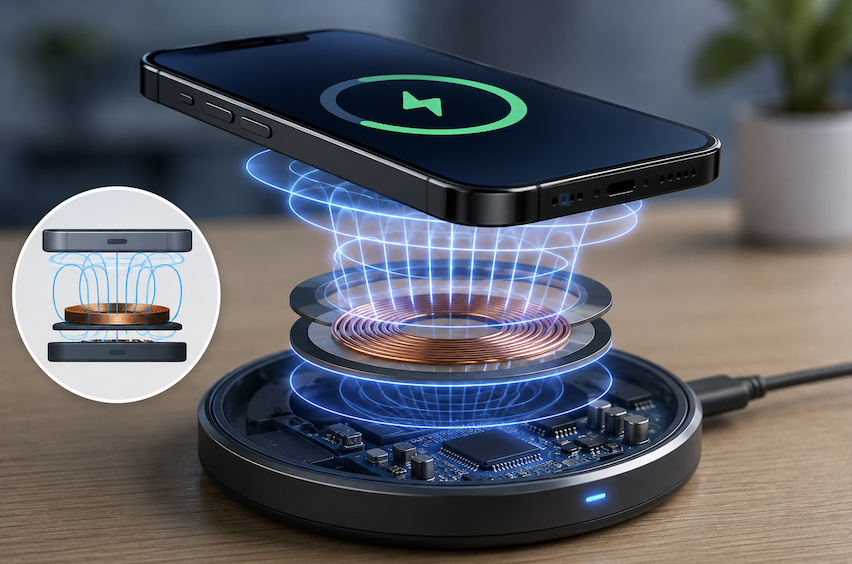
Wireless charging relies on a scientific principle called electromagnetic induction. In simple terms, when electricity flows through a coil of wire, it creates a magnetic field around it. If you place a second coil of wire close enough within that magnetic field, it induces an electrical current in the second coil as well, effectively transferring energy without any physical wire connecting the two.
Your wireless charging pad contains one coil connected to a power source, and your phone contains a second coil built into its internal components. When you place the phone on the pad, these two coils align closely enough for the magnetic field to transfer usable electrical energy from the pad into your phone’s battery.
Why the Alignment and Distance Actually Matter
Wireless charging is far more sensitive to positioning than most people realize. The magnetic field generated between the two coils weakens quickly with distance, which is why wireless charging only works when a device is placed directly on or very close to the pad, unlike a cable that works regardless of angle or distance.
This is also why thick cases, certain metal attachments, or misaligned placement can noticeably slow down or completely interrupt the charging process. Most phones display a visual indicator or vibrate slightly when proper contact and alignment are achieved.
- Even a small gap or offset can reduce charging efficiency significantly
- Some cases, especially thick or metal ones, can block the magnetic field entirely
- Manufacturers design coils with specific alignment markers to help guide correct placement
The Different Types of Wireless Charging Standards
Not all wireless chargers use exactly the same underlying technology, though most modern consumer devices rely on one dominant standard.
- Qi wireless charging is the most widely adopted standard, supported by the vast majority of smartphones and charging pads on the market
- Magnetic alignment systems use built in magnets to snap a device into the perfect charging position automatically
- Higher wattage fast wireless charging standards allow for quicker charging speeds compared to older, slower wireless technology
- Reverse wireless charging allows some phones to actually charge other devices, like earbuds, by acting as the power source themselves
Why Wireless Charging Tends to Be Slower Than Cabled Charging
Wireless charging typically transfers energy less efficiently than a direct cable connection, largely due to energy lost as heat during the induction process. This means wireless charging often takes noticeably longer to fully charge a device compared to a wired connection at the same wattage rating.
This efficiency loss is simply a byproduct of transferring energy through a magnetic field rather than a direct physical connection, and it is a trade off most users accept in exchange for the added convenience of not dealing with cables.
Practical Tips for Getting the Most Out of Wireless Charging
- Remove thick or metal phone cases that might interfere with proper coil alignment
- Place your phone directly in the center of the pad rather than at an angle or edge
- Use a wireless charger that matches or exceeds your phone’s supported wattage for faster charging
- Avoid placing metal objects like coins or keys on the charging pad, since they can interfere with the magnetic field
- Consider a charging stand instead of a flat pad if you want to use your phone while it charges
How Fast Wireless Charging Technology Keeps Improving
Early wireless charging was noticeably slower than cable charging, often frustrating users who expected similar speeds to a wired connection. Manufacturers have steadily closed that gap by improving coil design, increasing supported wattage, and refining how heat generated during the charging process gets managed and dissipated.
Modern fast wireless charging standards can now approach speeds that come reasonably close to standard wired charging under ideal conditions, particularly with well aligned, higher wattage charging pads paired with compatible phones. Some manufacturers have also introduced proprietary fast wireless charging technology that exceeds the baseline Qi standard, though this often requires using that specific brand’s charger to achieve the fastest possible speeds.
- Coil design improvements have reduced energy loss during the induction process
- Higher wattage charging pads now support noticeably faster charging speeds than early models
- Better heat management allows devices to sustain faster charging for longer periods
- Some brands offer proprietary fast charging that exceeds standard Qi speeds with matching hardware
Despite these improvements, a meaningful efficiency gap between wired and wireless charging still exists, largely due to the fundamental physics of transferring energy through a magnetic field rather than a direct electrical connection. For most users, the convenience trade off remains worthwhile, especially as the speed gap continues to narrow with each new generation of hardware.
Final Thoughts
Wireless charging combines genuinely clever physics with everyday convenience, transforming a slightly technical scientific principle into something as simple as setting your phone down on a pad. Understanding how alignment, coils, and magnetic fields work together can help you troubleshoot slow charging and get the most reliable performance from your setup.
Frequently Asked Questions
1. Does wireless charging damage phone batteries faster than cable charging?
Not significantly, as long as you use a certified charger. Modern phones include software that manages heat and charging speed carefully regardless of whether you use a cable or a wireless pad.
2. Why does my phone charge slower on some wireless pads than others?
Charging speed depends on the wattage supported by both your phone and the charging pad. A lower wattage pad, or one not properly aligned, will charge more slowly than a higher wattage, well aligned setup.
3. Can I use any wireless charger with any phone?
Most modern smartphones support the widely adopted Qi standard, meaning most wireless chargers will work across different phone brands, though charging speed may vary depending on device compatibility.
4. Is it safe to leave my phone on a wireless charger overnight?
Yes, modern phones and chargers include built in safeguards that stop charging once the battery is full, preventing overcharging even if the device stays on the pad for an extended period.