Privacy conscious internet users hear the term VPN constantly, often alongside promises of hiding your identity online and protecting your data from prying eyes. But the actual technical process behind how a VPN hides your IP address is rarely explained clearly. This article walks through exactly what happens when you connect to a VPN and why it genuinely changes how visible you are online.
What Your IP Address Actually Reveals About You
Every device connected to the internet is assigned an IP address, a unique string of numbers that identifies your connection on the network. Websites, apps, and online services use this address to know where to send data back to you, but it also reveals information such as your approximate geographic location and your internet service provider.
Without any protection, your IP address is visible to every website you visit, every app you use, and potentially any third party monitoring network traffic along the way. This is the core privacy concern that VPNs are designed to address.
How a VPN Actually Reroutes Your Connection
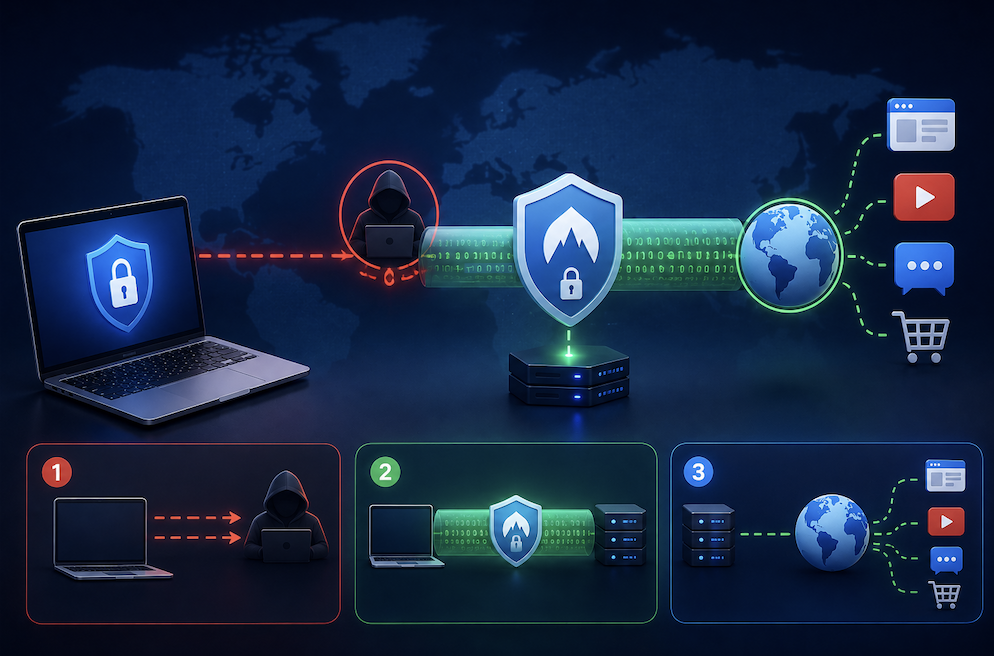
When you connect to a VPN, your device establishes an encrypted connection to a VPN server, which could be located anywhere in the world depending on the service you use. Instead of your internet traffic going directly from your device to the websites you visit, it first travels through this VPN server.
From the perspective of any website or service you interact with, the traffic appears to originate from the VPN server’s IP address rather than your own. Your actual IP address remains hidden behind that server, effectively masking your real location and identity from the sites you visit.
- Your device encrypts data before sending it to the VPN server
- The VPN server decrypts it and forwards your request to the destination website
- The website only ever sees the VPN server’s IP address, not your own
- Return data follows the same encrypted path back to your device
Why Encryption Matters Just as Much as IP Masking
Hiding your IP address is only part of what a VPN does. The encrypted tunnel between your device and the VPN server also protects your data from being intercepted or read by anyone monitoring the network, such as on public Wi-Fi at a coffee shop or airport.
Without encryption, someone on the same network could potentially intercept unprotected data, even if your IP address were somehow hidden through other means. A proper VPN combines both IP masking and strong encryption to provide genuine privacy protection during your browsing session.
What a VPN Does Not Actually Protect You From
It is important to have realistic expectations about what a VPN can and cannot do. A VPN does not make you completely anonymous online, since websites can still track you through cookies, account logins, and browser fingerprinting techniques unrelated to your IP address.
- A VPN will not stop tracking from accounts you are actively logged into, like social media or email
- It does not protect against malware or phishing attempts that trick you into giving up information voluntarily
- Free VPN services sometimes log and sell user data, undermining the very privacy they claim to offer
- A VPN cannot make illegal activity legal simply by hiding your IP address
Practical Tips for Choosing and Using a VPN
- Choose a reputable VPN provider with a clearly stated no logging policy
- Look for strong encryption standards and a proven track record of independent security audits
- Avoid free VPN services that may monetize your data instead of protecting it
- Enable a kill switch feature, which cuts your internet connection if the VPN connection drops unexpectedly
- Combine VPN use with good general privacy habits, like clearing cookies and avoiding unnecessary account logins
How VPN Server Location Affects Your Browsing Experience
The specific VPN server you connect to affects more than just which IP address websites see, it also influences your actual browsing speed and what content you can access. Connecting to a server that is physically far away from your real location typically introduces additional delay, since your data has to travel a longer physical distance before reaching its final destination.
Server location also determines what region a website believes you are browsing from, which matters for accessing region specific content or pricing that differs by country. However, it is worth noting that using a VPN to access content restricted in your region may violate the terms of service of certain platforms, even though the VPN itself is legal to use.
- Servers closer to your actual physical location typically offer faster connection speeds
- Distant servers can introduce noticeable delay, especially for video calls or online gaming
- Server location determines what regional content or pricing a website believes you should see
- Reputable providers offer a wide range of server locations to balance speed and access needs
Choosing the right server often involves a trade off between speed and the specific reason you are using a VPN in the first place, whether that is general privacy protection, secure browsing on public Wi-Fi, or accessing region specific content responsibly.
Final Thoughts
A VPN genuinely hides your IP address by rerouting your traffic through an encrypted server, making it much harder for websites and networks to identify your real location and identity. Understanding both its strengths and its limitations helps you use it as one meaningful piece of a broader approach to online privacy, rather than a complete solution on its own.
Frequently Asked Questions
1. Does a VPN make me completely anonymous online?
No, a VPN hides your IP address and encrypts your traffic, but it does not prevent tracking through logged in accounts, cookies, or browser fingerprinting techniques used by many websites.
2. Can my internet provider still see what I am doing if I use a VPN?
Your internet provider can see that you are connected to a VPN server, but they cannot see the specific websites you visit or the data being transmitted, since it is encrypted.
3. Is it legal to use a VPN?
In most countries, yes, using a VPN is completely legal. Some countries do restrict or regulate VPN use, so it is worth checking local laws if you are traveling internationally.
4. Do free VPNs actually protect my privacy?
Not always. Some free VPN services generate revenue by logging and selling user data, which can undermine the privacy protection you are trying to achieve in the first place.