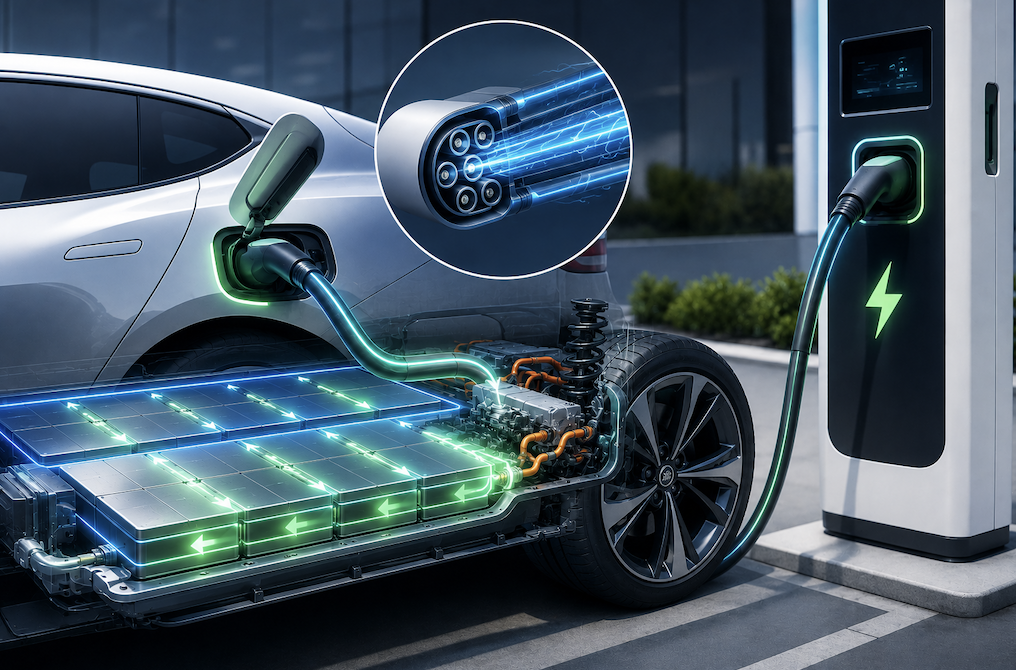
Watching an electric vehicle add significant range in just twenty or thirty minutes at a fast charging station represents a genuinely impressive engineering achievement, especially considering how slowly a standard phone charges by comparison. Understanding how electric car batteries manage to charge this quickly reveals some genuinely clever electrical engineering working behind the scenes. This article explains exactly how fast charging technology actually works.
The Basic Principle Behind Electric Vehicle Charging
Electric vehicle batteries charge by receiving direct electrical current that gets stored chemically within the battery’s cells. The fundamental relationship governing charging speed involves both voltage and current, since the total power delivered to the battery, measured in kilowatts, depends on both of these factors working together, and higher power delivery generally translates directly into faster charging.
Standard home charging typically delivers relatively modest power levels, resulting in charging times measured in many hours. Fast charging stations, by contrast, are specifically engineered to deliver dramatically higher power levels, which is exactly what enables their significantly faster charging times.
Why Fast Chargers Use Direct Current Instead of Alternating Current
Most home electrical outlets deliver alternating current, which needs to be converted to direct current before it can actually charge a battery, since batteries fundamentally store energy using direct current. Standard home charging equipment performs this conversion using a relatively modest converter built into the vehicle itself, which limits the maximum charging speed achievable at home.
- Fast charging stations deliver direct current directly, bypassing the vehicle’s onboard converter entirely
- This allows for dramatically higher power delivery than a vehicle’s onboard converter could otherwise handle
- The charging station itself contains the powerful conversion equipment, rather than the vehicle
- This is exactly why fast charging stations achieve significantly higher charging speeds than home charging
How Battery Chemistry Affects Maximum Safe Charging Speed
Even with sufficient power available from a fast charging station, a battery’s own internal chemistry places genuine limits on how quickly it can safely accept that power without generating excessive heat or experiencing accelerated degradation. Modern electric vehicle batteries and their accompanying management systems are specifically engineered to balance charging speed against long-term battery health.
- Battery management systems continuously monitor temperature and cell health during charging
- Charging speed automatically adjusts based on the battery’s current state and temperature
- This is exactly why charging speed often slows down considerably as a battery approaches full capacity
- These safeguards help protect long-term battery health while still allowing genuinely fast charging when appropriate
Why Charging Speed Slows Down Significantly Near Full Capacity
A common observation among electric vehicle owners is that fast charging speed decreases considerably once a battery reaches roughly eighty percent capacity, a pattern directly related to battery chemistry and the safety systems mentioned above. Accepting a very high charging rate becomes progressively riskier for the battery’s
long-term health as it approaches full capacity, which is why manufacturers program a gradual, deliberate slowdown during this final charging phase.
- Charging speed typically remains high and consistent up until around eighty percent capacity
- Beyond this point, charging speed decreases considerably to protect long-term battery health
- This is exactly why many drivers charge to around eighty percent rather than waiting for a full charge
- This pattern is a deliberate, engineered safety behavior rather than a limitation or malfunction
Practical Considerations for Electric Vehicle Charging
- Understand that fast charging speed will naturally decrease as your battery approaches full capacity
- Consider charging to around eighty percent for daily use, reserving a full charge for longer trips
- Extreme temperatures, both hot and cold, can meaningfully affect charging speed and battery performance
- Regular fast charging is generally safe for modern batteries, though occasional slower charging can benefit long-term battery health
How Charging Infrastructure Has Improved to Support Faster Speeds
The fast charging speeds available today were not always achievable, and much of the recent progress reflects genuine improvements across the entire charging ecosystem, not just the vehicles themselves. Charging station hardware has become considerably more powerful, electrical grid connections supporting these stations have been upgraded in many locations, and communication protocols between vehicles and chargers have become more sophisticated, allowing for more precise, optimized power delivery throughout the charging session.
This ecosystem-wide improvement matters because a vehicle capable of accepting very fast charging speeds still depends entirely on having access to charging infrastructure actually capable of delivering that power. As more high-power charging stations get deployed and existing ones receive upgrades, the practical, real-world fast charging experience continues improving alongside the underlying vehicle technology itself.
- Charging station hardware has become significantly more powerful in recent years
- Electrical grid connections supporting fast charging stations have been upgraded in many locations
- Improved communication protocols allow more precise, optimized power delivery during charging
- Real-world charging speed depends on both vehicle capability and available charging infrastructure
Final Thoughts
Electric vehicle fast charging achieves its impressive speeds through a combination of high-power direct current delivery and sophisticated battery management systems working together to balance speed against long-term battery health. Understanding why charging speed naturally varies, particularly the slowdown near full capacity, helps set realistic expectations and makes it easier to plan charging stops effectively during longer trips.
- You May Want to Know How Do Self-Driving Car Sensors Actually Work?
Frequently Asked Questions
1. Is fast charging bad for an electric vehicle’s battery over time?
Modern batteries and their management systems are specifically engineered to handle regular fast charging safely, though relying exclusively on fast charging rather than occasionally using slower charging may contribute to slightly faster long-term battery degradation.
2. Why does my electric vehicle charge much slower at home than at a fast charging station?
Home charging typically delivers considerably less power than a dedicated fast charging station, which is specifically engineered with powerful direct current conversion equipment that a home charging setup simply does not include.
3. Does cold weather actually affect electric vehicle charging speed?
Yes, significantly. Battery chemistry is temperature sensitive, and charging speed often decreases meaningfully in very cold conditions as the battery management system adjusts to protect the battery from potential damage.
4. Why does charging slow down so much after eighty percent capacity?
This is a deliberate safety behavior programmed into the battery management system, since accepting very high charging rates becomes progressively riskier for long-term battery health as the battery approaches full capacity.