Adjusting your home’s temperature manually throughout the day, remembering to lower the heat before leaving for work and raise it again before returning, is exactly the kind of repetitive task that smart thermostats were designed to eliminate. Beyond simple remote control through a smartphone app, many modern smart thermostats genuinely learn your household’s patterns and adjust automatically. This article explains how this learning capability actually works.
What a Smart Thermostat Actually Is
A smart thermostat is a connected device that controls your home’s heating and cooling system, offering considerably more sophisticated functionality than a traditional thermostat, including remote control through a smartphone app, scheduling capabilities, and in many cases, genuine learning algorithms that adapt to your household’s actual patterns over time without requiring extensive manual programming.
Unlike a traditional programmable thermostat, which requires you to manually input a fixed schedule that remains static until you deliberately change it, many smart thermostats actively observe your actual behavior and gradually adjust their automated schedule to match your genuine, real-world patterns, rather than requiring you to predict and program your schedule perfectly in advance.
How Smart Thermostats Actually Learn Your Schedule
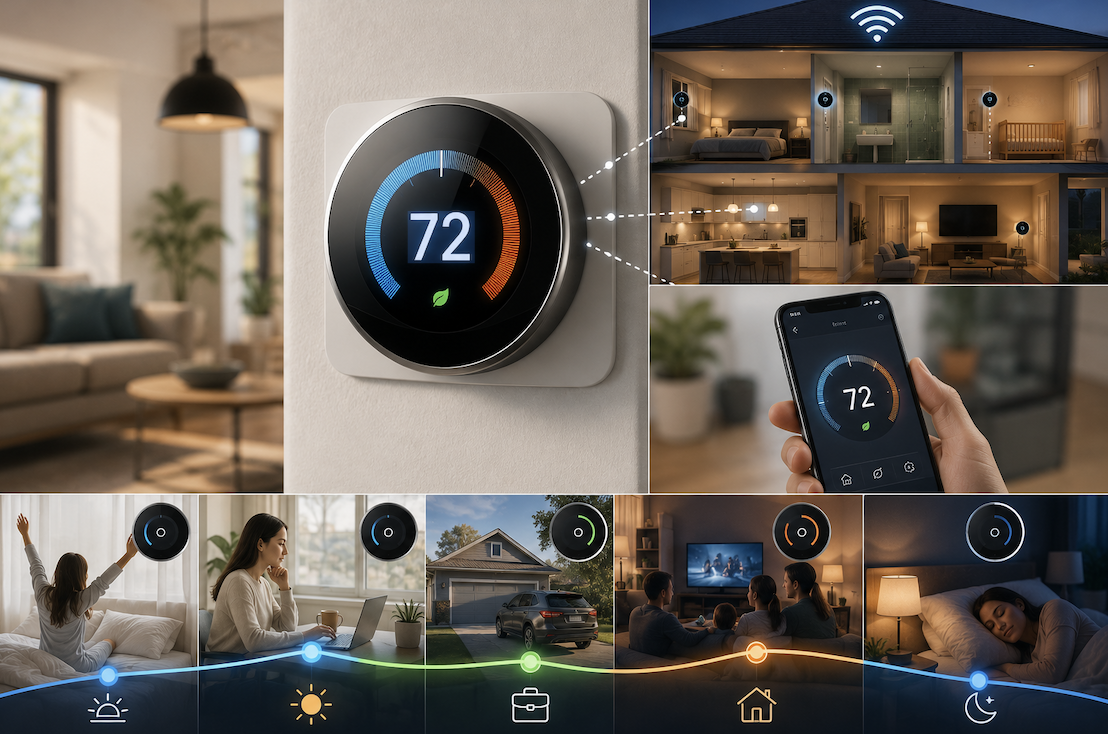
The learning capability found in many smart thermostats relies on continuously monitoring several types of data over time, gradually building an increasingly accurate model of your household’s actual temperature preferences and occupancy patterns throughout a typical week.
- The thermostat tracks when you manually adjust the temperature, noting the specific time and preferred setting
- Occupancy sensors, when included, detect whether anyone is actually present in the home at a given time
- The system observes patterns across multiple days and weeks to distinguish genuine patterns from occasional anomalies
- Over time, the thermostat begins automatically adjusting temperature settings to match these observed, learned patterns
This learning process typically takes some time to become genuinely accurate, often requiring a week or more of consistent data collection before the thermostat’s automated adjustments closely match your actual household patterns, since the system needs sufficient data to distinguish reliable, recurring patterns from one-off occurrences.
The Role of Occupancy Sensors in Improving Accuracy
Many smart thermostats include built-in motion or occupancy sensors specifically to help distinguish between times when your home is genuinely occupied versus empty, providing genuinely valuable additional data beyond simply tracking scheduled patterns based on time of day alone.
- Motion sensors detect movement near the thermostat, providing a signal about likely occupancy
- Some systems combine data from multiple sensors placed throughout the home for more accurate whole-house occupancy detection
- This occupancy data helps the system avoid heating or cooling an empty home unnecessarily
- Combining time-based patterns with actual occupancy data generally produces more accurate, efficient automated adjustments
This combination addresses a genuine limitation of purely schedule-based automation, since a fixed schedule cannot account for days when your actual routine deviates from the typical pattern, such as an unexpected day working from home or an unplanned outing that changes when the home is actually occupied.
How Smart Thermostats Use Location Data From Your Phone
Beyond learning from historical patterns, many smart thermostats also use your smartphone’s location data to determine whether you are approaching or leaving home, allowing for genuinely responsive, real-time adjustments rather than relying purely on predicted, scheduled patterns.
- Your smartphone’s location can trigger the thermostat to begin adjusting temperature as you approach home
- This geofencing capability helps ensure comfortable temperatures upon arrival without unnecessarily heating or cooling an empty home all day
- The system can similarly detect when everyone has left home and adjust to a more energy-efficient setting
- This location-based approach complements, rather than replaces, the pattern-based learning described earlier
This combination of learned patterns, occupancy sensing, and real-time location awareness allows modern smart thermostats to provide genuinely responsive automation that adapts to your actual daily life, rather than rigidly following a fixed schedule regardless of your actual, sometimes variable, real-world routine.
Why Smart Thermostats Can Genuinely Reduce Energy Costs
Beyond the convenience of automated temperature management, smart thermostats often provide genuine energy savings by avoiding unnecessary heating or cooling during periods when a home is actually unoccupied, a pattern that manual thermostats often fail to consistently achieve due to the effort required for constant manual adjustment.
- Avoiding unnecessary heating or cooling during unoccupied periods directly reduces energy consumption
- Many smart thermostats provide detailed energy usage reports, helping identify additional savings opportunities
- Gradual, learned adjustments tend to be more consistently applied than manually remembered schedule changes
- Some utility companies offer rebates specifically for smart thermostat installation, reflecting their genuine energy-saving potential
Practical Tips for Getting the Most Out of a Smart Thermostat’s Learning
- Allow sufficient time, typically at least one to two weeks, for the learning algorithm to accurately capture your patterns
- Manually adjust the temperature consistently during this initial learning period rather than leaving it untouched
- Enable location-based features if your specific model supports this capability for more responsive automation
- Periodically review the thermostat’s learned schedule to ensure it genuinely reflects your current routine
- Manually override and adjust settings if your schedule changes significantly, helping the system relearn more quickly
How Smart Thermostats Account for Outdoor Weather Conditions
Beyond learning your household’s occupancy patterns, many smart thermostats also incorporate outdoor weather data into their automated adjustments, recognizing that maintaining a comfortable indoor temperature requires accounting for how much heating or cooling effort is actually needed given current external conditions, rather than applying identical settings regardless of whether it is a mild spring day or an extreme winter cold snap.
This weather awareness allows the system to begin adjusting temperature slightly earlier on days when outdoor conditions suggest more time will be needed to reach a comfortable indoor temperature, helping
ensure your home reaches your preferred setting right when you actually need it, rather than consistently running slightly behind schedule during more extreme weather conditions. Some systems also use this weather data to suggest efficiency-focused adjustments, like slightly widening your comfort range during particularly extreme weather to reduce strain on your heating or cooling system.
- Many smart thermostats incorporate real-time outdoor weather data into their automated adjustments
- This allows the system to begin adjusting earlier on days requiring more time to reach a comfortable temperature
- Weather awareness helps ensure your home reaches your preferred setting at the actual time you need it
- Some systems suggest efficiency adjustments during particularly extreme weather conditions
Final Thoughts
Smart thermostats combine pattern learning, occupancy sensing, and smartphone location data to provide genuinely responsive, automated temperature management that adapts to your household’s actual routine rather than requiring rigid, manually programmed scheduling. Understanding how this learning process actually works helps you set realistic expectations during the initial adjustment period and get the most genuine benefit, both in convenience and energy savings, from this increasingly common smart home technology.
Patience during those first couple of weeks genuinely pays off. Many people abandon the learning process too early, manually overriding settings so frequently that the system never gets a clear enough signal to build an accurate model of their actual routine, then conclude the device simply does not work well for their household. Giving the algorithm consistent, uninterrupted data during the initial learning window typically produces noticeably better long-term automation than a household that keeps second-guessing the system before it has had a fair chance to adapt.
Frequently Asked Questions
1. How long does it typically take for a smart thermostat to learn my schedule?
Most systems require approximately one to two weeks of consistent data collection before their automated adjustments closely reflect your actual household patterns, though this can vary somewhat depending on how consistent or variable your daily routine actually is.
2. Does a smart thermostat work if I have a highly irregular schedule?
Learning algorithms generally work best with somewhat consistent patterns, though many modern systems handle reasonable variability well, and features like occupancy sensing and location-based adjustments help accommodate genuine day-to-day variation beyond a fixed weekly schedule.
3. Can I manually override a smart thermostat’s learned schedule?
Yes, virtually all smart thermostats allow manual temperature adjustments at any time, and this manual input often also serves as additional data that helps the system continue refining its learned schedule going forward.
4. Do smart thermostats actually save meaningful money on energy bills?
Many households do report genuine energy savings, primarily from avoiding unnecessary heating or cooling during unoccupied periods, though actual savings vary depending on your specific climate, home insulation, and previous thermostat habits before switching.
5. Is my location data safe when using a smart thermostat’s geofencing feature?
This depends on the specific manufacturer’s privacy practices, and it is worth reviewing a device’s privacy policy regarding location data handling, though reputable manufacturers generally implement reasonable safeguards for this genuinely sensitive category of data.