

The market for personal audio has split into two dominant formats, over-ear noise-canceling headphones and compact noise-canceling earbuds, and shoppers now face a confusing set of tradeoffs when picking between them. Both formats promise to block out the hum of an airplane cabin or an open office, but they achieve that goal through different engineering approaches, and each comes with its own set of compromises around comfort, battery life, and sound quality.
This guide breaks down the real differences between the two formats so a shopper can match the choice to how and where the device will really be used day to day.
Setting Expectations for How Noise Cancellation Really Works
Both formats rely on a similar core technology: microphones that pick up ambient sound, a processor that generates an inverse sound wave, and a speaker that plays that inverse wave to cancel out the original noise before it reaches the ear. The physics are identical between headphones and earbuds, but the practical results differ because of how each format physically seals against the head.
Over-ear headphones create a larger, more consistent seal around the entire ear, which gives the cancellation system a stable acoustic environment to work with. This generally produces stronger cancellation of low-frequency, constant sounds like engine rumble or air conditioning hum, which is why frequent flyers have historically favored the over-ear format for long flights.
- Passive isolation: The physical seal blocking sound mechanically before any electronic cancellation applies.
- Active cancellation layer: The electronic system generating opposing sound waves to cancel remaining noise.
- Low-frequency strength: Over-ear designs typically excel at canceling steady, low-pitched sounds like engine drone.
- Variable fit challenges: Earbuds depend heavily on finding the right ear tip size for a consistent seal.
Earbuds face a tougher physical challenge since the seal depends entirely on a small silicone or foam tip fitting snugly in a highly variable ear canal shape. When that seal is good, modern earbuds can perform remarkably close to over-ear headphones, but an imperfect fit noticeably weakens cancellation performance in a way that over-ear headphones are less prone to.
Microphone placement adds another layer of difference between the two formats. Over-ear headphones typically house several microphones spread across each ear cup, giving the processing system more data points to analyze ambient noise from multiple directions. Earbuds pack the same basic function into a far smaller housing, which limits microphone spacing and can make the cancellation system slightly less precise when dealing with sudden, irregular sounds like a dog barking or a door slamming, compared with steady background noise like a running engine or an air vent.
Wind noise handling further separates the two formats in outdoor settings. Earbuds, sitting flush against the head with minimal surface area exposed to moving air, generally handle wind better than over-ear headphones, whose larger ear cups can catch gusts and translate them into a rushing sound that sometimes overwhelms the cancellation system entirely. Anyone who regularly walks or cycles outdoors in windy conditions may find earbuds perform more reliably in that specific scenario, even if over-ear headphones otherwise offer stronger cancellation overall.
Weighing Comfort for Extended Daily Wear
Comfort over long stretches of use separates these two formats more than almost any other factor, and the right answer depends heavily on an individual’s ear shape, hair, glasses use, and tolerance for pressure against the head. Over-ear headphones rest on the outer ear and apply clamping pressure across a wider surface area, which some people find comfortable for hours while others develop soreness around the temples or behind the ears, especially if they also wear glasses.
Earbuds avoid clamping pressure entirely but introduce a different kind of fatigue tied to pressure inside the ear canal itself. For some wearers, this pressure becomes noticeable after a few hours and can even contribute to minor ear canal irritation with extended daily use, while others report no discomfort at all even after a full workday of continuous wear.
- Glasses compatibility: Over-ear headphones can press temple arms uncomfortably against the head for glasses wearers.
- Ear canal sensitivity: Earbuds rely on an in-ear seal that some wearers find irritating after extended sessions.
- Clamping force variation: Headphone models differ widely in how tightly they grip the head, affecting comfort directly.
- Hairstyle interference: Certain hairstyles and headphone band designs can create friction or discomfort with over-ear wear.
Trying a model in person before buying, when possible, remains the most reliable way to judge comfort, since published specifications rarely capture how a specific design feels after three or four hours of continuous wear.
Weight distribution plays a role that is easy to overlook when comparing specification sheets side by side. Two over-ear headphones with nearly identical total weight can feel very different on the head depending on how that weight is balanced between the headband and the ear cups.
A model that concentrates weight toward the top of the head often feels lighter in practice than its raw weight figure suggests, while a bottom-heavy design can feel fatiguing even at a lower overall weight. Earbuds sidestep this issue almost entirely, since their weight is so low that distribution rarely becomes a noticeable factor, though an earbud that protrudes well out of the ear can create its own balance issue, feeling like it might work loose during movement even when the seal itself remains secure.
Tracking Battery Life Across Formats

Battery life differences between the two formats are substantial and often underestimated by first-time buyers moving from wired to wireless audio. Over-ear headphones typically offer twenty to forty hours of battery life per charge with noise cancellation active, since the larger shell has room for a much bigger battery than a compact earbud can accommodate.
Earbuds, by contrast, usually offer four to eight hours per charge directly in the ear, supplemented by a charging case that can extend total usable time to twenty or thirty hours across multiple recharge cycles throughout a day. This case-dependent model works well for most daily routines but requires remembering to return the earbuds to the case during breaks, which over-ear headphones simply do not require.
- Headphone battery capacity: Twenty to forty hours per charge is typical with cancellation enabled.
- Earbud in-ear duration: Four to eight hours before needing a return trip to the charging case.
- Case-extended total: Combined earbud and case battery often reaches twenty to thirty hours across a full day.
- Charging speed differences: Quick-charge features vary widely, with some models adding hours of playback from just minutes of charging.
For travelers on long international flights, over-ear headphones’ single-charge endurance often proves more convenient than managing an earbud case repeatedly throughout a twelve or fifteen-hour journey.
Battery health over time also differs sharply between the two formats in ways that rarely appear in initial product reviews. A lithium battery inside a large headphone shell tends to run cooler and experience less charge-cycle stress than the cramped battery packed into an earbud, since heat buildup accelerates battery wear and smaller housings dissipate heat less efficiently.
This helps explain why headphone batteries often retain a larger share of their original capacity after two or three years compared with earbud batteries facing the same usage pattern, even when both products are charged and discharged a similar number of times per week.
Calculating the True Cost of Each Format
Sticker price alone leaves out much of the cost comparison between these formats, since replacement parts, accessories, and expected lifespan differ in ways that affect long-term value. Over-ear headphones at a given price point often use higher-grade materials and tend to have a longer practical lifespan, with ear cushions and headbands sometimes replaceable individually rather than requiring a full replacement of the unit.
Earbuds, especially at lower price points, often have a shorter practical lifespan tied to battery degradation inside the small earbud shells themselves, which cannot typically be replaced the way a headphone cushion can. After one to two years of daily use, many earbud batteries show a noticeable drop in per-charge duration, effectively limiting the product’s useful life even if the sound quality and cancellation performance remain otherwise fine.
- Replaceable parts: Over-ear headphone cushions and cables are often replaceable, extending usable life.
- Battery degradation: Earbud batteries tend to wear down within one to two years of regular daily use.
- Accessory costs: Replacement ear tips, cases, and cables add incremental costs over a product’s lifespan.
- Resale value: Over-ear headphones from established brands often hold resale value better than earbuds.
Factoring in an expected replacement cycle, rather than comparing only the initial purchase price, gives a more complete picture of which format truly costs less over several years of ownership.
Spotting the Right Format for Specific Use Cases
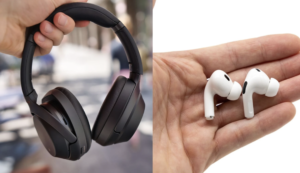
Matching the format to a specific daily routine matters more than chasing the single best-reviewed model on the market. A commuter switching between walking, transit, and an office desk throughout the day benefits from the compact, easy-to-pocket nature of earbuds, while someone working a long remote shift at a home desk may prefer the sustained comfort and stronger cancellation of over-ear headphones.
Exercise and sweat resistance tilt the decision further toward earbuds for anyone incorporating workouts into a daily audio routine, since most earbud models carry water and sweat resistance ratings that over-ear headphones rarely match. Meanwhile, anyone prioritizing video calls throughout the day may lean toward over-ear headphones with a boom or built-in microphone array better suited to picking up voice clearly in a noisy home environment.
- Daily commuters: Compact earbuds fit easily in a pocket or bag between transit, walking, and desk use.
- Remote desk workers: Over-ear headphones offer sustained comfort and stronger cancellation for long stationary sessions.
- Frequent exercisers: Sweat and water resistance make earbuds the more practical choice for active use.
- Heavy video-call users: Over-ear models with dedicated microphone arrays often capture voice more clearly.
- Frequent flyers: Longer single-charge battery life and stronger low-frequency cancellation favor over-ear headphones.
A shopper who splits time across several of these categories may ultimately benefit from owning both formats rather than forcing a single device to cover every scenario equally well.
Open-plan office environments deserve a specific mention, since they represent one of the most common daily use cases driving demand for both formats. The steady hum of HVAC systems, combined with unpredictable bursts of nearby conversation, creates a mixed noise profile that neither format handles perfectly on its own.
Over-ear headphones tend to suppress the steady background hum more thoroughly, while the irregular conversation bursts often slip through regardless of format, since voice frequencies sit in a range that active cancellation technology generally struggles to eliminate completely without also muffling music or calls. Pairing either format with a focus-friendly audio track, such as low-level ambient sound, is a common workaround office workers use to mask the voice frequencies that cancellation alone cannot fully remove.
Climate and seasonal use patterns shape format preference as well, even though this factor rarely appears in buying guides. Over-ear headphones can trap heat against the ears during hot, humid months, leading some wearers to switch to earbuds seasonally purely for comfort reasons unrelated to sound quality or cancellation strength.
Earbuds carry the opposite seasonal consideration, since cold weather can make silicone ear tips feel stiffer and less comfortable immediately after being outdoors, a minor issue that typically resolves within a few minutes as the tips warm against body heat.
Avoiding Common Mistakes When Choosing a Model
A frequent mistake is prioritizing cancellation strength above all else without weighing sound quality, comfort, and battery life together as a package. Two models can offer similarly strong cancellation while differing sharply in how natural voices and music sound, and a buyer focused purely on cancellation specifications can end up disappointed by the overall listening experience.
Another common mistake is skipping the return policy check before buying, especially for earbuds, where ear tip fit cannot be judged from a product page alone. A retailer offering a generous return window, often thirty days or more, removes much of the risk tied to a purchase where comfort and seal quality only become clear after real-world use.
- Spec-chasing: Focusing only on cancellation strength while ignoring comfort and sound balance.
- Skipping return policies: Buying earbuds without confirming a fair return window for fit issues.
- Ignoring app requirements: Some models require a companion app for full feature access, which not every buyer wants.
- Overlooking call quality: Assuming music performance predicts voice call clarity, which does not always hold true.
Reading reviews that specifically address call quality and app reliability, rather than only music playback and cancellation strength, rounds out the picture before committing to a purchase.
Multipoint connectivity is a feature worth checking for anyone who regularly switches between a laptop and a phone throughout the day. Models that support pairing with two devices at once allow audio to jump automatically between a work call on a laptop and a notification on a phone without manually reconnecting each time, a convenience that saves real friction for hybrid workers.
Not every model, even among premium options, supports this feature well, and some implementations lag noticeably behind others when switching sources, so checking recent reviews specifically for multipoint performance is worthwhile rather than assuming the feature works identically across brands.
Final Thoughts
Choosing between noise-canceling headphones and earbuds comes down to matching the format’s inherent tradeoffs to a specific daily routine rather than chasing whichever option carries the most hype at a given moment. Over-ear headphones tend to win on raw cancellation strength, battery life, and long-term durability, while earbuds win on portability, exercise compatibility, and all-day convenience for anyone moving frequently between settings.
Testing a model in person whenever possible, checking the return policy carefully for earbuds, and factoring in the full cost of ownership rather than just the sticker price all lead to a more satisfying purchase. For many people, the right answer is not picking a single winner between the two formats but recognizing which one fits the bulk of a typical week and buying accordingly, then treating any secondary device as a complement rather than a redundant purchase.
Frequently Asked Questions
Which format cancels noise better overall?
Over-ear headphones generally provide stronger, more consistent cancellation due to their larger, more stable seal. Earbuds can come close with a good tip fit, but performance varies more from person to person based on ear canal shape.
Are earbuds less comfortable than headphones for long wear?
It depends on the individual. Some people find in-ear pressure from earbuds more tiring over several hours, while others find the clamping force of over-ear headphones less comfortable, especially if they also wear glasses.
Do noise-canceling earbuds work well for phone calls?
Quality varies widely by model. Many modern earbuds use multiple microphones and wind-reduction processing that perform well, but checking call-quality reviews for a specific model is worthwhile before relying on it for daily calls.
How often do noise-canceling earbuds need replacing?
Most earbuds show noticeable battery degradation within one to two years of daily use, since the small internal batteries cannot be replaced individually. Over-ear headphones often last longer since more components, like cushions, are replaceable.
Is it worth owning both formats instead of choosing just one?
For anyone with varied daily routines, such as commuting, exercising, and working from a desk, owning both can make sense. Each format suits certain situations better, and the combined cost may still be reasonable compared with one premium device.
Do more expensive models always cancel noise better?
Not always. Price often reflects build quality, sound tuning, and extra features like app customization as much as raw cancellation strength. Reading independent reviews that test cancellation specifically is more reliable than assuming price alone predicts performance.