
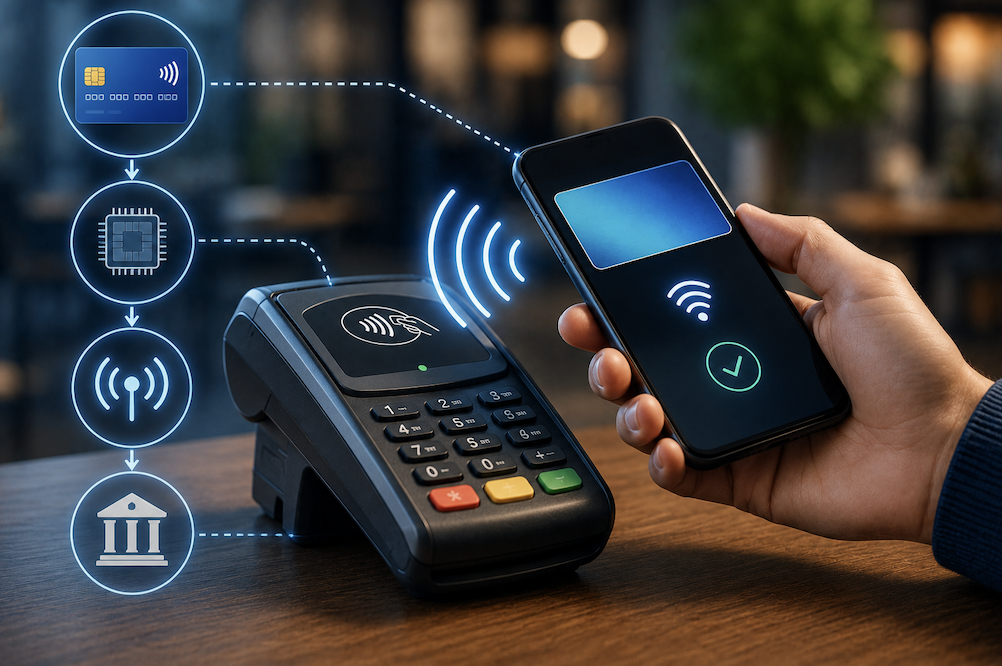
Tapping a card or phone against a payment terminal has become such a routine part of daily shopping that few people stop to consider the technology quietly making it possible. Contactless payments feel almost instantaneous, yet a surprising amount of secure, precise engineering happens in that brief tap. This article explains exactly how contactless payment technology works and what keeps those transactions secure.
The Core Technology Behind Contactless Payments
Contactless payments rely on a short range wireless technology called near field communication, often abbreviated as NFC. This technology allows two devices, in this case a payment card or phone and a payment terminal, to exchange data wirelessly when held within a very short distance of each other, typically just a few centimeters.
Unlike Wi-Fi or Bluetooth, which can maintain connections over much longer distances, NFC is intentionally designed for extremely short range communication, which actually serves as a built in security feature by making it far more difficult for an unauthorized device to intercept a transaction from any meaningful distance away.
How a Contactless Transaction Actually Happens
When you hold your card or phone near a contactless enabled terminal, the terminal generates a small electromagnetic field. This field powers a tiny antenna embedded within your card or phone, allowing it to transmit encrypted payment information back to the terminal without requiring any physical battery power from a standard payment card.
- The terminal generates a short range electromagnetic field when a payment is initiated
- This field powers the antenna inside your contactless card, even without a battery
- Encrypted payment data transmits wirelessly between your card and the terminal
- The transaction typically completes and gets approved within just a second or two
Phones using contactless payment work slightly differently, since they have their own battery and processing power, but the underlying NFC communication with the terminal follows the same basic wireless principle.
Why Contactless Payments Are Genuinely Secure
Each contactless transaction generates a unique, one time code rather than transmitting your actual, reusable card number directly to the terminal. This means even if someone intercepted the wireless signal during a transaction, the captured data would be useless for any future purchase, since that specific code only works for that single transaction.
- Each transaction uses a unique, single use code rather than reusable card details
- The extremely short transmission range makes unauthorized interception genuinely difficult
- Phone based contactless payments often add fingerprint or face authentication as an extra layer
- Transaction data is encrypted throughout the entire brief wireless exchange
Common Misconceptions About Contactless Payment Security
A persistent myth suggests that criminals can easily steal your card details simply by walking past you with a hidden scanner. In reality, the extremely short range required for NFC communication, combined with the unique transaction codes generated for each payment, makes this type of theoretical attack significantly more difficult and far less practical than popular imagination often suggests.
That said, reasonable precautions, like using a card holder with basic shielding if you are especially cautious, do not hurt, even though the actual real world risk of this specific attack remains genuinely low for most everyday users.
Practical Tips for Using Contactless Payments Safely
- Monitor your account statements regularly for any unfamiliar transactions, contactless or otherwise
- Enable transaction notifications through your bank or card provider for real time purchase alerts
- Use phone based contactless payments when possible, since they often include added biometric authentication
- Report a lost or stolen contactless card immediately to prevent any unauthorized physical use
How Contactless Payment Adoption Has Grown Over Time
Contactless payment technology existed for years before it became a genuinely mainstream habit, and its rapid adoption was significantly accelerated by a widespread global shift toward minimizing physical contact during everyday transactions. Retailers that once viewed contactless terminals as an optional convenience quickly began treating them as a baseline expectation, and many countries saw contactless spending limits raised specifically to accommodate this surge in everyday usage.
This growth has extended well beyond simple retail purchases. Public transit systems in many major cities now accept contactless card or phone payments directly at the fare gate, eliminating the need for a separate transit card entirely. Vending machines, parking meters, and even some small local businesses have increasingly adopted contactless terminals, reflecting just how thoroughly this technology has embedded itself into everyday routines across a wide range of settings.
- Global events accelerated contactless adoption significantly beyond its earlier, more gradual growth
- Many countries raised contactless spending limits to accommodate growing everyday usage
- Public transit systems increasingly accept direct contactless payment without a separate transit card
- Smaller businesses and vending machines have steadily adopted contactless terminals as well
This broad, continued expansion suggests contactless payment technology will likely keep extending into new everyday contexts, building on the same core NFC technology that already handles billions of transactions worldwide each year.
Final Thoughts
Contactless payment technology combines short range wireless communication with strong encryption and unique transaction codes to deliver a payment experience that is both remarkably fast and genuinely secure. Understanding how NFC actually works behind that brief tap helps explain why this technology has become such a trusted, everyday part of how people pay for purchases around the world today.
Frequently Asked Questions
1. Can someone steal my card information just by standing near me?
This is largely a myth. The extremely short range required for NFC communication, combined with unique transaction codes for each payment, makes this type of theoretical attack significantly more difficult than commonly believed.
2. Is contactless payment slower or faster than inserting a chip card?
Contactless payment is generally faster, often completing in about a second or two, compared to the slightly longer process of inserting and waiting for a traditional chip card transaction to complete.
3. Do contactless payments work without an internet connection?
The payment terminal itself typically needs a connection to process the transaction with your bank, though the brief wireless exchange between your card or phone and the terminal happens locally without requiring your own device to be connected to the internet.
4. Is there a limit to how much I can spend using contactless payment?
Many card issuers and countries do set contactless spending limits for security purposes, though this varies by region and provider, and larger purchases may require inserting your card and entering a PIN instead.