
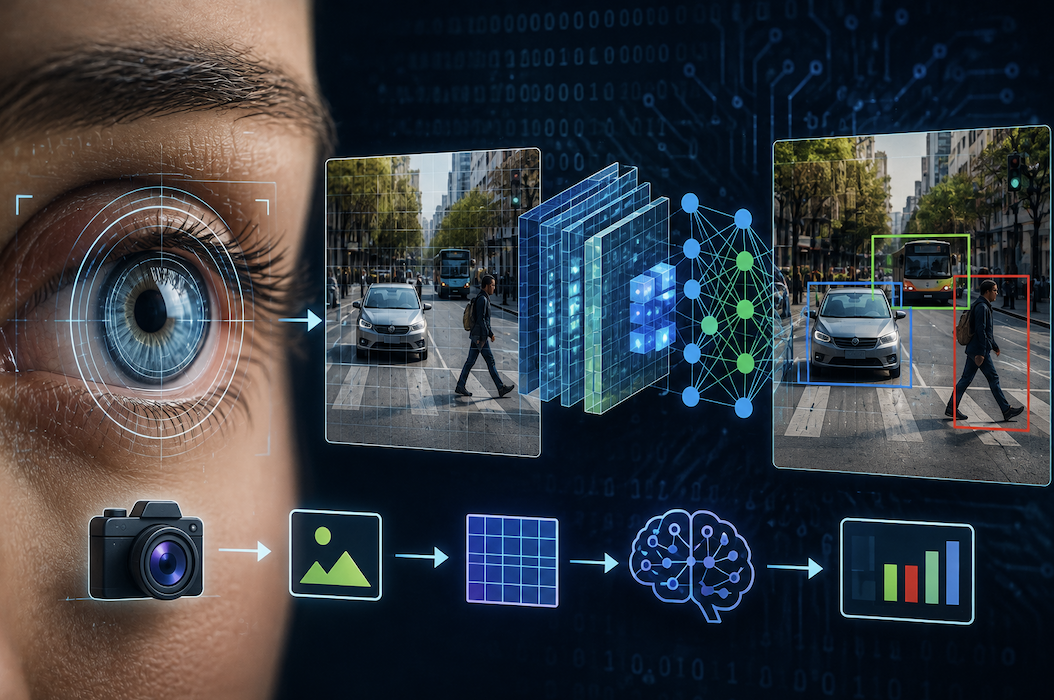
Self-checkout kiosks that recognize produce, phones that unlock by looking at your face, and cars that detect pedestrians all rely on the same underlying technology: computer vision. It is one of the most widely deployed branches of artificial intelligence, quietly working behind the scenes most people never think twice about. This article explains what computer vision actually is and how it manages to make sense of the visual world.
What Computer Vision Actually Means
Computer vision is a field of artificial intelligence focused on enabling computers to interpret and understand visual information from the world, whether that comes from a photo, a video feed, or a live camera. The goal is teaching a machine to do something humans do almost effortlessly: look at an image and understand what it actually contains, not just the raw pixels but the objects, people, text, and context within it.
This is a genuinely difficult problem for a computer, since an image is fundamentally just a grid of numbers representing color values. Turning that raw numerical data into an understanding of “this is a dog sitting on a chair” requires layers of processing that took decades of research to develop effectively.
How Computer Vision Systems Actually Process an Image
Modern computer vision relies heavily on neural networks specifically designed to process visual data, often called convolutional neural networks. These systems analyze an image in stages, first detecting simple features like edges and colors, then combining those simple features into increasingly complex patterns, eventually recognizing shapes, objects, and entire scenes.
- Early processing layers detect basic features like edges, corners, and color gradients
- Middle layers combine these basic features into recognizable shapes and textures
- Later layers assemble these shapes into full object recognition, like identifying a face or a car
- The system was trained on millions of labeled images to learn these patterns statistically
This layered approach mirrors, in a rough sense, how the human visual system processes information, building from simple signals toward complex understanding, though the actual underlying mechanisms are quite different from biological vision.
Everyday Applications Powered by Computer Vision
- Facial recognition systems used to unlock smartphones and verify identity
- Quality control systems on manufacturing lines that spot defective products automatically
- Medical imaging tools that help identify potential abnormalities in scans
- Self-driving car systems that detect pedestrians, other vehicles, and road signs
- Retail checkout systems that identify products without manual barcode scanning
- Photo organization apps that automatically group images by the people or objects they contain
Each of these applications relies on the same fundamental capability: extracting meaningful, structured understanding from what would otherwise be an enormous, unstructured grid of pixel values.
Why Computer Vision Still Struggles With Certain Situations
Despite genuine advances, computer vision systems can still be fooled or confused by situations that a human would handle effortlessly. Poor lighting, unusual camera angles, partially obscured objects, or visually similar but distinct objects can all reduce accuracy meaningfully.
- Unusual lighting conditions can significantly reduce recognition accuracy
- Objects partially blocked from view are harder to identify confidently
- Visually similar objects, like different dog breeds, can be confused by less sophisticated systems
- Systems trained primarily on one type of data can struggle with unfamiliar variations
This is exactly why critical applications, like medical diagnosis or self-driving cars, generally combine computer vision with additional sensors and human oversight rather than relying on visual recognition alone.
How Training Data Shapes What a System Can Actually Recognize
A computer vision system can only reliably recognize what it was actually trained to recognize. If the training data lacked diversity in lighting conditions, camera angles, or represented subjects, the resulting system will likely perform worse in situations that differ meaningfully from that training data. This is why data quality and diversity matter just as much as the underlying model architecture itself.
- Training data diversity directly determines what real-world situations a system handles well
- Underrepresented scenarios in training data lead to weaker performance in those same situations
- Ongoing retraining with new data helps systems adapt to previously unfamiliar conditions
- Responsible development involves actively testing for these gaps rather than assuming broad coverage
How Computer Vision Differs From Simple Image Recognition Software
It helps to distinguish genuine computer vision from simpler, older approaches that sometimes get lumped together under the same general label. Early image recognition software often relied on matching an image against a fixed database of known reference images, which worked only for exact or very close matches and failed completely when presented with genuinely novel variations.
Modern computer vision, by contrast, learns generalizable patterns rather than memorizing specific reference images, allowing it to recognize a dog it has never specifically seen before, based on learned patterns about what generally makes something look like a dog. This generalization ability is precisely what separates genuinely capable computer vision systems from earlier, far more limited approaches that could only handle narrow, predefined matching tasks.
- Older approaches relied on matching against fixed, predefined reference databases
- Modern systems learn generalizable visual patterns rather than memorizing specific examples
- This generalization allows recognition of genuinely novel objects never specifically seen during training
- The shift toward learned, generalizable patterns is what enabled the current wave of practical applications
Final Thoughts
Computer vision has quietly become one of the most widely deployed forms of artificial intelligence, powering everything from unlocking your phone to helping cars detect pedestrians. Understanding how it actually processes visual information, layer by layer, from simple edges to complex recognition, helps explain both its impressive capabilities and its genuine, ongoing limitations.
Frequently Asked Questions
1. Is computer vision the same thing as facial recognition?
Facial recognition is one specific application of computer vision, focused narrowly on identifying faces, while computer vision more broadly covers recognizing any visual content, including objects, text, scenes, and movement.
2. Can computer vision systems see as well as humans?
In some narrow, well-defined tasks, computer vision can match or exceed human accuracy, but it generally lacks the flexible, contextual understanding humans apply naturally across unfamiliar or ambiguous visual situations.
3. Why do computer vision systems sometimes make embarrassing mistakes?
Mistakes often stem from training data that did not adequately represent the specific situation encountered, or from genuinely ambiguous visual input that would challenge even a careful human observer.
4. Does computer vision require an internet connection to work?
Not always. Many modern devices process computer vision tasks directly on the device itself, particularly for features like face unlock, without needing to send image data to an external server.