Internet service providers frequently advertise fiber internet as the fastest, most reliable option available, but the actual technology behind those glowing marketing claims often goes unexplained. Unlike older internet technologies that rely on electrical signals traveling through copper wires, fiber internet uses an entirely different approach involving light. This article explains exactly how fiber internet works and why it genuinely outperforms older connection types.
What Makes Fiber Internet Fundamentally Different
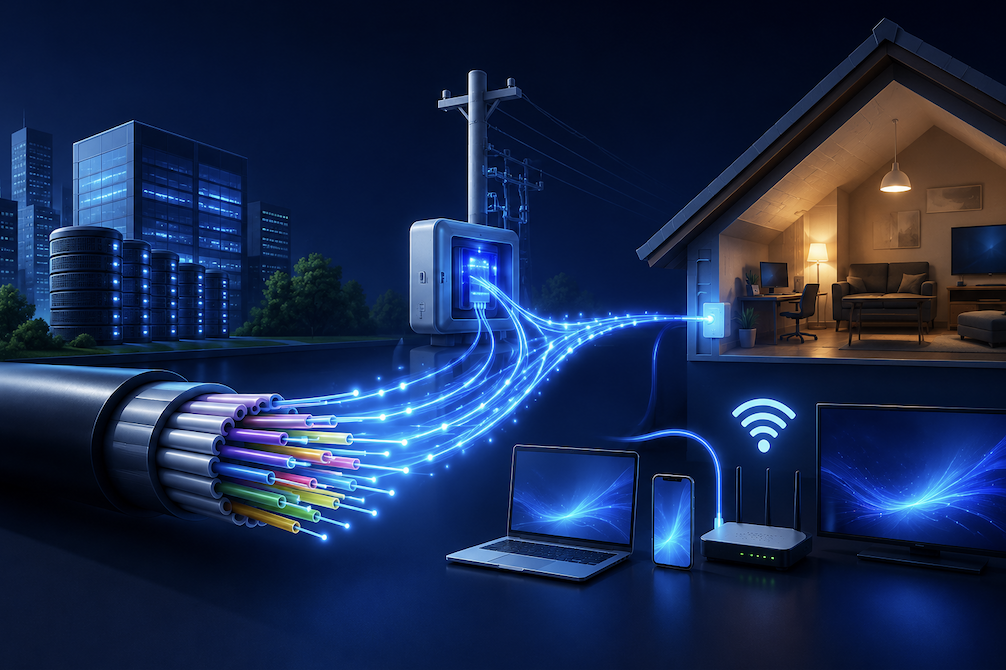
Traditional internet connections, including DSL and cable, transmit data using electrical signals sent through copper wiring. Fiber internet instead uses incredibly thin strands of glass or plastic, each roughly the width of a human hair, to transmit data as pulses of light rather than electrical signals.
This fundamental difference in how data actually travels is the primary reason fiber internet can achieve significantly higher speeds and more consistent performance compared to older, copper based technologies, which are inherently more limited by the physical properties of electrical signal transmission.
How Light Actually Carries Your Data
Inside a fiber optic cable, data gets converted into rapid pulses of light generated by a laser or LED light source. These light pulses travel through the thin glass or plastic strand, bouncing along its internal walls through a principle called total internal reflection, which keeps the light contained and traveling efficiently along the length of the cable with minimal signal loss.
At the receiving end, a sensor converts these light pulses back into the digital data your devices can actually use. Because light travels so quickly and experiences considerably less interference and signal degradation compared to electrical signals traveling through copper, fiber connections can maintain high speeds over much longer distances.
- Data gets converted into rapid light pulses at the sending end of the connection
- Light travels through the fiber strand using total internal reflection to stay contained
- A receiving sensor converts light pulses back into usable digital data
- Minimal signal loss allows fiber to maintain speed and quality over long distances
Why Fiber Handles Multiple Users Better Than Older Technology
Cable internet connections often share bandwidth among multiple households within the same neighborhood, which can cause noticeable slowdowns during peak usage hours when many people are online simultaneously. Fiber connections are typically architected differently, often providing more dedicated bandwidth capacity per household rather than sharing a single limited connection across an entire neighborhood.
This structural difference is a major reason fiber internet tends to maintain more consistent speeds throughout the day, even during periods when cable based connections in the same area might slow down considerably due to shared network congestion.
The Real World Speed and Reliability Advantages
- Significantly higher maximum speeds compared to most cable and DSL connections
- More symmetrical speeds, meaning uploading data is often just as fast as downloading it
- Greater resistance to electrical interference, since light signals are not affected by nearby electronics
- More consistent performance during peak usage hours compared to shared cable connections
Why Fiber Is Not Yet Available Everywhere
Despite its clear advantages, fiber internet infrastructure is expensive and time consuming to install, requiring new cables to be physically run to each individual home or building. This is exactly why fiber availability remains more limited in certain rural or lower density areas compared to widely established cable and DSL networks, even though many providers continue expanding their fiber coverage over time.
Practical Tips If You Are Considering Fiber
- Check availability directly with providers in your specific area, since coverage varies significantly by location
- Compare actual advertised upload speeds, not just download speeds, since fiber’s symmetrical speed is a genuine advantage
- Ask about installation requirements, since fiber sometimes requires professional installation of new cabling
- Consider your household’s actual usage patterns to determine whether the upgrade is worth any price difference
How Fiber Rollout Actually Happens in a Neighborhood
Understanding why fiber sometimes takes years to reach a particular area helps explain the practical reality behind its expansion. Providers typically begin by mapping out which neighborhoods offer the best return on the substantial cost of installation, often prioritizing densely populated areas where more customers can be served per mile of new cable installed.
Once a neighborhood is selected, crews need to run new fiber optic cable, either underground through existing utility conduits or overhead along utility poles, before individual homes can actually be connected. This process involves coordination with local government permitting, utility companies, and sometimes physical construction work, all of which takes considerably longer than simply activating an existing cable connection would.
- Providers prioritize areas offering the best financial return on installation costs
- New cable must be physically run, either underground or along utility poles, before connection is possible
- Local permitting and coordination with utility companies can add significant time to rollout
- Even after cable reaches a neighborhood, individual homes still need a separate connection installed
This lengthy, capital intensive process is exactly why fiber expansion often happens gradually, neighborhood by neighborhood, rather than becoming available everywhere all at once, even in regions where a provider has clearly committed to eventually offering the service.
Final Thoughts
Fiber internet represents a genuine technological leap forward, using light instead of electrical signals to deliver faster, more reliable, and more consistent internet performance. Understanding how this light based transmission actually works helps explain why fiber consistently outperforms older cable and DSL technology, even if it is not yet available in every neighborhood just yet, as providers continue steadily expanding their coverage year after year.
Frequently Asked Questions
1. Is fiber internet always faster than cable internet?
Generally yes, particularly for upload speeds, though actual real world performance also depends on your specific plan, provider, and local network conditions rather than the underlying technology alone.
2. Why is fiber internet not available in every area yet?
Installing fiber requires running new physical cabling to each individual location, which is expensive and time consuming, making it more common in densely populated areas where the cost can be spread across more customers.
3. Does weather affect fiber internet performance?
Fiber connections are generally more resistant to weather related interference compared to older technologies, since light signals are not affected by electrical interference the way copper based connections can be.
4. Is fiber internet worth the higher cost compared to cable?
For households with heavy internet usage, multiple simultaneous users, or a need for fast, reliable upload speeds, fiber often provides genuine value, while lighter internet users may not notice as significant a difference.