
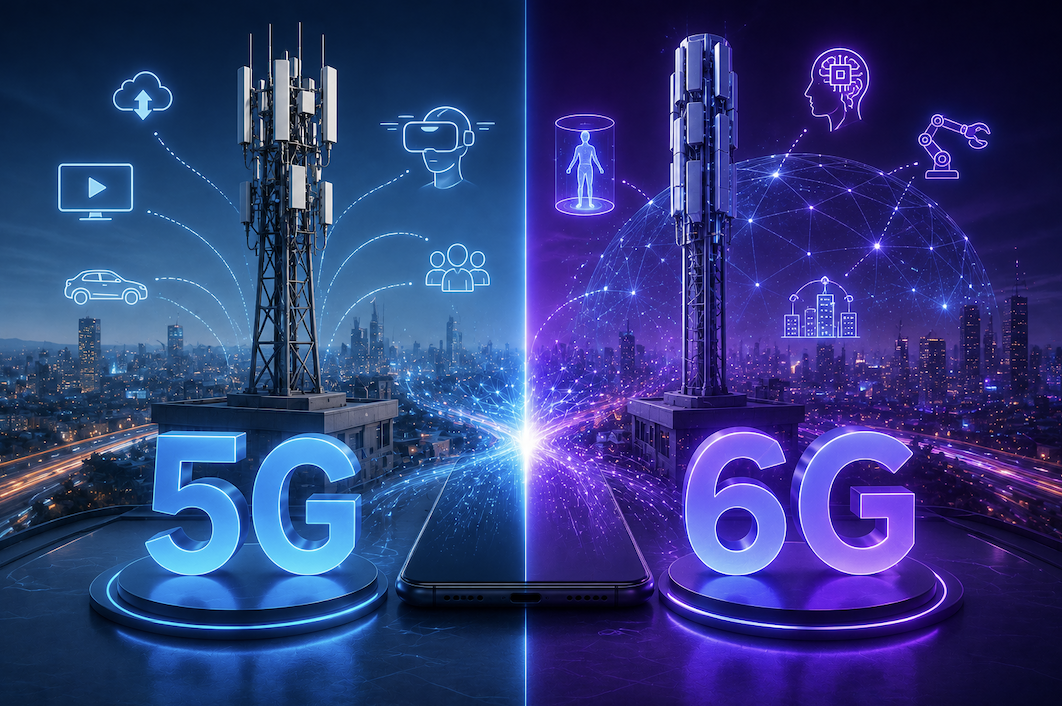
While many people are still getting used to 5G, researchers and telecommunications companies are already deep into developing the next generation of mobile networking technology. 6G remains years away from widespread consumer availability, but understanding what it actually promises helps clarify where mobile networking is genuinely headed next. This article explains how 6G is expected to differ from the 5G networks currently in use.
Where 5G Currently Stands and What It Actually Delivers
5G networks were designed to deliver significantly faster speeds, lower latency, and greater capacity for connected devices compared to previous 4G networks. In practice, this has enabled meaningfully faster mobile browsing, improved streaming quality, and better support for applications requiring real-time responsiveness, like certain gaming and video calling scenarios.
Despite these genuine improvements, 5G still has real limitations, particularly around consistent coverage, since achieving its highest speeds often requires infrastructure that is expensive and complex to deploy broadly, meaning many users experience speeds well below the technology’s theoretical maximum in everyday practical use.
What 6G Is Expected to Improve Upon
6G research is focused on pushing considerably further beyond what 5G currently offers, targeting improvements across several key dimensions of mobile network performance.
- Substantially higher theoretical maximum speeds compared to even the fastest current 5G deployments
- Meaningfully lower latency, potentially enabling new categories of real-time applications
- Greater network capacity, supporting an even larger number of simultaneously connected devices
- Improved energy efficiency, addressing growing concerns about the power demands of expanding networks
These are ambitious targets, and as with 5G, real-world performance will likely fall somewhat short of theoretical maximums in typical everyday usage, particularly during the early years of rollout.
The New Technical Approaches Being Explored for 6G
Researchers are exploring several genuinely new technical approaches to achieve these ambitious 6G goals, some of which represent meaningful departures from how current networks operate.
- Higher frequency spectrum usage, potentially including terahertz frequencies, to enable dramatically higher data rates
- Deeper integration between networking infrastructure and artificial intelligence for smarter, more adaptive network management
- Enhanced integration between terrestrial networks and satellite connectivity for more consistent global coverage
- New antenna technologies designed to more efficiently direct signals precisely toward connected devices
These higher frequency approaches, while promising for raw speed, also come with the same fundamental physics challenge that has affected higher frequency 5G deployments: signals at these frequencies travel shorter distances and are more easily blocked by physical obstacles, requiring considerably more infrastructure density to provide consistent coverage.
What New Applications 6G Might Genuinely Enable
- More advanced augmented and virtual reality experiences requiring extremely low latency
- More reliable support for autonomous vehicles requiring instant, dependable connectivity
- Advanced remote robotics and telepresence applications requiring near-instant response times
- More sophisticated smart city infrastructure coordinating enormous numbers of connected sensors simultaneously
Why 6G Remains a Genuinely Long-Term Development
Building an entirely new generation of mobile networking technology involves years of research, standardization, infrastructure development, and gradual rollout, mirroring the timeline that brought 5G from early research to widespread consumer availability. Based on typical technology development cycles and public research roadmaps, meaningful commercial 6G deployment is not expected until sometime toward the end of this decade at the earliest.
- New network standards require lengthy international coordination and formal standardization processes
- Infrastructure buildout takes years and requires substantial financial investment from telecommunications companies
- Consumer devices need time to be developed and adopted before a new standard sees meaningful real-world usage
- Historical patterns from previous network generation transitions suggest a similarly gradual rollout timeline for 6G
How Global Standardization Efforts Shape the 6G Timeline
Unlike a single company deciding on its own product roadmap, mobile network standards like 6G require extensive coordination among international standards bodies, telecommunications companies, equipment manufacturers, and government regulators across many different countries. This coordination ensures that devices and networks from different manufacturers and countries can actually work together reliably, but it also means the timeline is genuinely dependent on reaching broad, international consensus rather than any single organization’s individual pace.
This standardization process typically unfolds in stages, beginning with early research and technical proposals, followed by narrowing down competing approaches, and eventually formal ratification of an agreed upon global standard. Only after this lengthy process concludes does large scale infrastructure development and device manufacturing genuinely begin in earnest, which is exactly why realistic 6G timelines extend so far into the future compared to how quickly the technology might otherwise seem achievable.
- International standardization requires coordination across many countries and organizations
- This process unfolds in distinct stages, from early research through formal ratification
- Large scale infrastructure and device development only begins in earnest after standardization concludes
- This lengthy, coordinated process explains why realistic 6G timelines extend years into the future
Final Thoughts
6G represents the next significant step in mobile networking evolution, promising substantial improvements in speed, latency, and connected device capacity, though it remains a genuinely long-term development still years away from widespread consumer availability. Understanding what it aims to deliver, and the realistic timeline involved, helps set accurate expectations rather than anticipating a sudden, imminent shift away from the 5G networks most people currently rely on.
Frequently Asked Questions
1. When will 6G actually become available to consumers?
Based on current research timelines and typical technology development cycles, meaningful commercial availability is not generally expected until toward the end of this decade, though this timeline could shift as research progresses.
2. Will I need to buy an entirely new phone to use 6G once it launches?
Yes, similar to previous network generation transitions, 6G will likely require new hardware specifically designed to support its updated technical standards and frequency requirements.
3. Does 5G become obsolete once 6G launches?
No, similar to how 4G continued operating alongside 5G, 5G networks will likely continue functioning for many years after 6G begins rolling out, particularly in areas where 6G infrastructure has not yet been deployed.
4. What is the single biggest practical improvement 6G aims to deliver?
While faster speeds get the most attention, meaningfully lower latency and support for a much larger number of simultaneously connected devices may end up being the more practically significant improvements for many real-world applications.