Typing a short text description and watching a completely original image appear moments later still feels remarkable, even for people who use AI image generators regularly. Behind that seemingly magical process sits a genuinely fascinating technical approach that took years of research to perfect. This article explains how these tools actually transform a text prompt into a finished image.
The Core Idea Behind Modern Image Generation
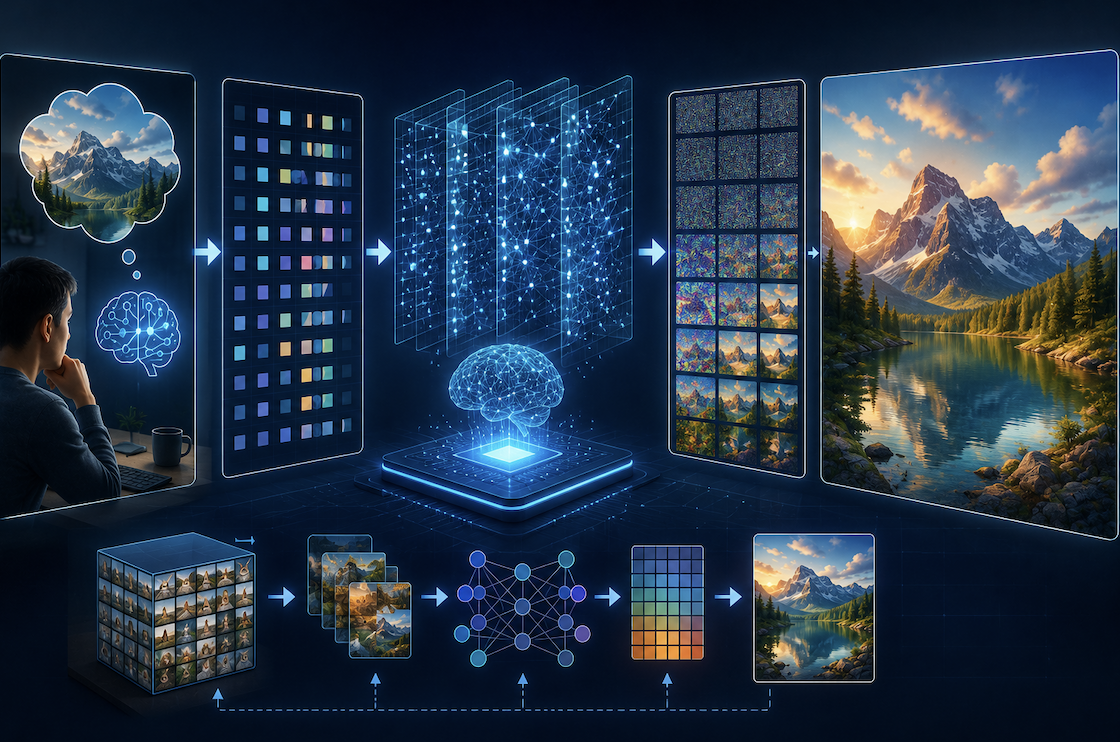
Most modern AI image generators rely on a technique called diffusion, which works in a way that initially sounds almost backwards. Rather than building an image up piece by piece the way a human artist might, a diffusion model starts with pure random noise, essentially visual static, and gradually refines that noise step by step until a coherent, detailed image emerges.
This approach was inspired partly by how these systems were trained. During training, the model was shown millions of real images that had noise progressively added to them until they became pure static, and it learned to reverse that process, predicting what noise should be removed at each step to recover something resembling the original image.
How a Text Prompt Actually Guides the Process
The text description you provide gets converted into a mathematical representation that captures its meaning, allowing the model to understand concepts like objects, styles, colors, and composition. This representation then guides the denoising process at every single step, nudging the gradually forming image toward something that matches the description you provided.
- Your text prompt gets converted into a numerical representation the model can process
- The generation process starts with random noise across the entire image canvas
- At each step, the model removes some noise while being guided by your text description
- After many refinement steps, a coherent, detailed image matching your description emerges
This entire process typically happens in a matter of seconds, running through dozens of refinement steps that each nudge the image slightly closer to the target you described.
Why the Same Prompt Can Produce Different Results
Because the process begins with random noise, running the exact same text prompt multiple times typically produces genuinely different images each time, since the starting point itself is randomized. This is actually a valuable feature rather than a limitation, allowing users to generate multiple variations of a concept and choose whichever result works best for their needs.
- Random starting noise means identical prompts naturally produce varied results
- This randomness allows for exploring multiple creative variations from a single prompt
- Some tools allow locking a specific random seed to reproduce a particular result later
- Adjusting prompt wording, even slightly, can meaningfully shift the resulting image
What These Systems Learned From and Why It Matters
AI image generators learn their capabilities from massive datasets of images paired with descriptive text, allowing them to learn statistical associations between words and visual concepts. This means the quality and diversity of that training data directly shapes what the model can and cannot generate convincingly.
- Training data diversity determines the range of styles, subjects, and concepts a model handles well
- Underrepresented visual concepts in training data lead to weaker or less accurate generation
- Bias present in training data can sometimes be reflected in generated outputs
- Ongoing model updates and retraining help address these gaps over time
Practical Tips for Getting Better Results From Image Generators
- Be specific about style, lighting, and composition rather than using vague descriptions
- Experiment with multiple generations, since randomness means results vary between attempts
- Break complex scenes into clearer, more specific descriptive language
- Review generated images critically, since these systems can still produce visual errors or inconsistencies
How These Tools Have Evolved Since Their Earliest Versions
Early attempts at AI image generation produced results that were often abstract, blurry, or only loosely related to the intended prompt, reflecting how immature the underlying technology still was at that stage of development. Each successive generation of models has brought noticeably sharper detail, better adherence to the specific text prompt provided, and considerably fewer visual errors and inconsistencies.
This rapid improvement has come from several combined factors, including larger and more carefully curated training datasets, refined diffusion techniques, and better methods for converting text descriptions into the guidance signal used throughout the generation process. Given how quickly this technology has advanced in just a few short years, it is reasonable to expect continued meaningful improvement in both accuracy and visual quality going forward.
- Early image generation models often produced blurry or only loosely accurate results
- Successive generations have brought sharper detail and better prompt accuracy
- Improvements stem from better training data, refined techniques, and improved text guidance methods
- Continued rapid improvement remains a reasonable expectation given the pace of recent advancement
Final Thoughts
AI image generators achieve their seemingly magical results through a genuinely clever process: starting with random noise and gradually refining it into a coherent image, guided at every step by your text description. Understanding this underlying diffusion process helps demystify how these tools work, making it easier to use them effectively and set realistic expectations about their genuine capabilities and limitations.
Frequently Asked Questions
Do AI image generators copy existing images directly?
No, they generate entirely new images pixel by pixel through the diffusion process, rather than copying or collaging existing images, though the resulting style is influenced by patterns learned from training data.
Why do AI generated images sometimes have strange errors, like extra fingers?
These errors often occur because certain complex visual details, like hands, are harder for the model to consistently learn accurate patterns for compared to simpler, more common visual elements.
Can I get the exact same image again if I really like a specific result?
Many tools allow you to save or lock the specific random seed used for a generation, which allows you to reproduce that same result again, sometimes with minor prompt adjustments.
Is the technology behind image generation the same as the technology behind text generation?
Not exactly, though both fall under generative AI broadly. Text generation typically relies on predicting sequences of words, while most modern image generation relies specifically on the diffusion process described here.