
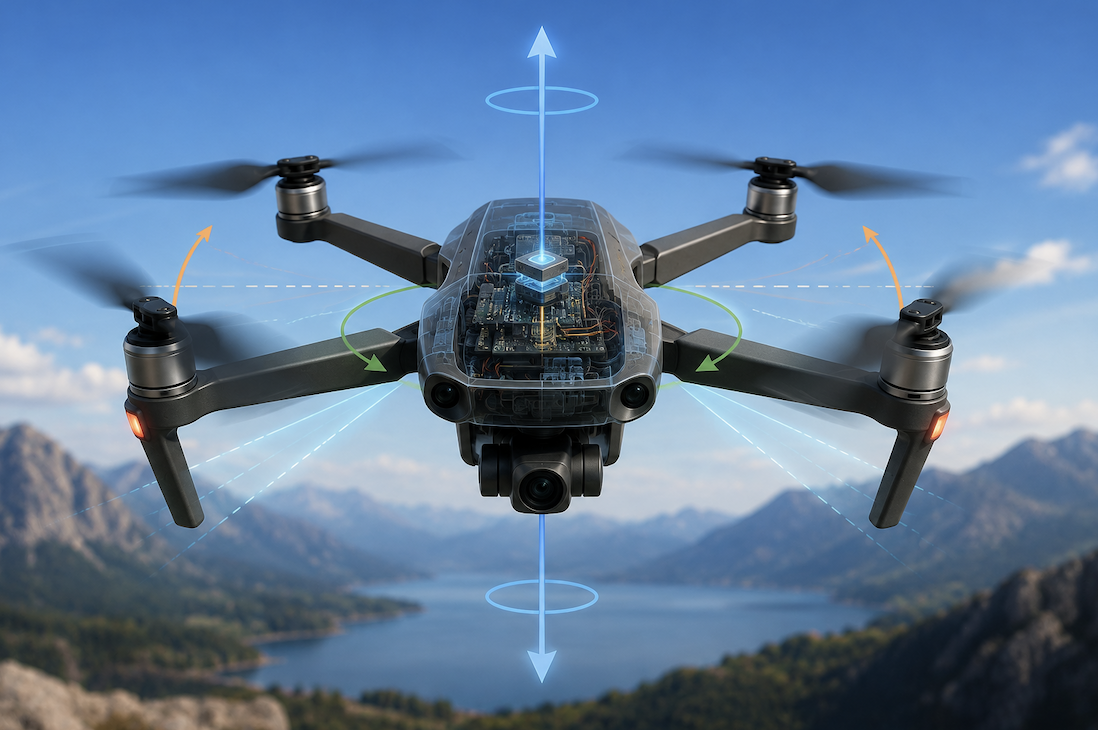
Watching a drone hover perfectly still in mid-air, or smoothly navigate through challenging wind conditions, represents a genuinely impressive feat of engineering that most people never stop to consider the complexity behind. Understanding how these devices actually maintain stability reveals a fascinating combination of sensors, rapid calculations, and precise motor control all working together many times per second.
Why Maintaining Stable Flight Represents a Genuine Engineering Challenge
Understanding the fundamental physics challenge drones face helps explain why stable flight requires considerably more sophisticated technology than simply spinning propellers to generate lift.
- Drones are inherently unstable without active, continuous correction from their control systems
- Even minor air currents or slight weight imbalances can genuinely affect a drone’s orientation and position
- Multiple propellers need precisely coordinated speed adjustments to maintain both stability and intended movement
- This coordination must happen continuously and extremely rapidly to prevent the drone from becoming genuinely uncontrollable
This inherent instability deserves particular emphasis, since a drone without active stabilization would genuinely struggle to maintain controlled flight for more than a few moments, meaning the sophisticated stabilization systems built into modern drones represent a genuinely essential component rather than simply an enhancement to otherwise naturally stable flight.
The Core Sensors That Enable Drone Stability
Understanding the specific sensor technology drones rely on to actually detect their current orientation and movement provides essential foundation for understanding how the broader stabilization system actually
functions.
- Gyroscopes detect rotational movement and help the drone understand its current orientation
- Accelerometers measure changes in speed and movement direction across multiple axes
- Barometric pressure sensors help determine and maintain altitude by measuring air pressure changes
- Some drones also incorporate GPS for additional position awareness, particularly during outdoor flight
These sensors work together continuously, providing the drone’s onboard flight controller with a constant, rapidly updating stream of data about the device’s actual current position, orientation, and movement, forming the essential foundational information that all subsequent stability corrections actually depend upon.
How the Flight Controller Actually Processes This Sensor Data
Understanding the genuine role of a drone’s flight controller, the central computing component that actually interprets sensor data and makes stability decisions, reveals how this rapid processing translates raw sensor information into actual stabilizing action.
- The flight controller continuously receives data from all the drone’s various sensors simultaneously
- This data gets processed to calculate the drone’s genuine current orientation and any needed corrections
- The flight controller then calculates precisely how each individual propeller’s speed should be adjusted
- These calculations and resulting adjustments happen many times per second for genuinely responsive stability
This processing speed deserves particular emphasis, since a drone’s flight controller typically performs these stability calculations hundreds of times per second, allowing it to respond to even brief, sudden disturbances, like a small gust of wind, considerably faster than would be humanly possible through manual piloting alone.
How Individual Propeller Speed Adjustments Actually Create Stability
Understanding the genuine mechanical principle behind how varying individual propeller speeds actually translates into overall drone stability and controlled movement provides insight into the final piece of this stabilization process.
- Each propeller’s speed can be adjusted independently from the others in real time
- Increasing speed on specific propellers while decreasing others creates controlled tilting or rotation
- This differential thrust approach allows the drone to actively counteract unwanted movement or maintain a stable hover
- The same fundamental principle also enables deliberate, controlled movement in any specific direction the pilot commands
This differential thrust principle deserves particular emphasis, since it represents the genuine mechanical foundation making all drone stability and movement possible, allowing a drone to make constant, subtle adjustments to individual propeller speeds that continuously counteract disturbances and maintain the pilot’s intended position or movement direction.
Why Wind and Environmental Conditions Still Genuinely Challenge Drone Stability
Understanding that even sophisticated stabilization systems face genuine limits when confronting particularly challenging environmental conditions helps set realistic expectations for drone performance across varying circumstances.
- Strong or gusty winds require more significant, rapid propeller adjustments to maintain stability
- Extremely challenging conditions can genuinely exceed a drone’s stabilization system’s practical capabilities
- Weight distribution changes, like an attached camera, affect how the stabilization system needs to compensate
- Understanding these genuine limitations helps explain why manufacturers specify particular operating condition recommendations
How GPS Enhances Stability for Outdoor Drone Flight Specifically
Understanding the additional stabilization benefit GPS technology provides specifically for outdoor drone operation helps clarify why this feature matters beyond simply navigation purposes alone.
- GPS provides additional positional reference data beyond what internal sensors alone can offer
- This allows drones to maintain a genuinely stable position even when experiencing wind or minor disturbances
- GPS-enabled position hold features use this data to automatically correct drift from an intended stationary position
- This capability represents a genuinely significant stability enhancement specifically for outdoor flight scenarios
Why Autonomous Stabilization Differs From Manual Piloting Assistance
Understanding the genuine distinction between a drone’s automatic stability corrections and features that specifically assist a human pilot in making deliberate movements helps clarify how these two related but distinct systems actually work together during typical flight.
The stabilization system described throughout this article operates continuously and automatically, regardless of whether a pilot is actively commanding movement, essentially serving as the constant background correction that keeps the drone controllable at all times. Pilot assistance features, by contrast, specifically help translate a human’s intentional joystick or app-based commands into smooth, appropriately calibrated movement, working alongside the underlying stabilization system rather than replacing it, meaning even a highly skilled manual pilot still fundamentally depends on this continuous automatic stabilization to keep the drone airborne and responsive throughout their flight.
- Automatic stabilization operates continuously regardless of whether a pilot is actively commanding movement
- Pilot assistance features specifically help translate human commands into smooth, calibrated movement
- These two systems work together rather than one replacing the other during typical flight operation
- Even highly skilled manual pilots genuinely depend on continuous automatic stabilization to maintain control
Final Thoughts
Drones achieve their remarkable stability through a sophisticated combination of sensors continuously detecting orientation and movement, a flight controller rapidly processing this data many times per second, and precise, differential propeller speed adjustments that actively counteract disturbances. Understanding this genuinely impressive engineering helps explain why modern drones can maintain such stable, controlled flight despite being fundamentally unstable machines that depend entirely on this continuous, rapid technical correction to remain airborne and controllable.
Frequently Asked Questions
1. Can drones maintain stable flight in genuinely strong wind conditions?
Modern drones can handle moderate wind reasonably well through their active stabilization systems, though genuinely strong winds can exceed what even sophisticated stabilization technology can fully compensate for, which is why most manufacturers specify recommended maximum wind conditions for safe operation.
2. Do all drones use the exact same sensors for stability, or does this vary by drone type?
While gyroscopes and accelerometers represent fairly universal components across most drones, more advanced or expensive models often incorporate additional sensors, like GPS or more sophisticated barometric pressure sensors, providing genuinely enhanced stability capabilities compared to more basic drone models.
3. How quickly can a drone’s stabilization system actually respond to sudden disturbances?
This happens remarkably quickly, often within milliseconds, since flight controllers perform their stabilization calculations many times per second, allowing for genuinely rapid correction of sudden disturbances like unexpected wind gusts.
4. Does adding a camera or other accessory to a drone genuinely affect its stability?
Yes, genuinely, since additional weight affects the drone’s balance and requires the stabilization system to compensate accordingly, which is why manufacturers typically design drones with specific weight capacity considerations and test stability performance with their intended accessories.
5. Can drone stabilization technology completely eliminate the need for pilot skill?
While stabilization technology handles the continuous, rapid technical corrections needed for basic stable flight, genuine piloting skill still matters for navigating complex environments, making deliberate movements, and responding appropriately to conditions that exceed the stabilization system’s automatic capabilities.