
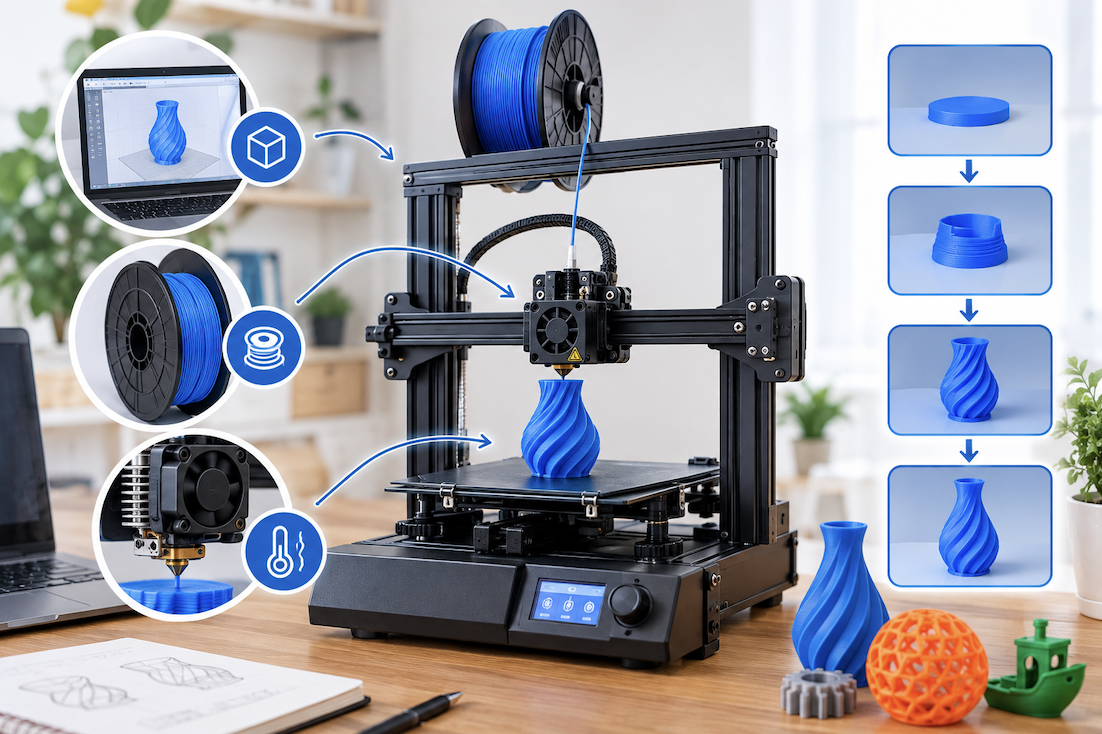
Watching a 3D printer gradually construct a genuinely solid, three-dimensional object from what began as a simple digital design represents a remarkable process that seems almost magical at first observation, yet understanding the actual underlying technology reveals a genuinely fascinating, methodical manufacturing process. Understanding how 3D printers actually work helps demystify this increasingly accessible technology that has moved from specialized industrial use toward genuine everyday consumer and hobbyist applications.
What 3D Printing Actually Means
3D printing refers to a manufacturing process that creates three-dimensional physical objects by building them up gradually, layer by layer, based on a digital design file. This differs fundamentally from traditional manufacturing methods, which typically involve cutting, carving, or molding material into a desired shape, since 3D printing instead genuinely constructs an object incrementally from essentially nothing, adding material specifically where needed according to the digital design.
Understanding this fundamental layer-by-layer construction approach genuinely matters, since it explains both 3D printing’s unique capabilities, like creating genuinely complex internal structures difficult to achieve through traditional manufacturing, and some of its inherent characteristics, like the visible layer lines sometimes noticeable on printed objects’ surfaces.
How the Basic 3D Printing Process Actually Works
Understanding the genuine, general process most 3D printers follow helps clarify how a digital design actually transforms into a physical object through this technology.
- A digital 3D design file provides the precise specifications for the object being created
- Specialized software converts this design into instructions the printer can actually follow
- The printer builds the object gradually, adding material in thin layers according to these instructions
- Each layer builds upon the previous one until the complete three-dimensional object is genuinely finished
This layer-by-layer instruction process deserves particular emphasis, since the software conversion step essentially breaks down the complete three-dimensional design into a series of individual, thin horizontal layers, then generates the specific movement and material deposition instructions the printer needs to follow to actually construct each individual layer in the correct sequence and position.
Understanding the Most Common Consumer 3D Printing Technology
Understanding the specific technology most commonly found in accessible, consumer-oriented 3D printers helps clarify how this particular popular approach actually creates physical objects.
- This common method works by melting a plastic filament material and depositing it through a heated nozzle
- The printer precisely moves this nozzle according to the design instructions, depositing melted material in the correct positions
- This deposited material cools and hardens quickly, maintaining its position as subsequent layers get added
- This process repeats layer by layer until the complete object has genuinely been constructed
How the Printer Actually Achieves Precise, Accurate Movement
Understanding the genuine mechanical systems allowing a 3D printer to actually achieve the precise positioning required for accurate object construction helps clarify this technology’s genuine engineering sophistication.
- Precise motors control movement along multiple different directional axes simultaneously
- This coordinated movement allows the printing mechanism to reach genuinely any position within the printer’s build area
- Sensors and control systems help ensure this movement remains genuinely accurate throughout the entire printing process
- This precision engineering allows for the genuinely detailed, accurate object construction 3D printing can achieve
Why Support Structures Sometimes Prove Genuinely Necessary
Understanding why some 3D printed designs require additional temporary support structures during the printing process helps clarify a practical consideration relevant to certain object geometries.
- Certain design shapes include overhanging sections that would genuinely lack support during initial layer construction
- Temporary support structures provide necessary physical support for these sections during the printing process
- These support structures typically get removed after printing completes, revealing the genuine final intended design
- Understanding this requirement helps clarify why certain complex designs require additional printing time and material
This overhang consideration deserves particular emphasis, since without adequate support, sections of a design extending outward without anything beneath them would genuinely have nothing to actually print onto during their specific layer, making temporary support structures a genuinely necessary practical solution for accurately constructing many complex, realistic object designs.
Common Applications of 3D Printing Technology
Understanding the range of genuine, practical applications where 3D printing has found meaningful use helps illustrate this technology’s broader significance beyond simply an interesting technical novelty.
- Rapid prototyping allows designers and engineers to quickly create physical models of new product designs
- Custom manufacturing enables creating genuinely personalized or specialized objects difficult to produce through traditional methods
- Educational applications help students understand design and engineering concepts through hands-on creation
- Hobbyist and creative applications allow individuals to design and create genuinely custom objects for personal use
Why Layer Height Settings Genuinely Affect Both Quality and Print Time
Understanding how adjusting the thickness of each individual printed layer creates a genuine trade-off between visual quality and total printing time helps clarify an important practical setting anyone using a 3D printer eventually needs to understand and adjust.
Thinner individual layers generally produce a smoother, more genuinely detailed final surface finish, since more numerous, finer layers create less visible stepping between each successive layer, though this improved quality comes at the cost of considerably longer total printing time, since the printer must complete more individual layers to reach the same overall object height. Conversely, thicker layers genuinely reduce total printing time considerably, though this comes at the cost of a more visibly rough, stepped surface texture, meaning choosing appropriate layer height involves a genuine, practical trade-off between prioritizing visual quality and total printing time based on your specific project needs and priorities.
- Thinner individual layers produce smoother, more detailed surfaces but require considerably longer printing time
- Thicker layers reduce total printing time but result in a more visibly rough, stepped surface texture
- This represents a genuine, practical trade-off between visual quality and time efficiency
- Choosing appropriate layer height depends on your specific project’s particular priorities and requirements
Final Thoughts
3D printing constructs physical objects through a genuinely methodical, layer-by-layer process, converting digital designs into real, three-dimensional objects through precisely controlled material deposition and positioning systems. Understanding this underlying technology helps demystify how this increasingly accessible manufacturing method actually works, while illustrating why it has found genuine, practical application across prototyping, education, custom manufacturing, and hobbyist creative pursuits.
Frequently Asked Questions
1. What materials can 3D printers actually use beyond plastic filament?
While plastic filament represents the most common consumer 3D printing material, other 3D printing technologies can work with materials including resin, metal powder, and even certain food materials, though these alternative materials often require specialized, different printer types beyond typical consumer models.
2. How long does it typically take to 3D print a genuine object?
This varies enormously based on object size, complexity, and the specific layer height settings used, ranging from relatively quick prints taking under an hour for simple, small objects to considerably longer prints spanning many hours or even days for larger, more complex designs.
3. Do I need genuine design expertise to actually use a 3D printer?
While creating your own original designs does benefit from some design software familiarity, many 3D printer users access pre-made design files created by others, making basic 3D printer operation accessible even without extensive personal design expertise.
4. Can 3D printers create genuinely functional objects, or only decorative items?
3D printers can genuinely create functional objects, including working mechanical parts, tools, and replacement components, though the specific functional capability depends on the printer’s precision, the material used, and the specific object’s actual design and intended use requirements.
5. Is 3D printing technology genuinely accessible for typical home hobbyist use?
Yes, increasingly, consumer 3D printers have become considerably more affordable and user-friendly in recent years, making this technology genuinely accessible for hobbyist use, though achieving genuinely high-quality, consistent results still typically benefits from some learning and practice.