
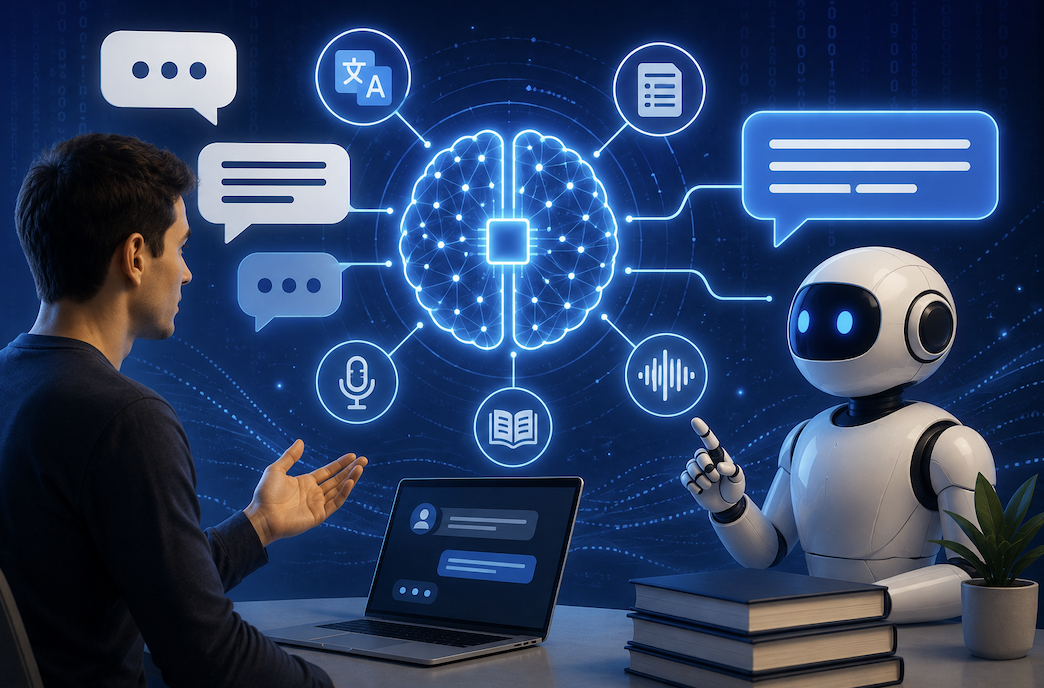
Every time you ask a voice assistant a question, type a search query, or watch a chatbot respond in fluent sentences, a technology called natural language processing is working behind the scenes to make that interaction possible. It is one of the foundational building blocks of modern AI, yet most people who benefit from it daily have never had it explained in plain terms. This article breaks down what NLP actually is, how it works, and why it matters so much to the technology you already use.
What Natural Language Processing Actually Means
Natural language processing, often shortened to NLP, is a branch of artificial intelligence focused specifically on helping computers understand, interpret, and generate human language. Human language is messy and full of ambiguity, slang, sarcasm, and context dependent meaning, all things that come naturally to people but historically proved extremely difficult for computers to handle reliably.
NLP bridges that gap by combining linguistics, statistics, and machine learning to teach computers how to process text and speech in ways that capture meaning rather than just matching keywords. This is what allows a search engine to understand what you actually meant, even when your query is phrased awkwardly or contains a typo.
How NLP Actually Works Behind the Scenes
Modern NLP systems typically begin by breaking text down into smaller pieces called tokens, which might be individual words or parts of words, depending on the specific system. From there, the model analyzes relationships between these tokens, learning patterns about grammar, meaning, and context from massive amounts of training text.
Rather than following rigid, hand written grammar rules, most modern NLP relies on machine learning models trained on huge datasets of real world text, allowing them to statistically learn how language actually works in practice, including its many exceptions and irregularities.
- Text gets broken down into smaller units called tokens before any analysis happens
- The model learns statistical relationships between words based on massive training datasets
- Context surrounding a word heavily influences how the system interprets its meaning
- Modern systems handle ambiguity far better than older, rule based approaches ever could
Everyday Technology Powered by NLP
- Search engines that understand the intent behind a query, not just matching exact keywords
- Voice assistants that convert spoken language into text and generate spoken responses
- Spam filters that analyze email content to identify unwanted or malicious messages
- Translation tools that convert text between languages while preserving meaning and context
- Sentiment analysis tools that determine whether a piece of text expresses a positive or negative tone
Each of these applications relies on the same underlying foundation: teaching a computer to work with human language in a way that captures actual meaning rather than surface level text matching.
Why Understanding Context Remains the Hardest Part
Even with significant advances, context remains one of the most challenging aspects of natural language processing. The same word can mean completely different things depending on the sentence surrounding it, and sarcasm, idioms, and cultural references can easily confuse even sophisticated systems.
Modern NLP models handle this far better than earlier generations by considering much larger amounts of surrounding text when interpreting meaning, rather than analyzing words in isolation. This broader context awareness is a major reason why today’s language tools feel dramatically more natural and accurate compared to systems from just a decade ago.
How NLP Continues to Improve Over Time
- Larger, more diverse training datasets help models learn a wider range of language patterns
- Improved model architectures allow systems to consider more context when interpreting meaning
- Multilingual training helps systems handle multiple languages more accurately within a single model
- Ongoing research into ambiguity and nuance continues to close the gap with genuine human understanding
How Businesses Actually Put NLP to Work
Beyond the consumer facing tools most people recognize, businesses across many industries quietly rely on NLP for tasks that would be impractical to handle manually at scale. Customer service teams use it to automatically categorize and route incoming support tickets based on their actual content, ensuring urgent issues reach the right team faster than manual sorting ever could.
Financial institutions use NLP to scan news articles and reports for relevant market signals, while legal teams use it to search through massive volumes of documents for specific clauses or relevant precedents. Social media platforms rely heavily on NLP to detect harmful content, moderate discussions, and understand trending topics across millions of posts simultaneously, a task that would be completely impossible to handle through manual review alone.
- Customer service teams use NLP to automatically categorize and prioritize incoming requests
- Financial analysts use NLP to scan news and reports for relevant market signals
- Legal teams use NLP to search large document collections for specific relevant content
- Social platforms use NLP at scale to moderate content and detect harmful material
What makes these business applications particularly valuable is the sheer scale involved. A human team simply could not manually review millions of social media posts or thousands of legal documents in a reasonable timeframe, and NLP makes that kind of large scale language analysis genuinely practical.
Final Thoughts
Natural language processing quietly powers a huge portion of the technology people interact with every single day, from search engines to voice assistants to spam filters. Understanding the basic idea behind it, teaching computers to genuinely interpret meaning rather than just matching text, makes it much easier to appreciate why some tools feel remarkably natural while others still occasionally misunderstand what you actually meant. As training techniques continue to improve, the gap between machine generated language and genuinely human communication keeps narrowing, one small technical refinement at a time.
Frequently Asked Questions
1. Is NLP the same thing as generative AI?
Not exactly. NLP is a broader field focused on understanding and processing human language, while generative AI, which often relies on NLP techniques, specifically focuses on producing new text or speech output.
2. Why do NLP systems sometimes misunderstand what I mean?
Because human language is genuinely ambiguous, and context, tone, and cultural references can be difficult even for sophisticated systems to interpret correctly, particularly with sarcasm or unusual phrasing.
3. Does NLP work equally well in every language?
Not always. NLP performance often depends on how much training data exists for a particular language, meaning widely spoken languages with abundant text data typically see better results than less common ones.
4. Is NLP only used in chatbots and voice assistants?
No, it powers a wide range of everyday technology, including search engines, spam filters, translation tools, and sentiment analysis used across customer service and social media monitoring.