
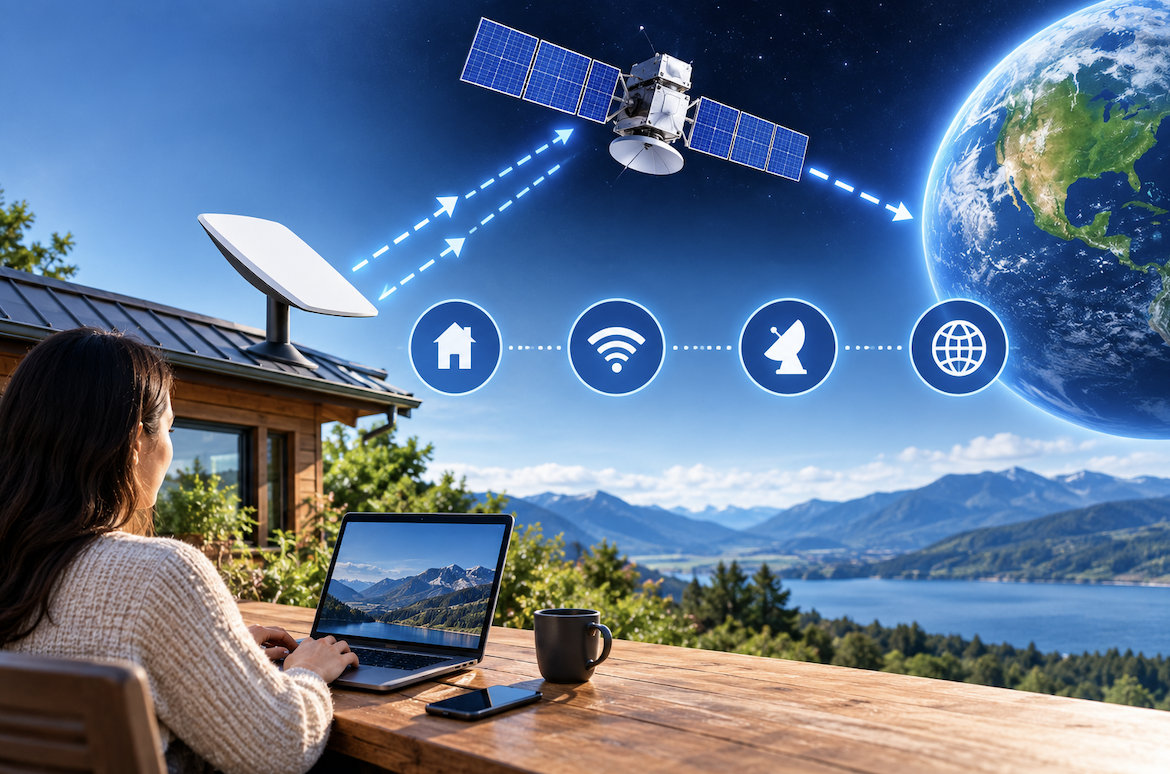
Rural and remote areas have historically struggled with limited internet access options, often relying on considerably slower connections than what urban areas typically enjoy, but satellite internet technology has genuinely expanded connectivity possibilities for these underserved regions. Understanding how this technology actually works, and its genuine trade-offs compared to traditional internet connections, helps clarify why this option has become increasingly significant for connecting previously underserved areas.
What Satellite Internet Actually Means
Satellite internet provides internet connectivity by transmitting data between your location and satellites orbiting Earth, rather than relying on physical cables running directly to your specific location the way traditional cable or fiber internet connections work. This approach allows internet access to reach genuinely remote areas where laying physical internet infrastructure would be prohibitively expensive or practically difficult.
Understanding this fundamental difference from cable-based internet genuinely matters, since it explains both satellite internet’s unique advantages for reaching remote areas and some of its genuine technical limitations compared to more traditional, cable-based internet connections available in more densely populated regions.
How Satellite Internet Actually Transmits Data
Understanding the genuine technical process behind how satellite internet actually moves data between your location and the broader internet helps clarify how this fundamentally different connectivity approach actually functions.
- A satellite dish at your location sends and receives signals to and from an orbiting satellite
- This satellite relays your data to a ground station connected to the broader internet infrastructure
- Your requests travel this genuine multi-step path before actually reaching their intended internet destination
- Responses travel back through this same general path before reaching your device
This multi-step transmission path deserves particular emphasis, since it directly explains one of satellite internet’s genuine technical characteristics, given that data traveling this longer physical path, especially to and from satellites positioned considerably far from Earth, inherently takes more time than data traveling through more direct, physical cable connections.
Understanding the Difference Between Traditional and Newer Satellite Systems
Understanding that satellite internet technology has genuinely evolved considerably, with newer approaches addressing some of the more significant limitations of earlier satellite internet systems, helps clarify why this technology has become increasingly viable in recent years.
- Traditional satellite internet relies on satellites positioned in considerably higher orbits above Earth
- Newer satellite internet systems use constellations of satellites positioned in genuinely lower orbits
- This lower orbital positioning significantly reduces the physical distance data needs to travel
- This reduced distance translates into genuinely improved speed and reduced delay compared to traditional satellite systems
This orbital distance difference deserves particular emphasis, since it represents the core technical innovation behind newer satellite internet systems’ improved performance, given that positioning satellites considerably closer to Earth genuinely reduces the physical travel time for data, addressing one of traditional satellite internet’s most significant historical limitations.
Why Satellite Internet Genuinely Experiences More Delay Than Cable Connections
Understanding why satellite internet typically exhibits more noticeable delay, called latency, compared to traditional cable or fiber connections helps clarify this technology’s genuine, inherent technical trade-off.
- Data traveling to and from satellites covers considerably more physical distance than data traveling through ground cables
- This additional distance inherently introduces more transmission delay, regardless of a satellite system’s genuine sophistication
- This delay matters particularly for activities requiring genuinely immediate response, like competitive online gaming
- Newer, lower-orbit satellite systems have meaningfully reduced this delay compared to older, higher-orbit alternatives
How Weather Conditions Genuinely Affect Satellite Internet Performance
Understanding that satellite internet connections can be genuinely affected by certain weather conditions in ways that typically do not affect underground cable connections helps clarify another important practical consideration for this technology.
- Heavy rain, snow, or severe weather can genuinely interfere with the signal between your dish and the satellite
- This interference can cause temporary connection slowdowns or, in more severe cases, brief connection interruptions
- This represents a genuine practical trade-off compared to underground cable connections, which weather does not directly affect
- Understanding this limitation helps set realistic expectations for satellite internet reliability during certain weather conditions
Why Satellite Internet Has Become Genuinely Important for Underserved Areas
Understanding the genuine, significant practical value satellite internet provides specifically for areas lacking traditional internet infrastructure options helps clarify this technology’s meaningful real-world impact beyond simply technical interest.
- Rural and remote areas often lack the population density justifying expensive traditional cable infrastructure investment
- Satellite internet provides a genuinely viable connectivity option without requiring this extensive physical infrastructure
- This technology has meaningfully expanded internet access for previously underserved or entirely unconnected areas
- This represents one of satellite internet’s most genuinely significant practical contributions beyond technical novelty alone
Comparing Satellite Internet to Other Available Connectivity Options
Understanding how satellite internet genuinely compares to alternative connectivity options helps clarify when this specific technology represents the most appropriate choice for a given situation.
- Cable and fiber internet generally offer faster speeds and lower delay where genuinely available
- Satellite internet provides connectivity in areas where these traditional options simply are not available
- Mobile data connections offer another alternative, though with their own genuine coverage and speed limitations
- Choosing the appropriate option depends significantly on what connectivity choices are actually available at your specific location
Why Newer Satellite Systems Require Considerably More Individual Satellites
Understanding why newer, lower-orbit satellite internet systems genuinely require deploying considerably more individual satellites compared to traditional satellite internet approaches helps clarify an important practical aspect of this improved technology’s actual implementation.
Since lower-orbit satellites cover considerably less geographic area individually compared to satellites positioned in higher, traditional orbits, providing consistent, genuine coverage across broad geographic regions requires deploying and coordinating a considerably larger number of these lower-orbit satellites working together as an integrated constellation. This increased satellite count represents a genuine trade-off underlying the improved speed and reduced latency these newer systems provide, since achieving this performance improvement required a fundamentally different, more complex approach to overall satellite deployment and coordination compared to the simpler, though less capable, traditional satellite internet model.
- Lower-orbit satellites cover considerably less geographic area individually than traditional higher-orbit satellites
- Achieving consistent broad coverage requires deploying many more satellites working together as a coordinated constellation
- This increased satellite count represents a genuine trade-off underlying newer systems’ improved performance
- Understanding this helps clarify the more complex infrastructure investment behind this improved satellite internet technology
Final Thoughts
Satellite internet provides genuine connectivity by transmitting data through orbiting satellites rather than physical cables, offering meaningful access to areas where traditional internet infrastructure is unavailable, while involving real trade-offs around latency and weather sensitivity compared to cable-based alternatives. Understanding both how this technology actually works and its genuine practical trade-offs helps clarify why it has become an increasingly important connectivity option, particularly as newer, lower-orbit satellite systems continue addressing some of this technology’s historical limitations.
Frequently Asked Questions
1. Is satellite internet fast enough for typical everyday activities like video calls and streaming?
Modern satellite internet, particularly newer lower-orbit systems, generally provides sufficient speed for most everyday activities including video calls and streaming, though performance can still vary based on weather conditions and overall network demand at any given time.
2. Does satellite internet require special equipment beyond what typical cable internet needs?
Yes, satellite internet requires a dedicated satellite dish and associated equipment specifically designed to communicate with orbiting satellites, representing different equipment requirements compared to the modem typically used for cable or fiber internet connections.
3. Why do some satellite internet systems experience more delay than others?
This primarily reflects the difference between traditional higher-orbit satellite systems and newer lower-orbit satellite constellations, with the considerably reduced physical distance in newer systems translating into meaningfully reduced transmission delay compared to older satellite technology.
4. Can satellite internet work anywhere on Earth, including genuinely remote locations?
Satellite internet generally offers considerably broader coverage than traditional cable infrastructure, though actual availability still depends on the specific satellite provider’s coverage area and whether your specific location has a sufficiently clear view of the sky for proper signal reception.
5. Is satellite internet typically more expensive than traditional cable or fiber internet?
Pricing varies by provider and specific plan, though satellite internet has historically often been priced somewhat higher than comparable traditional internet options in areas where both are genuinely available, reflecting the different infrastructure and operational costs involved.