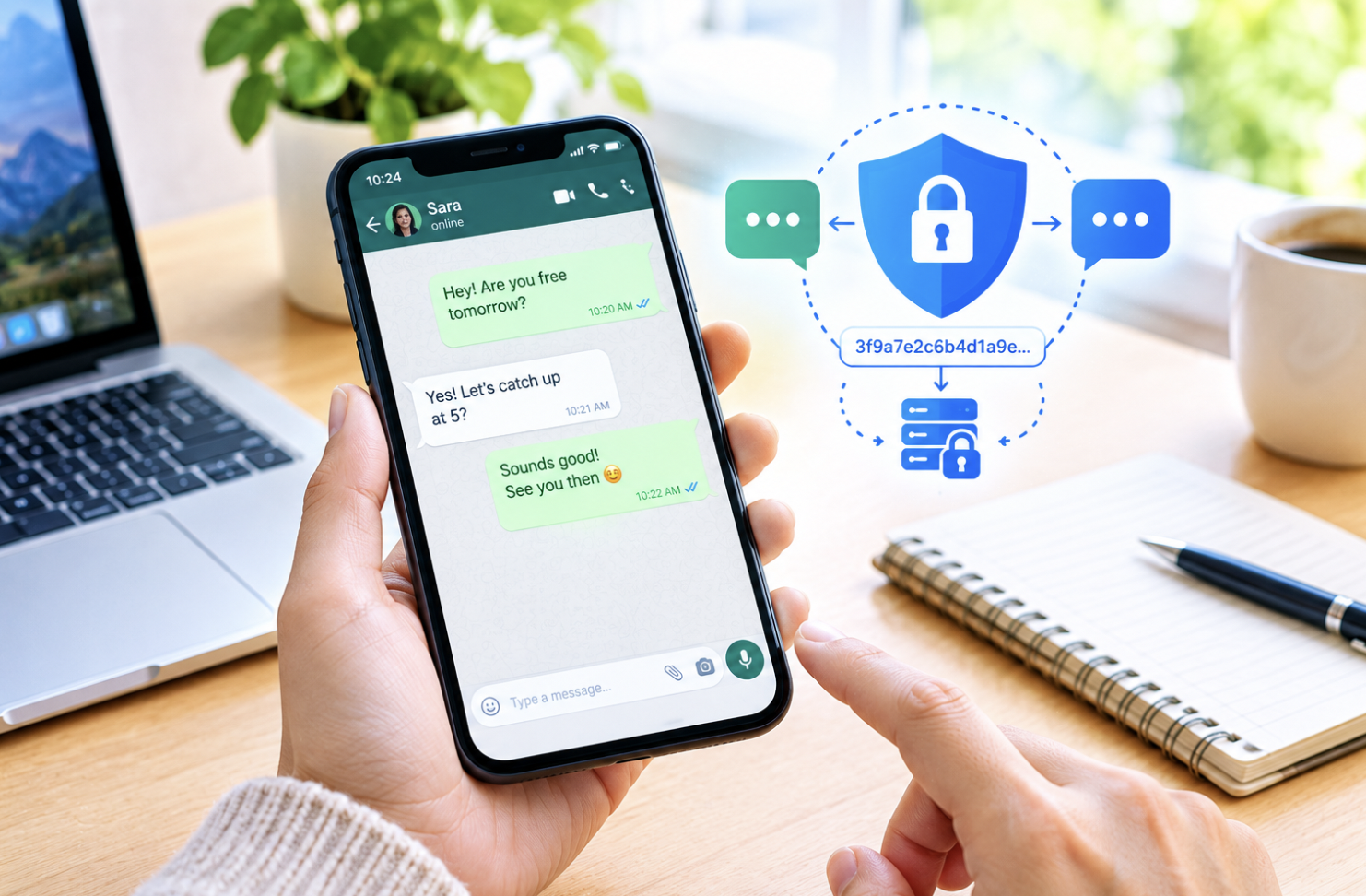
Two friends are texting through an app that advertises “end-to-end encryption” in its marketing, and neither of them could explain what that phrase actually means if asked. It sounds reassuring, but the real mechanics behind it are what actually determine whether their conversation stays private or not. Here’s what’s happening behind the marketing claim.
What Encrypted Messaging Actually Accomplishes
Encrypted messaging transforms your messages into an unreadable format during transmission and storage, so only the intended recipient, holding the correct decryption key, can read the original content. Even if intercepted mid-transmission or pulled from a compromised server, the data remains meaningless without that key.
Basic Cryptographic Principles Behind Message Encryption
Encryption uses mathematical algorithms combined with specific keys to scramble readable text into unreadable data, reversible only with the correct decryption key. Modern encryption relies on math that makes reversing this process computationally infeasible without that key, even given unlimited time and considerable computing power.
End-to-End Encryption Specifically
End-to-end encryption ensures only sender and recipient can decrypt message content, not even the messaging company itself can read it. This is meaningfully stronger than encryption that only protects data in transit, and it’s worth checking whether a specific app actually offers this standard before assuming your messages are private.
How Encryption Keys Get Generated and Exchanged
Apps typically generate unique keys for each conversation or device, exchanged through processes specifically designed to resist interception. All of this happens automatically, users benefit from strong protection without needing to understand any of the underlying cryptography themselves.
Why Message Metadata Often Remains Visible
Encryption typically protects content, but metadata, who you’re talking to, and when, may remain visible to the service provider. Even with airtight content encryption, patterns in who you contact and how often can still reveal meaningful information to anyone with access to that metadata.
Why Device Security Still Matters
Encryption protects messages during transmission and storage on servers, not necessarily on your own device. If your phone or computer is compromised, decrypted messages sitting on the screen or in local storage are fair game regardless of how strong the underlying encryption was.
Verifying a Messaging App’s Encryption Claims
- Check whether the app has undergone independent security audits confirming its claims
- Look for technical documentation explaining the actual implementation
- Stay skeptical of vague marketing language without substantiation behind it
Why “Encrypted” Doesn’t Automatically Mean “Private”
Returning to the two friends from our opening example, it’s worth understanding that plenty of apps use the word “encrypted” technically accurately while still falling well short of end-to-end protection. Some encrypt data only while it’s traveling between your device and the company’s servers, leaving the company itself fully able to read every message once it arrives there, a meaningfully weaker guarantee than true end-to-end encryption, even though both might get described using similar marketing languag
This distinction is exactly why checking for specific, verifiable claims matters more than trusting the word “encrypted” on its own. A company that’s confident in their encryption implementation usually publishes real technical detail about it; one relying on vague reassurance is worth a second look before trusting it with anything sensitive.
How Group Conversations Complicate the Picture
Encryption gets more complex once a conversation involves more than two people. Every additional participant in a group chat needs the ability to decrypt messages, which means the underlying key management has to handle multiple recipients simultaneously rather than the simpler one-to-one exchange a private conversation requires. Some apps handle this elegantly, while others make real trade-offs in group settings that don’t apply to one-on-one conversations.
This is worth knowing if you’re evaluating a messaging app specifically for group use, since an app’s one-on-one encryption strength doesn’t automatically guarantee the same level of protection once a conversation expands to include several participants.
Why Cloud Backups Sometimes Undermine the Encryption You Thought You Had
A important, often-missed detail involves what happens when a messaging app backs up your conversation history to a cloud storage service. Some backup implementations maintain the same strong encryption in the backup itself, while others store the backup in a considerably less protected form, effectively creating a copy of your supposedly private conversation history that sits somewhere with meaningfully weaker protection than the original messages ever had.
Checking a specific app’s actual backup encryption practices, rather than assuming the strong protection applied to active conversations automatically extends to every backup as well, is a worthwhile step for anyone treating a specific conversation as truly sensitive.
Final Thoughts
Encrypted messaging protects your conversations through cryptographic processes that make intercepted data meaningless without the right key, with end-to-end encryption offering the strongest available standard. Knowing the real limitations, metadata visibility, device security, and the gap between “encrypted” and private, helps you choose tools that actually match what you assumed you were getting.
Frequently Asked Questions
1. Can encrypted messages ever be decrypted without proper authorization?
Properly implemented modern encryption is computationally infeasible to break without the key using current technology, though future advances like quantum computing could eventually change that picture for some methods.
2. Does encrypted messaging protect against screenshots taken by the recipient?
No, It protects the message in transit and storage, but can’t stop someone who’s legitimately received and decrypted it from sharing it further.
3. Are all messaging apps claiming encryption equally secure?
No, Implementation quality varies considerably, so it’s worth researching a specific app’s track record rather than trusting the claim at face value.
4. Can law enforcement access encrypted messages with legal authorization?
It depends on the app’s implementation. With strong end-to-end encryption, even the provider may lack the technical ability to hand over readable content.
5. Does encrypted messaging slow down sending messages?
Not noticeably, Modern implementations encrypt and decrypt quickly enough that users typically don’t notice any delay.
6. Is encrypted messaging necessary for everyday personal conversations?
Not strictly, but many privacy advocates suggest using it by default anyway, so sensitive conversations don’t stand out as unusual.